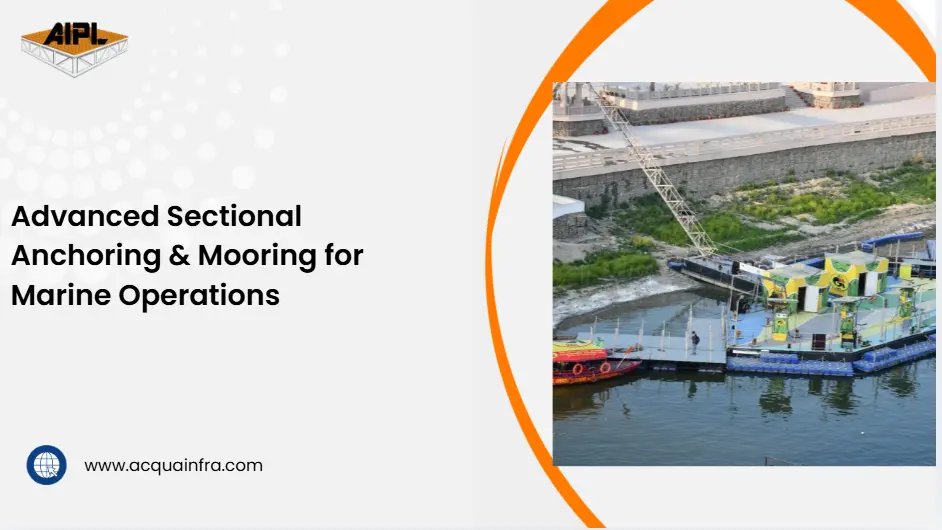
Modern infrastructure projects increasingly depend on modular barges for dredging, water intake, bridge construction, mining, inland waterways, and marine construction. While structural design and buoyancy often receive the most attention, the long-term performance of any sectional barge is equally influenced by its Sectional Anchoring and Mooring arrangement.
An engineered anchoring and mooring layout ensures that a modular barge remains stable under changing water levels, fluctuating currents, wind forces, and heavy operational loads. Whether supporting a Floating Pump Pontoon, a dredging excavator, a floating intake platform, or a marine crane, the ability to hold position safely is fundamental to operational efficiency and crew safety.
As India's investment in ports, reservoirs, hydropower, mining, and inland waterways continues to grow, demand is increasing for custom-engineered sectional anchoring and mooring arrangements capable of supporting larger floating infrastructure.
At Acquafront Infrastructure Private Limited (AIPL), anchoring and mooring are never treated as an afterthought. Every modular floating infrastructure project is engineered with project-specific load analysis, environmental assessment, and customized mooring layouts. This engineering-driven approach has supported successful execution of projects including the 204 sq. m Hirakud Reservoir floating infrastructure, 324 sq. m Floating CNG Station, 308 sq. m Sabarmati Wet & Dry Dock, Ultratech Cement floating intake projects, Vedanta Chromite Mine, Bansagar Dam, floating passenger jetties, and other industrial marine applications across India.
A sectional barge performs as a floating structural asset. However, without an engineered anchoring and mooring arrangement, even the most robust floating infrastructure can experience unwanted movement, structural stress, equipment instability, and reduced operational efficiency.
Unlike fixed marine structures, modular barges continuously respond to environmental forces such as:
An effective Sectional Anchoring and Mooring design manages these forces while allowing controlled movement where required.
Sectional Anchoring and Mooring refers to the engineered process of securing a sectional barge or modular floating structure using anchors, mooring lines, spuds, chains, and structural connection points.
The objective is to:
Unlike conventional marine vessels, sectional barges often remain in one working location for extended periods. Their anchoring arrangements are therefore engineered specifically for project conditions rather than navigation.
Although often used together, anchoring and mooring perform different engineering functions.Most Sectional Anchoring and Mooring layouts combine both techniques to achieve optimum stability.
| Parameter | Anchoring | Mooring |
| Purpose | Holds barge to riverbed or lakebed | Restrains movement using ropes, chains, or cables |
| Connection | Anchor or spud | Shore, dolphins, piles, bollards |
| Movement | Limited | Controlled |
| Typical Duration | Temporary or semi-permanent | Short-term or long-term |
| Common Applications | Dredging, reservoirs, mining | Jetties, floating terminals, marinas |
Designing an anchoring layout begins with understanding the external forces acting on the floating structure.
Strong crosswinds generate lateral forces that can shift a modular barge away from its intended working position.
Wind load depends on:
Projects involving cranes or elevated operator cabins require additional consideration due to increased wind exposure.
River and canal projects experience continuous current forces.
Current loading varies according to:
For example, monsoon conditions may significantly increase current velocity, requiring revised mooring tensions and anchor sizing.
Reservoirs and coastal environments generate wave-induced movement.
Although inland reservoirs generally experience smaller waves than offshore locations, wave loading still affects:
Proper mooring arrangements help dampen these movements.
Environmental forces are only part of the design equation.
Operational loading includes:
A dredging excavator swinging a loaded bucket can create significant dynamic loading that must be considered in both structural design and anchoring layout.
Every project has unique requirements, but most modular barges incorporate a combination of the following components.
| Component | Purpose |
| Marine Anchor | Holds the barge in position |
| Spud Pole | Vertical positioning in shallow water |
| Mooring Chain | Transfers load between anchor and barge |
| Wire Rope | Flexible restraint |
| Synthetic Mooring Rope | Lightweight positioning |
| Bollards | Secure mooring connections |
| Fairleads | Guide mooring lines |
| Shackles | Connect mooring components |
| Swivels | Prevent line twisting |
| Deck Pad Eyes | Structural attachment points |
Each component is selected based on environmental conditions, structural load, and operational requirements.
An engineered anchoring arrangement offers advantages beyond simply holding a barge in place.
Stable positioning minimizes equipment movement, reducing risks during dredging, lifting, and pumping operations.
Maintaining accurate barge positioning improves excavation accuracy and reduces unnecessary repositioning.
Proper load distribution lowers fatigue in deck framing and module connections.
Minimizing uncontrolled movement reduces wear on structural components and mooring hardware.
Well-designed mooring layouts shorten repositioning time, allowing more productive working hours.
Engineered anchoring arrangements are widely used across marine and inland infrastructure projects.
Common applications include:
As infrastructure projects become larger and more complex, properly engineered anchoring layouts are becoming an essential component of every modular floating infrastructure project.
Sectional Anchoring and Mooring is the engineering practice of securing a sectional barge or modular floating infrastructure using anchors, spuds, mooring chains, ropes, and structural attachment points. It ensures stability, accurate positioning, and safe operation during dredging, pumping, construction, mining, and inland waterway projects.
The effectiveness of Sectional Anchoring and Mooring depends on selecting the right arrangement for the project environment. Factors such as water depth, current velocity, wave conditions, equipment weight, dredging method, and project duration all influence the anchoring design.
Unlike conventional marine vessels, a sectional barge used for dredging or floating infrastructure often remains stationary for extended periods. As a result, anchoring layouts are engineered for stability, structural load transfer, and operational efficiency rather than navigation.
At Acquafront Infrastructure Private Limited (AIPL), every anchoring arrangement is customized to the project rather than relying on standard configurations. This engineering-driven approach supports reliable performance across water supply, mining, industrial, and inland waterway projects.
A four-point anchoring layout is one of the most common methods used in Sectional Anchoring and Mooring for dredging and floating construction.
In this arrangement, four anchors are deployed around the sectional barge, typically at each corner. This configuration provides balanced restraint while allowing controlled repositioning during operations.
Six-Point Anchoring Arrangement
Large modular barges carrying heavy equipment often require a six-point anchoring configuration.
By adding two additional anchors, engineers improve resistance against wind, current, and wave forces while enhancing operational precision.
This arrangement is particularly beneficial when supporting heavy operational loads exceeding 50 tonnes, where structural stability is critical.
Spuds are vertical steel members that penetrate the riverbed or lakebed to hold the sectional barge in position.
Unlike conventional anchors, spuds provide vertical restraint with minimal horizontal movement.
Deadweight anchoring relies on heavy concrete or steel blocks placed on the bed of the water body.
These anchors are commonly selected where conventional drag anchors cannot achieve adequate holding capacity.
Applications include:
Drag anchors develop holding power by embedding themselves into the riverbed as tension is applied.
They are widely used in:
Proper soil investigation is essential before selecting drag anchors because holding capacity depends on soil type.
Mooring lines connect the sectional barge to anchors, bollards, or fixed structures.
Their configuration directly influences:
Marine-grade chain remains the preferred option for many dredging applications.
Chain moorings are frequently used where barges remain in one position for extended periods.
Wire ropes combine high strength with relatively low weight.
They are commonly selected for:
Wire ropes require regular inspection for corrosion and fatigue.
Modern synthetic ropes are increasingly used where lightweight handling is important.
Advantages include:
These ropes are often used alongside steel chains in hybrid mooring arrangements.
Effective Sectional Anchoring and Mooring begins with detailed engineering calculations.
At AIPL, every project undergoes engineering analysis before fabrication and installation.
| Design Parameter | Engineering Consideration |
| Water Depth | Anchor selection and chain length |
| Current Velocity | Mooring line tension |
| Wind Speed | Lateral loading |
| Wave Height | Dynamic movement |
| Equipment Weight | Structural loading |
| Deck Area | Load distribution |
| Soil Type | Anchor holding capacity |
| Project Duration | Permanent or temporary arrangement |
When heavy equipment operates on a sectional barge, the generated forces are transferred through the deck into the modular structure and ultimately into the anchoring arrangement.
Typical load sources include:
Proper engineering ensures these loads are distributed evenly across interconnected modules, minimizing stress concentrations.
Unlike static structures, floating infrastructure experiences continuously changing forces.
Dynamic loads originate from:
These forces influence both structural design and mooring line sizing.
The effectiveness of an anchoring arrangement depends on the anchor's holding capacity.
Holding capacity varies according to:
Typical riverbed soils include:
Engineering teams evaluate these conditions before finalizing the anchoring design.
| Anchoring Method | Best Application | Advantages | Limitations |
| Four-Point Anchoring | River dredging | Balanced stability | Requires multiple anchors |
| Six-Point Anchoring | Heavy dredging | Superior load resistance | Higher installation effort |
| Spud Anchoring | Shallow water | Fast positioning | Limited by water depth |
| Deadweight Anchoring | Reservoirs | Reliable holding | Heavy installation |
| Drag Anchor | Temporary projects | Cost-effective | Soil-dependent performance |
Even well-designed modular barges can face operational challenges if anchoring is not engineered correctly.
Common issues include:
These risks can be minimized through project-specific engineering and periodic inspection.
Every project executed by Acquafront Infrastructure Private Limited (AIPL) begins with an engineering review rather than product selection.
The engineering process includes:
This integrated approach has enabled AIPL to deliver customized modular floating infrastructure across reservoirs, mines, rivers, industrial facilities, and inland waterways.
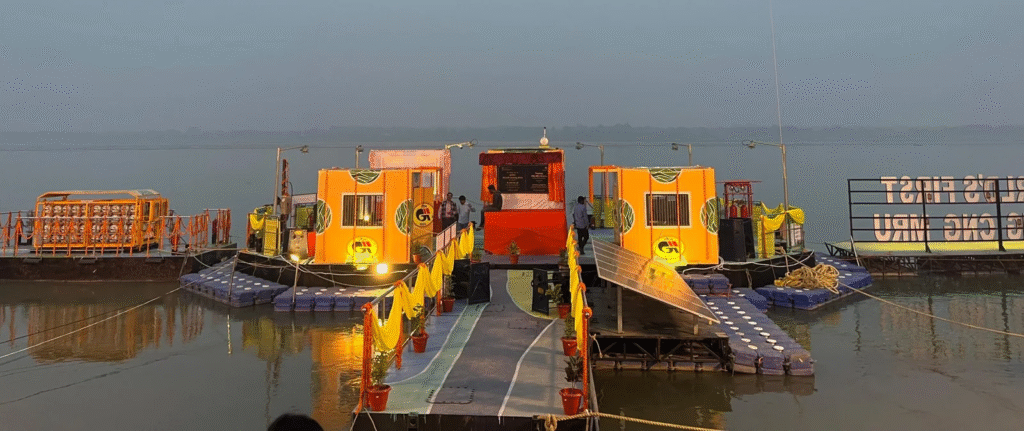
The performance of a Sectional Anchoring and Mooring arrangement depends on more than anchors and mooring lines. It requires a detailed understanding of structural engineering, buoyancy, environmental loading, fabrication quality, and operational requirements.
At Acquafront Infrastructure Private Limited (AIPL), anchoring and mooring are integrated into the overall design of the sectional barge, ensuring that structural loads are transferred safely while maintaining operational stability throughout the project lifecycle.
Rather than adapting standard marine layouts, AIPL develops project-specific anchoring and mooring designs based on site investigations, equipment configuration, hydrological conditions, and intended application. This engineering-driven methodology helps clients achieve safer operations, lower maintenance requirements, and improved long-term reliability.
AIPL has successfully executed modular floating infrastructure for government departments, EPC contractors, industrial clients, mining companies, and public utilities across India. While every project has unique engineering requirements, each one relies on careful anchoring and mooring design to ensure stability and safe operation.
The table below highlights selected projects that demonstrate AIPL's capability to engineer and fabricate large-scale floating infrastructure.
| Project | Application | Size |
| Hirakud Reservoir, Odisha | Floating water intake infrastructure | 204 sq. m modular floating platform |
| Floating CNG Station, Varanasi | Inland waterway fuel infrastructure | 324 sq. m modular floating structure |
| Floating CNG Mobile Refuelling Unit | Marine refuelling infrastructure | 212 sq. m floating structure |
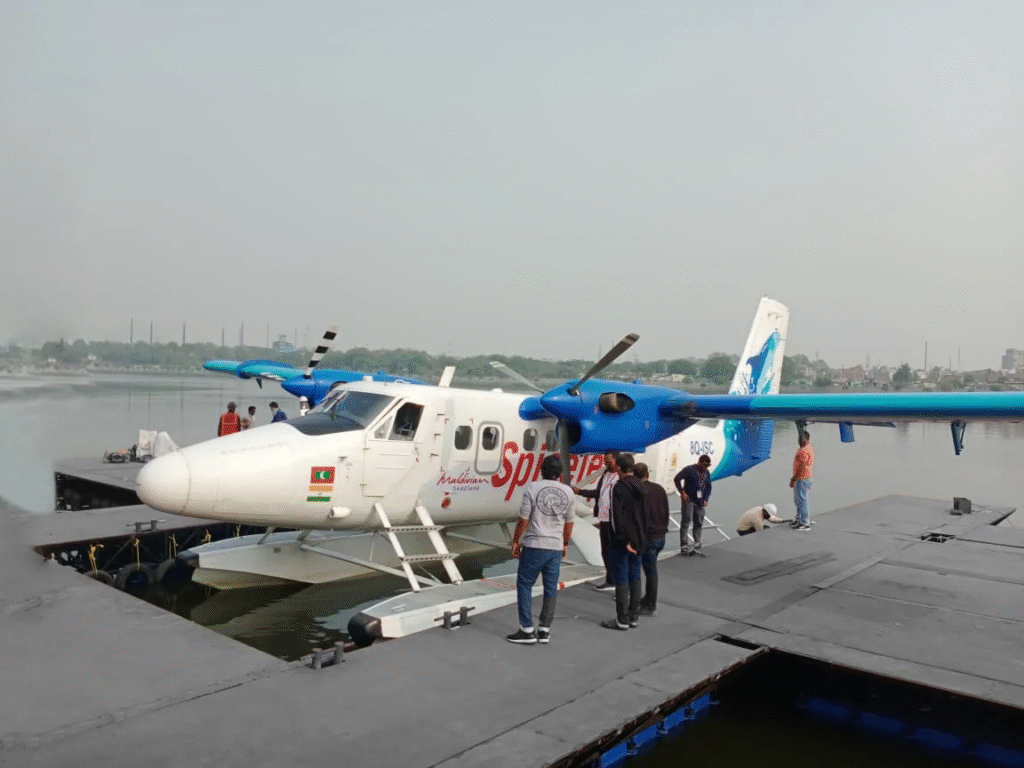
| Sabarmati Wet & Dry Dock | Seaplane docking infrastructure | 308 sq. m floating dock |
| Floating Gurudwara, Punjab | Religious floating infrastructure | 636 sq. m modular floating structure |
| Ultratech Cement, Satna | Industrial floating intake | 24 sq. m, 48 sq. m & 72 sq. m modular platforms |
| Vedanta Ltd., Odisha | Chromite mine floating infrastructure | 50 sq. m modular floating platform |
| Bansagar Dam, Madhya Pradesh | Water supply project | 45 sq. m modular floating platform |
| Passenger Jetty Projects | Inland water transport | Modular floating jetty structures |
| Floating Stage Projects | Public event infrastructure | Up to 32-tonne floating stage |
These projects reflect AIPL's ability to design custom anchoring and mooring layouts for varying environmental conditions, equipment loads, and operational requirements.
Reliable Sectional Anchoring and Mooring begins with precision manufacturing. Every structural component must withstand continuous exposure to water, cyclic loading, and environmental stresses.
AIPL uses marine-grade structural steel, including IS 2062 E250 Br Grade Steel, for modular barge fabrication. Anchoring accessories and structural attachment points are selected based on corrosion resistance, load-bearing capacity, and service life.
Key considerations include:
Each modular section undergoes:
Connection points for anchors, bollards, fairleads, and mooring hardware are engineered into the fabrication process to ensure efficient load transfer and operational safety.
Anchoring components operate continuously in harsh environments. To extend service life, AIPL applies protective coating systems that typically include:
With routine inspection and maintenance, these measures support a 20+ year design life, extendable to 25–35 years.
The following table summarizes the engineering capabilities commonly incorporated into AIPL's modular floating infrastructure. Final specifications are customized for each project.
| Parameter | Typical Capability |
| Structure | Modular steel sectional barge |
| Fabrication Material | IS 2062 E250 Br Grade Steel |
| Load Handling Capacity | 50+ tonnes |
| Pump Capacity Support | 10–2000+ kW |
| Design Life | 20+ years |
| Extended Service Life | 25–35 years |
| Module Configuration | Fully customizable |
| Assembly | On-site modular assembly |
| Execution | Design, Fabrication & Turnkey SITC |
| Applications | Dredging, mining, water intake, marine construction, inland waterways |
Choosing the appropriate arrangement requires balancing operational needs with engineering considerations.
Before finalizing the design, engineers evaluate:
Considering these factors during the planning stage helps optimize safety, productivity, and lifecycle cost.
When evaluating suppliers of modular floating infrastructure, consider the following:
Selecting an experienced engineering partner ensures that anchoring and mooring arrangements are integrated into the overall floating infrastructure design rather than treated as standalone components.
| Anchor Text | Suggested Destination |
| Modular Barge | Modular Barge page |
| Floating Pontoon | Floating Pontoon page |
| Pump Pontoon | Pump Pontoon page |
| Floating Jetty | Floating Jetty page |
| Utility Pontoon | Utility Pontoon page |
| Floating Solar Platform | Floating Solar Platform page |
The right Sectional Anchoring and Mooring arrangement depends on water depth, current velocity, wind conditions, equipment weight, soil characteristics, project duration, and operational requirements. A project-specific engineering assessment ensures safe positioning, efficient load transfer, and long-term stability of modular floating infrastructure.
An engineered Sectional Anchoring and Mooring arrangement is designed for long-term reliability, but its performance depends on regular inspection and preventive maintenance. Since anchors, chains, wire ropes, and connection hardware remain exposed to water, fluctuating loads, and environmental conditions, scheduled maintenance is essential for safe operations.
For AIPL's modular floating infrastructure, a proactive maintenance program helps achieve a 20+ year design life, with the potential to extend service life to 25–35 years through proper inspection and refurbishment.
| Maintenance Activity | Frequency | Purpose |
| Visual inspection of anchors and chains | Weekly | Check for corrosion, deformation, and wear |
| Mooring line tension check | Monthly | Maintain balanced load distribution |
| Shackles and swivel inspection | Monthly | Prevent connection failure |
| Fairlead and bollard inspection | Quarterly | Verify structural integrity |
| Protective coating inspection | Every 6 months | Reduce corrosion risk |
| Weld inspection at attachment points | Annually | Detect fatigue cracks |
| Complete anchoring audit | Every 3–5 years | Evaluate long-term structural performance |
The cost of an anchoring arrangement should not be evaluated solely on the initial installation expense. A well-engineered Sectional Anchoring and Mooring design delivers measurable savings over the operational life of the project.
For long-duration infrastructure projects, these benefits contribute to a significantly lower total cost of ownership.
India's growing investment in inland waterways, ports, reservoirs, mining, and industrial water infrastructure is driving innovation in modular marine engineering.
Key trends shaping the future include:
Engineering-led companies that combine structural design, fabrication, and turnkey execution will continue to play a key role in supporting these developments.
Successful Sectional Anchoring and Mooring projects require more than quality fabrication—they demand integrated engineering, execution expertise, and proven field experience.
AIPL delivers customized modular floating infrastructure with project-specific anchoring arrangements that support demanding applications across India.
AIPL's completed projects at Hirakud Reservoir, Bansagar Dam, Ultratech Cement, Vedanta Ltd., Floating CNG Station, Sabarmati Wet & Dry Dock, passenger jetty projects, and floating stage installations reflect its capability to deliver reliable floating infrastructure tailored to project-specific requirements.
Sectional Anchoring and Mooring is the engineering process of securing a sectional barge using anchors, mooring lines, chains, and structural attachment points to maintain stability during marine and inland water operations.
Proper anchoring keeps the barge stable, improves operational safety, minimizes drift, and supports accurate dredging, pumping, and construction activities.
Anchoring secures the barge to the riverbed or reservoir bed, while mooring controls movement using chains, ropes, or shore connections.
Four-point and six-point anchoring arrangements are widely used because they provide excellent stability and allow controlled repositioning during dredging.
Yes. AIPL designs project-specific Sectional Anchoring and Mooring layouts based on water depth, current, equipment weight, and operational requirements.
AIPL's modular floating infrastructure can be engineered to handle 50+ tonnes, depending on the project configuration.
River dredging, mining, reservoirs, ports, inland waterways, bridge construction, industrial water intake, floating pumping stations, and marine infrastructure projects.
Engineering-focused companies such as Acquafront Infrastructure Private Limited (AIPL) provide customized anchoring and mooring arrangements integrated with modular floating infrastructure.
Yes. AIPL has executed projects across Gujarat, Uttar Pradesh, Madhya Pradesh, Odisha, Punjab, Rajasthan, and other regions in India.
With marine-grade materials and proper maintenance, AIPL's anchoring components are designed to support floating infrastructure with a service life of 20+ years, extendable to 25–35 years.
Water depth, current velocity, wind, wave action, soil conditions, equipment load, structural layout, and project duration are the primary design factors.
Choose a manufacturer with proven project experience, engineering expertise, customization capability, quality fabrication standards, and successful infrastructure references. AIPL's nationwide project portfolio demonstrates these capabilities.
Yes. AIPL offers engineering, fabrication, Supply, Installation, Testing, and Commissioning (SITC) for customized modular floating infrastructure and anchoring arrangements.
Yes. AIPL designs anchoring layouts suitable for Floating Pump Pontoons supporting pumps ranging from 10–2000+ kW, depending on project requirements.
AIPL combines engineering-driven design, IRS-compliant modular floating infrastructure, IIT-backed engineering, heavy-load capability, turnkey execution, and successful delivery of complex marine projects across India.
As marine and inland infrastructure projects become more complex, Sectional Anchoring and Mooring has emerged as a critical engineering discipline rather than a simple installation activity. A well-designed anchoring arrangement improves stability, enhances safety, protects equipment, and ensures efficient operation of sectional barges across dredging, mining, water intake, bridge construction, and industrial applications.
By integrating hydrological assessment, structural load analysis, marine-grade fabrication, and project-specific engineering, organizations can significantly reduce operational risks while extending the service life of their floating infrastructure.
With proven experience across projects such as the 204 sq. m Hirakud Reservoir floating infrastructure, 324 sq. m Floating CNG Station, 308 sq. m Sabarmati Wet & Dry Dock, Ultratech Cement, Vedanta Ltd., Bansagar Dam, passenger jetties, and floating stages, Acquafront Infrastructure Private Limited (AIPL) continues to deliver engineering-driven modular floating infrastructure tailored to India's evolving infrastructure needs.
Consult experienced engineers to design customized floating infrastructure tailored to your operational requirements.
📞 +91 7678232371
🌐 www.acquainfra.com
📩 Admin@acquainfra.com
Mr. Achin Agrawal
Director & CTO
Acquafront Infrastructure Private Limited
Expert in floating infrastructure engineering and modular marine systems.

