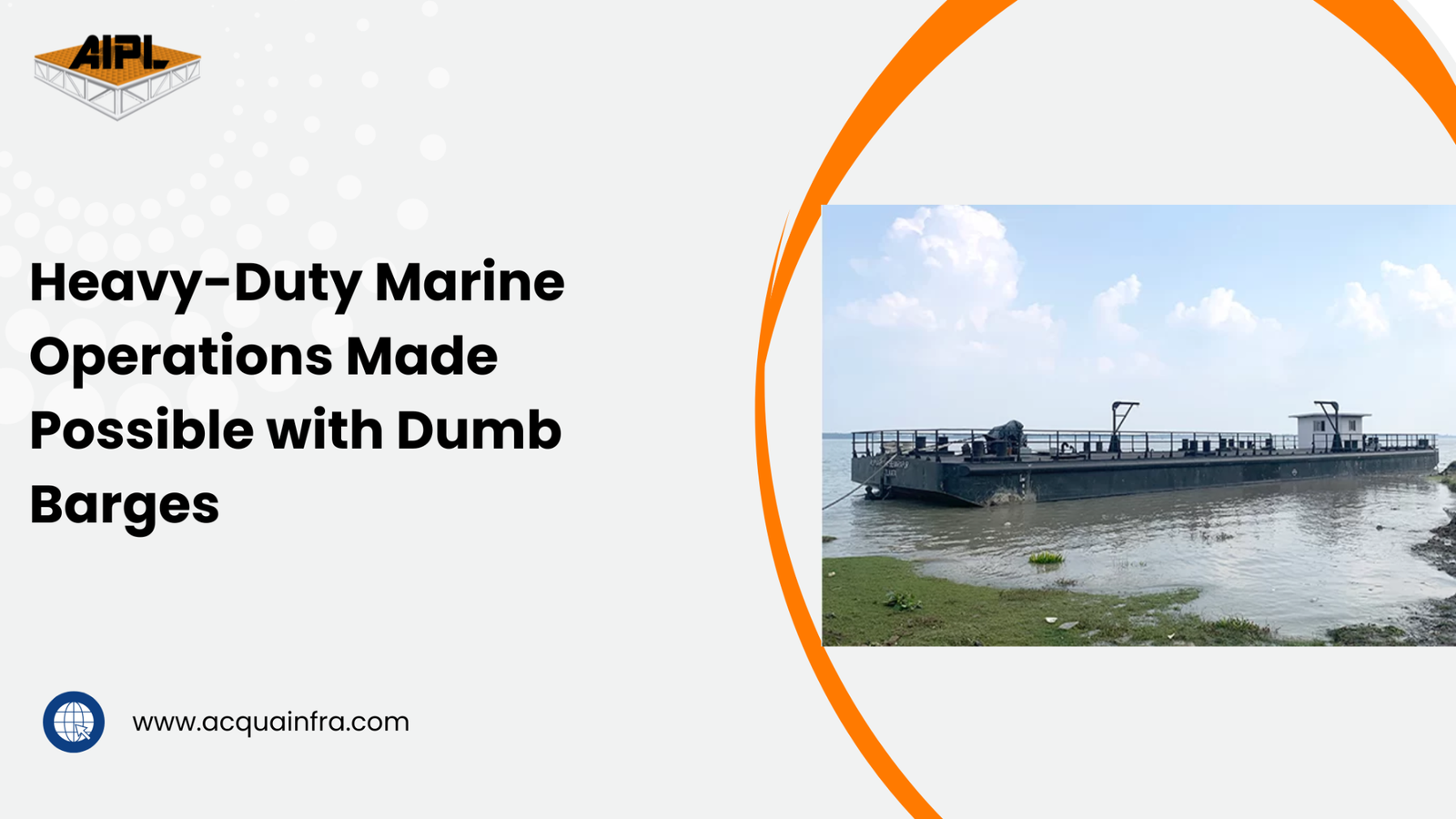
Modern infrastructure projects are no longer confined to land. From ports and reservoirs to mining sites and riverfront developments, today's engineering challenges demand reliable floating infrastructure that can transport heavy equipment, support construction activities, and operate efficiently in difficult water conditions. As projects become larger and more complex, contractors are increasingly looking for marine assets that offer high load capacity, durability, and operational flexibility.
One such asset is the Dumb Barge. Though it does not have its own propulsion, it plays a vital role in marine construction, dredging, cargo movement, and industrial logistics. Towed by tugboats or workboats, a dumb barge provides a stable floating deck capable of carrying heavy machinery, construction materials, and specialized equipment where conventional transport methods are either impractical or too expensive.
At Acquafront Infrastructure Private Limited (AIPL), engineering expertise has transformed conventional barges into customized floating infrastructure tailored to project-specific requirements. Designed using IIT-driven engineering principles and fabricated to IRS-compliant standards, AIPL's barges are engineered to handle 50+ tonnes of structural load, withstand demanding marine environments, and deliver a service life of over 20 years, extendable to 25–35 years with proper maintenance. This engineering-first approach has supported landmark projects across India's water infrastructure sector, including the Hirakud Reservoir Project, Bansagar Dam Project, Vedanta, UltraTech Cement, Floating CNG Stations, and Sabarmati Wet & Dry Dock Project.
A Dumb Barge is a non-self-propelled floating vessel used to transport heavy materials, construction equipment, and industrial cargo across rivers, reservoirs, ports, and coastal waters. Unlike powered barges, it relies on tugboats or workboats for movement, making it a simple yet highly economical choice for large-scale marine operations.
Modern dumb barges are no longer limited to cargo transportation. Today, they also serve as marine work platforms, supporting cranes, excavators, piling rigs, pumps, pipelines, and temporary infrastructure during complex engineering projects.
A well-engineered dumb barge typically includes:
Depending on the application, barges can be customized in size, deck layout, buoyancy, and load capacity to match specific operational requirements.
Marine projects often face logistical challenges that cannot be addressed through conventional transportation methods. Remote project locations, fluctuating water levels, restricted road access, and the movement of oversized equipment make water-based logistics a more practical alternative.
A Dumb Barge addresses these challenges by providing a stable floating workspace while reducing transportation complexity and operational costs.For long-term infrastructure projects, these advantages translate into improved productivity and lower overall project expenditure.
| Operational Advantage | Project Benefit |
| Heavy load carrying capacity | Fewer transportation cycles |
| Stable floating deck | Safe equipment operation |
| Water-based mobility | Access to remote project locations |
| Custom deck configuration | Supports multiple applications |
| Long service life | Higher lifecycle value |
| Low operating cost | Better return on investment |
One of the most common uses of a Dumb Barge is transporting construction materials across rivers, reservoirs, canals, and coastal regions where road transport becomes inefficient.
Large infrastructure projects frequently require continuous movement of materials such as:
Using a dumb barge significantly reduces dependence on road transportation while minimizing traffic congestion and handling costs. For large dam, bridge, and port projects, a single barge can transport several truckloads of material in one trip, improving project productivity.
Dredging remains one of the largest application areas for dumb barges. During desilting and channel maintenance, barges are used to transport excavated material from the dredging site to designated disposal or reclamation areas.
Typical dredging applications include:
AIPL has delivered floating infrastructure for reservoir and water management projects where customized marine structures support efficient maintenance operations under varying water levels.
For example, the Hirakud Reservoir Project, one of India's largest reservoir developments, required floating infrastructure capable of maintaining stability despite fluctuating water conditions. Such projects demonstrate the importance of engineering-led design rather than standard floating assets.
Marine construction requires stable floating infrastructure capable of supporting both equipment and workforce during operations over water.
A Dumb Barge serves as a dependable marine work platform for activities such as:
Its wide deck provides ample space for cranes, piling rigs, generators, reinforcement materials, and construction crews.
Unlike fixed temporary structures, a dumb barge can be repositioned throughout the project, allowing contractors to complete multiple work fronts without dismantling and rebuilding access infrastructure.
Transporting oversized equipment through remote project locations often presents major logistical challenges.
A dumb barge provides a practical alternative for moving:
At AIPL, floating infrastructure is engineered to support structural loads exceeding 50 tonnes, enabling safe transportation and operation of heavy machinery in demanding industrial environments.
Projects executed for UltraTech Cement and Vedanta demonstrate how customized floating infrastructure supports industrial operations where reliable equipment movement directly impacts project timelines and productivity.
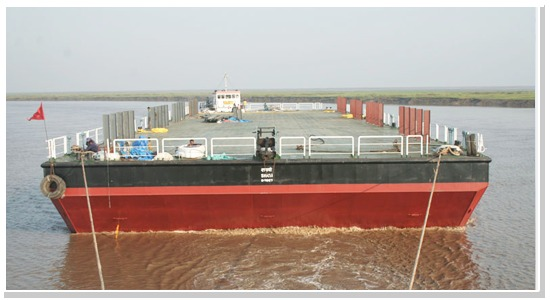
Beyond operational versatility, a Dumb Barge offers significant economic advantages throughout the project lifecycle.
Instead of investing in multiple specialized floating assets, contractors can deploy a single customized barge across different phases of construction. Whether transporting materials, supporting excavation, or carrying heavy equipment, the same floating asset can be adapted to evolving project needs.
Key economic benefits include:
For EPC contractors and government agencies managing long-duration infrastructure projects, these lifecycle benefits contribute to substantial cost savings while improving operational efficiency.
Mining operations frequently extend into reservoirs, tailing ponds, and waterlogged excavation areas where conventional transport equipment cannot operate efficiently. A Dumb Barge provides a dependable floating base for transporting machinery, construction materials, fuel, and maintenance equipment across these challenging environments.
Common mining applications include:
AIPL has executed floating infrastructure for industrial clients such as Vedanta and UltraTech Cement, where custom-engineered floating structures were designed to handle demanding operational conditions. These projects demonstrate how engineering-led fabrication improves reliability while reducing equipment mobilization time.
With India's growing focus on inland waterways, Dumb Barges have become an economical alternative for transporting bulk cargo over water. Compared to road transport, barges can move significantly larger quantities in a single trip while reducing fuel consumption and traffic congestion.
Typical cargo transported includes:
For industries located near rivers, canals, reservoirs, or ports, water-based logistics improve supply chain efficiency while lowering transportation costs.
Heavy lifting over water requires a stable working deck capable of supporting high-capacity cranes and lifting equipment. A Dumb Barge provides the structural stability needed for safe marine lifting operations.
Typical applications include:
When engineered correctly, a dumb barge distributes structural loads evenly, ensuring operational safety during complex lifting activities.
Water resource projects require floating infrastructure that can operate reliably despite fluctuating water levels and changing environmental conditions.
A Dumb Barge is commonly used for:
AIPL has successfully delivered floating infrastructure for landmark projects such as the Hirakud Reservoir Project and Bansagar Dam Project, where customized floating assets were engineered to perform under varying water depths and site conditions. These projects reinforce AIPL's expertise in designing floating infrastructure for India's critical water resource sector.
Selecting the right dumb barge requires more than choosing the required size. Proper engineering ensures long-term safety, operational efficiency, and lower lifecycle costs.
The structural design should account for:
AIPL designs floating infrastructure capable of supporting 50+ tonnes of structural load, depending on project-specific requirements.
Stable positioning is essential for marine operations.
Engineering analysis considers:
Proper mooring improves operational safety while minimizing unwanted barge movement during construction or dredging.
Fabrication quality directly influences durability and maintenance costs.
Key design considerations include:
With planned maintenance, AIPL-engineered floating infrastructure delivers a 20+ year service life, extendable to 25–35 years.
A Dumb Barge performs only as well as the engineering behind it. At Acquafront Infrastructure Private Limited (AIPL), every floating asset is designed around project-specific operational requirements rather than standard dimensions.
AIPL's engineering capabilities include:
Over the years, AIPL has delivered floating infrastructure across multiple sectors through projects including:
This diverse project portfolio highlights AIPL's authority in delivering customized floating infrastructure for complex marine applications across India.
1. What is a Dumb Barge?
A Dumb Barge is a non-self-propelled floating vessel used for transporting materials, supporting construction equipment, and marine operations.
2. Where are Dumb Barges commonly used?
They are widely used in construction, dredging, mining, ports, reservoirs, and industrial logistics.
3. Can a Dumb Barge carry heavy equipment?
Yes. Custom-engineered barges can safely support structural loads exceeding 500 tonnes, depending on design.
4. Are Dumb Barges suitable for dredging projects?
Yes. They transport dredged material and support dredging equipment efficiently.
5. What is the lifespan of a Dumb Barge?
Typically 20+ years, extendable to 25–35 years with proper maintenance.
6. Can Dumb Barges be customized?
Yes. Deck layout, dimensions, and load capacity are customized for each project.
7. What industries benefit from Dumb Barges?
Construction, mining, ports, irrigation, infrastructure, and water resource sectors.
8. Do Dumb Barges require self-propulsion?
No. They are moved using tugboats or workboats.
9. What makes AIPL's Dumb Barges different?
AIPL combines IIT-driven engineering, IRS-compliant fabrication, and turnkey execution with project-specific customization.
10. Who provides Dumb Barge fabrication in India?
AIPL designs and fabricates custom-engineered Dumb Barges for projects across India.
11. Are Dumb Barges available in Gujarat?
Yes. AIPL supports projects throughout Gujarat and other coastal regions.
12. Are Dumb Barges supplied in UP, MP, and Odisha?
Yes. AIPL has delivered floating infrastructure across Uttar Pradesh, Madhya Pradesh, Odisha, and several other states.
13. How do I choose the best Dumb Barge manufacturer?
Look for engineering expertise, project experience, fabrication quality, customization, and turnkey execution capability.
14. Can a Dumb Barge reduce transportation costs?
Yes. High-capacity water transport significantly reduces logistics costs for bulk materials and heavy equipment.
15. Does AIPL provide complete project support?
Yes. AIPL offers engineering, fabrication, SITC, installation support, and turnkey floating infrastructure execution.
As marine infrastructure projects continue to expand across India, the Dumb Barge has become far more than a simple transport vessel. Its ability to move heavy cargo, support construction activities, facilitate dredging, and operate in challenging water conditions makes it an indispensable asset for modern engineering projects.
When backed by strong engineering and quality fabrication, a dumb barge delivers higher operational efficiency, improved safety, and long-term value. Through IIT-driven engineering, IRS-compliant fabrication, and proven execution across projects like Hirakud Reservoir, Bansagar Dam, UltraTech Cement, Vedanta, Floating CNG Stations, and the Sabarmati Wet & Dry Dock Project, Acquafront Infrastructure Private Limited (AIPL) continues to deliver reliable floating infrastructure tailored to India's evolving marine construction needs.
Consult experienced engineers to design customized floating infrastructure tailored to your operational requirements.
📞 +91 7678232371
🌐 www.acquainfra.com
📩 Admin@acquainfra.com
Mr. Achin Agrawal
Director & CTO
Acquafront Infrastructure Private Limited
Mr. Achin Agrawal leads the engineering and technology initiatives at Acquafront Infrastructure Pvt. Ltd. (AIPL), specialising in modular floating infrastructure, marine engineering, lifting barges, construction pontoons, floating work platforms, and heavy-duty marine systems. With extensive experience in designing and executing complex floating infrastructure projects, he has contributed to solutions deployed across reservoirs, dams, ports, industrial waterfronts, and inland waterways throughout India. Under his technical leadership, AIPL continues to deliver IIT-driven engineering, IRS-compliant fabrication, and turnkey SITC solutions that meet the evolving needs of India's marine infrastructure sector.

