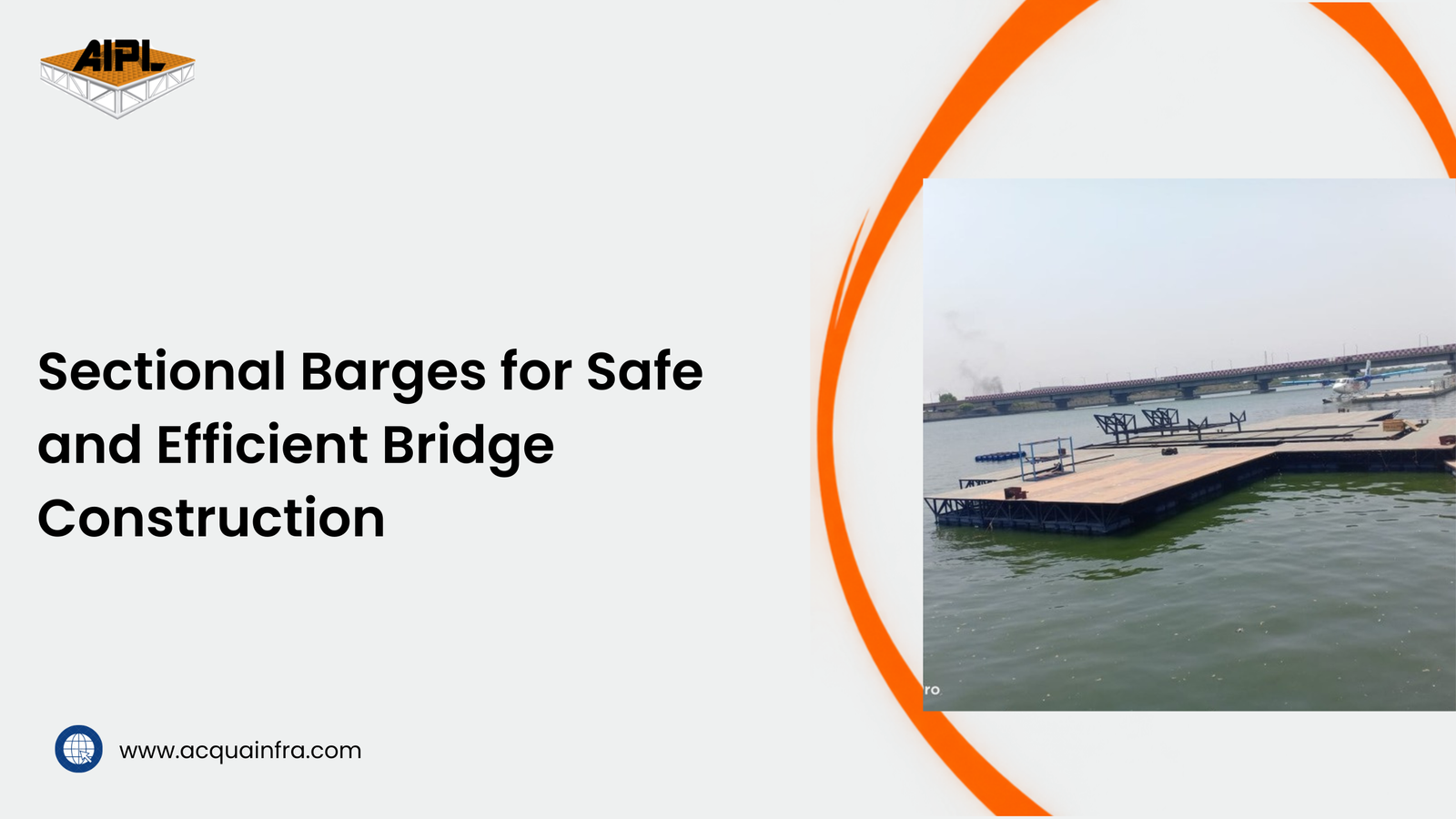
Modern bridge construction is no longer confined to land. As India continues to invest in highways, expressways, river crossings, metro corridors, and coastal infrastructure, engineering teams increasingly rely on sectional barges to execute critical construction activities over water.
Unlike conventional fixed barges, a sectional barge consists of modular units that can be assembled in different configurations based on project requirements. This flexibility allows EPC contractors, government agencies, and infrastructure developers to optimize construction logistics even in remote reservoirs, rivers, canals, and coastal zones where traditional access is limited.
For bridge projects, every stage—from foundation construction and pier development to girder launching and maintenance—requires stable floating infrastructure capable of handling heavy structural loads while ensuring operational safety.
With more than a decade of experience in floating infrastructure engineering, Acquafront Infrastructure Private Limited (AIPL) has established itself as one of India's leading manufacturers of IRS-compliant modular floating infrastructure. This engineering expertise directly translates into reliable support for complex bridge construction projects requiring customized floating work platforms.
Bridge construction involves far more than placing concrete and steel. Engineers must transport heavy machinery, create stable work surfaces, support foundation activities, and ensure uninterrupted movement of materials across challenging water bodies.
A sectional barge addresses these challenges through its modular construction, allowing engineers to configure the floating platform according to the specific requirements of each project.
Some of the primary bridge construction activities supported by sectional barges include:
Unlike conventional floating structures with fixed dimensions, modular barges can be assembled into larger working decks capable of supporting multiple construction operations simultaneously.
A sectional barge is fabricated using multiple modular steel pontoons that are mechanically connected to create a customized floating platform. Depending on project requirements, individual modules can be added or removed to achieve the desired deck area, buoyancy, and load distribution.
This modular approach offers several engineering advantages:
| Feature | Engineering Benefit |
| Modular Construction | Easy transportation and site assembly |
| Expandable Deck Area | Supports project-specific configurations |
| Heavy Structural Capacity | Suitable for cranes, piling rigs, and construction equipment |
| Marine-Grade Fabrication | Improved durability in freshwater and coastal environments |
| Custom Mooring Design | Stable positioning during operations |
| Reusable Modules | Lower lifecycle costs across multiple projects |
| IRS-Compliant Design | Enhanced structural safety and regulatory compliance |
This flexibility enables bridge contractors to adapt the floating work platform as construction progresses from one phase to another.
One of the most demanding stages of bridge construction is the installation of foundations within rivers or reservoirs. Piling rigs, drilling equipment, hydraulic cranes, and reinforcement cages require a highly stable floating platform capable of maintaining structural integrity under varying operational loads.
A well-engineered sectional barge provides:
Because modular barges can be configured according to water depth, current velocity, and equipment weight, they offer significantly greater flexibility than conventional floating platforms.
Modern bridge construction involves numerous high-capacity machines, including:
These machines generate substantial point loads that require engineered load distribution.
AIPL's modular floating infrastructure is designed to support heavy operational loads exceeding 50 tonnes, making it suitable for demanding marine construction applications. The structural design considers deck loading, buoyancy calculations, stability criteria, and equipment placement to ensure safe and efficient operations.
Bridge construction projects often span long distances over rivers, reservoirs, or estuaries where road access is limited. In such scenarios, a sectional barge functions as an efficient cargo transport platform.
Commonly transported materials include:
By enabling direct transportation over water, modular barges reduce dependency on temporary access roads and minimize handling time, contributing to faster project execution.
No two bridge construction projects are identical. Water depth, current velocity, equipment loads, construction sequence, and environmental conditions vary significantly across sites. Therefore, the design of a sectional barge must be customized rather than standardized.
| Design Parameter | Typical Considerations |
| Structural Load | Equipment weight, material storage, personnel |
| Water Conditions | River flow, wave action, seasonal fluctuations |
| Buoyancy | Operational freeboard and reserve buoyancy |
| Mooring Arrangement | Anchoring, positioning accuracy, safety |
| Deck Configuration | Crane radius, piling rig placement, work zones |
| Stability Analysis | Longitudinal and transverse stability |
| Fabrication Standards | Marine-grade steel and IRS compliance |
| Future Expansion | Modular scalability for changing project needs |
One of the biggest differentiators in modern marine infrastructure is the use of measurable engineering parameters rather than generic design assumptions.
At AIPL, modular floating infrastructure is engineered using project-specific calculations that consider:
| Engineering Capability | AIPL Capability |
| Load Handling Capacity | 50+ tonnes |
| Pump Support (for floating pump applications) | 10–2000+ kW |
| Standard Design Life | 20+ years |
| Extendable Service Life | 25–35 years (with maintenance) |
| Design Approach | Fully customized for each project |
| Compliance | IRS-compliant modular floating infrastructure |
| Execution Scope | Design, Engineering, Fabrication, SITC & Turnkey Execution |
Rather than offering a one-size-fits-all product, AIPL custom-engineers each modular floating platform based on project loading, operational requirements, water conditions, and lifecycle expectations. This engineering philosophy has enabled the successful execution of floating infrastructure across reservoirs, rivers, industrial facilities, and urban waterfront developments.
A bridge project involves multiple engineering disciplines working simultaneously. Civil engineers, marine contractors, geotechnical consultants, structural designers, fabrication teams, and EPC contractors must coordinate construction activities in dynamic water environments where access is often restricted.
This is where a sectional barge becomes much more than a floating platform—it acts as a mobile marine work platform that supports equipment, personnel, materials, and construction operations throughout the project lifecycle.
Unlike conventional barges with fixed dimensions, modular sectional barges can be reconfigured as project requirements evolve, making them an economical and operationally efficient choice for long-duration infrastructure projects.
Every bridge project begins with detailed site investigations. Before foundation work starts, engineers assess the water body's characteristics to determine the most suitable floating infrastructure configuration.
| Engineering Parameter | Importance |
| Water Depth | Determines draft and buoyancy requirements |
| River Flow Velocity | Influences anchoring and mooring design |
| Seasonal Water-Level Variation | Ensures year-round operational stability |
| Riverbed Conditions | Critical for pile installation planning |
| Equipment Loading | Defines deck strength requirements |
| Material Storage Needs | Determines modular deck size |
| Navigation Constraints | Ensures uninterrupted waterway traffic |
One of the biggest advantages of a sectional barge is its ease of transportation. Instead of mobilizing a single oversized floating structure, individual modules can be transported by road to the project site and assembled on location.
This approach offers several advantages:
For infrastructure projects in reservoirs, dams, rivers, and inland waterways, this modular approach significantly reduces project setup time.
Bridge foundations often require construction activities directly over water, where stable working conditions are essential.
A sectional barge provides a secure floating base for:
Because these activities generate concentrated structural loads, engineers perform detailed calculations for:
Proper engineering ensures the floating platform remains stable throughout construction.
Heavy lifting is one of the most demanding aspects of bridge construction. Cranes are used for:
These operations require a sectional barge with sufficient structural rigidity and load-bearing capacity.
| Equipment | Purpose |
| Hydraulic Crawler Crane | Heavy lifting |
| Excavator | Material handling |
| Rotary Drilling Rig | Foundation work |
| Concrete Pump | Pier construction |
| Diesel Generator | Site power supply |
| Welding Equipment | Fabrication support |
| Reinforcement Bending Machines | Steel preparation |
Modern bridge projects often involve transporting oversized structural elements over water, including:
A sectional barge enables these components to be transported directly to the installation location, reducing dependence on temporary access roads and minimizing multiple handling operations.
This streamlined logistics approach improves productivity and reduces project timelines.
The role of a sectional barge extends beyond initial construction. It also supports long-term bridge maintenance activities, including:
Because modular barges can be reassembled for future projects, they offer excellent lifecycle value for infrastructure owners and contractors.
Traditional barges are often limited by fixed dimensions and transportation challenges. In contrast, modular sectional barges provide unmatched flexibility.
| Benefit | Project Impact |
| Modular Expansion | Platform size can be increased as required |
| Reusable Modules | Reduced capital investment over multiple projects |
| Faster Deployment | Shorter mobilization periods |
| Simplified Transportation | Road transport of individual modules |
| Easy Maintenance | Replacement of individual sections |
| Adaptability | Suitable for multiple applications beyond bridge construction |
A significant advantage of investing in a sectional barge is its versatility. Once a bridge project is completed, the same modular floating platform can be reconfigured for other marine and industrial applications.
Common applications include:
This multi-purpose capability maximizes return on investment for contractors and infrastructure developers.
Selecting a sectional barge manufacturer is about more than fabrication—it requires confidence in engineering capability, project execution, and long-term reliability.
Acquafront Infrastructure Private Limited (AIPL) has built its reputation through an engineering-led approach, combining structural analysis, marine-grade fabrication, and turnkey execution for floating infrastructure across India.
This integrated capability allows AIPL to deliver floating infrastructure that is not only structurally robust but also optimized for operational efficiency and lifecycle performance.
AIPL's experience extends across government, industrial, and infrastructure sectors, providing practical insights that inform the design of modular floating platforms for bridge construction.
One of AIPL's landmark projects is the Floating CNG Station at Khirkiya Ghat, Varanasi, developed in collaboration with Indraprastha Gas Limited. The floating structure spans approximately 324 square metres and demonstrates AIPL's expertise in designing stable, marine-grade floating infrastructure for public utility applications.
At the Hirakud Reservoir in Odisha, AIPL supplied engineered floating infrastructure designed to perform reliably under large-reservoir conditions, showcasing expertise in stability, anchoring, and modular fabrication.
For the Bansagar Dam Water Supply Scheme, AIPL delivered customized floating infrastructure supporting water intake operations. The project highlights the company's capability to engineer floating platforms for critical public infrastructure.
AIPL's work on the Sabarmati Wet & Dry Dock reflects its capabilities in supporting complex marine construction and waterfront infrastructure, requiring precision engineering and durable fabrication.
The company has also executed floating infrastructure projects for leading industrial organizations, including UltraTech Cement and Vedanta, where reliability, structural integrity, and long-term performance are essential.
These diverse projects demonstrate AIPL's ability to design and fabricate modular floating infrastructure for demanding environments, reinforcing its authority as an engineering-driven partner for bridge construction and other marine applications.
While a sectional barge may appear to be a simple floating platform, its engineering involves extensive structural analysis, hydrodynamic calculations, and project-specific customization. Every bridge construction project presents unique challenges—ranging from fluctuating water levels and river currents to varying equipment loads and construction methodologies.
AIPL follows an engineering-driven design approach, ensuring that every modular barge is optimized for stability, durability, safety, and long-term operational performance.
One of the primary considerations in designing a sectional barge is accurately determining the structural load that the platform must safely support.
| Load Type | Description |
| Dead Load | Weight of the barge structure itself |
| Equipment Load | Cranes, piling rigs, excavators, generators |
| Material Load | Steel, concrete, reinforcement cages, precast elements |
| Personnel Load | Engineers, operators, technicians |
| Dynamic Load | Equipment movement and lifting operations |
| Environmental Load | Wind, waves, water current, impact forces |
For bridge construction, stability is as important as load capacity. Even a high-capacity floating platform can become unsafe if buoyancy and weight distribution are not properly engineered.
These calculations ensure that the sectional barge remains stable during lifting, drilling, concreting, and transportation activities, even under varying operational conditions.
No two bridge construction projects require the same deck layout. Depending on the construction stage, contractors may need different working areas for cranes, piling rigs, material storage, or personnel movement.
A modular sectional barge can be configured into multiple layouts, such as:
This adaptability reduces the need for specialized floating equipment and allows contractors to maximize utilization across multiple projects.
Maintaining the position of a floating platform is critical during bridge construction. Even slight movement can affect the accuracy of piling, concreting, or girder placement.
| Mooring Method | Typical Application |
| Anchor Mooring | Reservoirs and rivers |
| Spud Leg Support | Shallow water operations |
| Winch-Controlled Positioning | Precision construction activities |
| Shore Tie Arrangement | Canal and narrow river projects |
| Hybrid Mooring | Large bridge construction sites |
Bridge construction barges operate continuously in demanding environments where exposure to water, moisture, and varying weather conditions can accelerate corrosion.
To enhance durability, AIPL incorporates:
These practices contribute to a standard design life of 20+ years, which can be extended to 25–35 years with appropriate inspection and maintenance programs.
Choosing the right floating infrastructure can significantly impact project timelines, safety, and lifecycle costs. The table below highlights the differences between modular sectional barges and conventional barges.
| Parameter | Sectional Barge | Conventional Barge |
| Configuration | Modular and customizable | Fixed dimensions |
| Transportation | Road transport in modules | Requires towing or specialized transport |
| Site Assembly | Quick modular assembly | Limited flexibility |
| Deck Expansion | Easily expandable | Not expandable |
| Reusability | High | Moderate |
| Suitability for Remote Sites | Excellent | Limited |
| Maintenance | Individual modules can be serviced | Entire barge requires maintenance |
| Lifecycle Cost | Lower over multiple projects | Higher for varied applications |
| Adaptability | Suitable for multiple marine applications | Limited to original configuration |
For EPC contractors and infrastructure developers working across diverse sites, the modular nature of a sectional barge offers a clear operational advantage.
Safety is a non-negotiable aspect of marine infrastructure. Every floating platform must be designed to withstand operational, structural, and environmental challenges while complying with applicable engineering standards.
AIPL's IRS-compliant modular floating infrastructure reflects its commitment to engineering quality and regulatory compliance, providing confidence to government agencies, consultants, and EPC contractors.
Modern infrastructure projects demand measurable performance rather than generic specifications. AIPL's engineering capabilities are backed by quantitative design parameters that help clients evaluate suitability for demanding applications.
| Engineering Parameter | AIPL Capability |
| Heavy Load Handling | 50+ tonnes |
| Pump Support Capacity (for pump pontoons) | 10–2000+ kW |
| Standard Design Life | 20+ years |
| Extended Service Life | 25–35 years |
| Design Methodology | Project-specific engineering |
| Fabrication | Marine-grade, custom-engineered |
| Compliance | IRS-compliant |
| Execution Scope | Design, Fabrication, SITC & Turnkey |
This data-driven approach enables AIPL to engineer floating infrastructure that aligns with the operational demands of bridge construction, industrial water intake, waterfront development, and marine logistics.
When selecting a sectional barge manufacturer, clients look beyond fabrication—they seek engineering expertise, proven execution, and long-term reliability.
This combination of engineering depth and execution capability positions AIPL as a trusted partner for bridge construction and other complex marine infrastructure projects.
A sectional barge provides a stable floating work platform for piling, crane operations, material transportation, concreting, girder launching, and inspection activities during bridge construction. Its modular design allows contractors to customize the platform based on project requirements.
Unlike conventional barges, a sectional barge can be assembled in multiple configurations, transported easily to remote locations, expanded as project requirements change, and reused across different infrastructure projects, reducing lifecycle costs.
Load capacity depends on the design and application. AIPL engineers modular floating infrastructure capable of supporting 50+ tonnes, with structural analysis performed for project-specific equipment, material, and operational loads.
Yes. Every bridge project has unique requirements related to water depth, equipment, deck area, and environmental conditions. AIPL custom-engineers each sectional barge with tailored modular configurations, buoyancy calculations, anchoring arrangements, and structural load analysis.
In addition to bridge projects, sectional barges are widely used for:
A well-designed modular sectional barge has a standard design life of 20+ years. With proper maintenance, marine-grade coatings, and periodic inspections, its service life can be extended to 25–35 years.
Acquafront Infrastructure Pvt. Ltd. (AIPL) is among India's engineering-driven manufacturers of IRS-compliant sectional barges, modular floating infrastructure, and marine work platforms. The company provides design, fabrication, SITC, and turnkey execution for infrastructure, industrial, and government projects.
Yes. AIPL has successfully delivered floating infrastructure projects across multiple states, including Uttar Pradesh, Madhya Pradesh, Odisha, and Gujarat, supporting government departments, EPC contractors, and industrial clients with customized modular floating platforms.
Because it is modular, a sectional barge is transported in individual sections by road. The modules are assembled at the project site, reducing transportation challenges and making deployment feasible even in remote reservoirs, rivers, and dam locations.
Yes. When properly engineered, a sectional barge can safely support crawler cranes, piling rigs, excavators, generators, and other heavy construction equipment. AIPL designs each platform based on detailed structural load calculations and stability analysis.
Choose a manufacturer with:
Yes. AIPL offers complete Design, Engineering, Fabrication, Supply, Installation, Testing, and Commissioning (SITC) services, ensuring seamless execution from concept to deployment.
A modular sectional barge reduces mobilization time, enables direct transportation of construction materials over water, minimizes temporary infrastructure requirements, and provides a stable working platform—helping contractors improve productivity and maintain project schedules.
When evaluating sectional barge suppliers, look for companies with demonstrated expertise in modular floating infrastructure, engineering-led design, and successful execution of government and industrial projects. AIPL's portfolio—including Floating CNG Stations, Passenger Jetties, Pump Pontoons, and infrastructure projects—reflects its capability to deliver reliable floating solutions across India.
AIPL combines IIT-driven engineering, IRS-compliant fabrication, 50+ tonne load handling capability, and turnkey project execution to deliver customized modular floating infrastructure. With experience across projects such as the Floating CNG Station in Varanasi, Hirakud Reservoir, Bansagar Dam, Sabarmati Wet & Dry Dock, UltraTech Cement, and Vedanta, AIPL provides engineering expertise that supports demanding bridge construction applications.
As India's infrastructure landscape expands with new highways, expressways, metro corridors, inland waterways, and river-crossing projects, the demand for reliable floating infrastructure continues to grow.
Its modular design enables contractors to adapt the platform to different project stages—from foundation piling and crane operations to girder transportation and long-term maintenance. Compared with conventional barges, sectional barges provide greater operational versatility, easier transportation, and improved lifecycle value, making them a preferred choice for modern infrastructure projects.
At Acquafront Infrastructure Pvt. Ltd. (AIPL), this capability is strengthened by an engineering-first philosophy. Rather than supplying standardized floating platforms, AIPL designs each modular barge around project-specific loading conditions, hydrographic parameters, and operational requirements.
Whether the requirement is bridge construction, industrial logistics, waterfront development, or marine infrastructure, selecting a well-engineered sectional barge contributes directly to safer operations, improved productivity, and long-term project success.
Consult experienced engineers to design customized floating infrastructure tailored to your operational requirements.
📞 +91 7678232371
🌐 www.acquainfra.com
📩 Admin@acquainfra.com
Mr. Achin Agrawal
Director & CTO
Acquafront Infrastructure Private Limited

