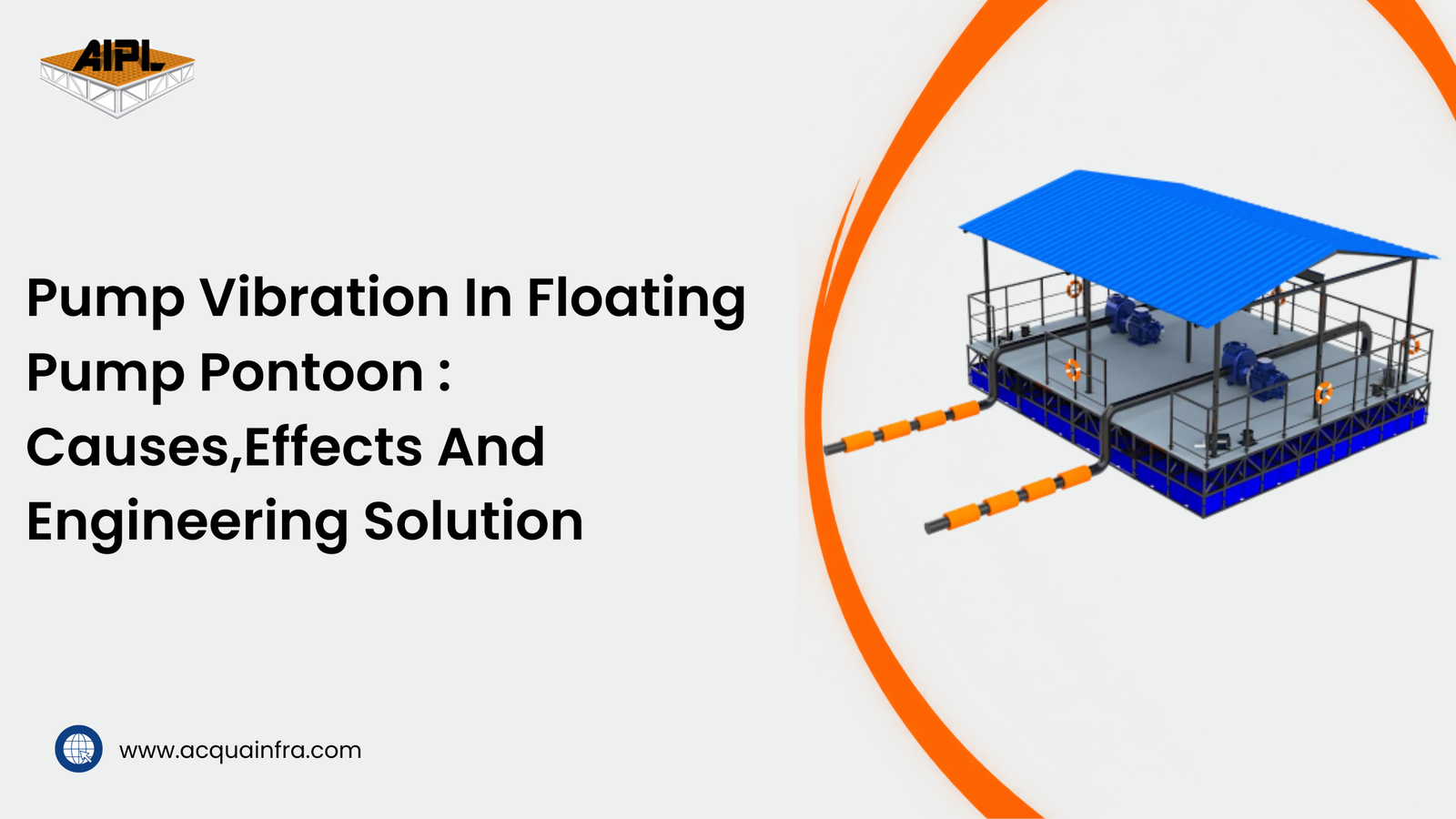
Across industrial water management, mining, irrigation and reservoir applications, high-capacity pumps are increasingly installed on floating pontoons / barges. However, when pump vibration is not properly addressed during engineering and fabrication, it can affect equipment performance, structural integrity and long-term operating reliability.
Pump Vibration in Floating Pump Pontoons is not simply a mechanical issue related to the pump itself. The vibration behaviour of a Floating Pump Pontoon depends on structural design, equipment alignment, buoyancy distribution, foundation stiffness, piping loads, water movement and operating conditions.
A well-engineered Pump Pontoon therefore requires vibration control to be considered from the design stage rather than after commissioning. This article explains the major causes, operational effects and engineering methods used to manage vibration in floating pumping stations.
A pump installed on land transfers vibration into a relatively rigid foundation. A Floating Pump Pontoon behaves differently because the supporting structure has its own flexibility and responds to changing water conditions.
When a large pump starts operating, mechanical forces travel through the pump base frame, structural members and floating hull. If these forces are not properly considered, vibration can become amplified rather than controlled.
For projects involving pumps ranging from 10 kW to 2000+ kW, the engineering approach must account for both the rotating equipment and the behaviour of the floating structure.
Excessive vibration can lead to:
The cost of correcting vibration after installation is often significantly higher than addressing it during the initial engineering stage.
Pump vibration generally originates from rotating and hydraulic forces generated during equipment operation. These forces may be small at the pump but can become significant when transferred through an improperly designed structure.
A Floating Pump Pontoon introduces additional variables because the entire structure is supported by buoyancy rather than a fixed concrete foundation.
The vibration behaviour depends on the interaction between:
This is why Pump Vibration in Floating Pump Pontoons must be analysed as an integrated engineering challenge rather than treating the pump and pontoon as separate components.
Misalignment between the pump and motor is one of the most common causes of excessive vibration.
Even minor angular or parallel misalignment can create cyclic forces during rotation. Over time, these forces can damage couplings, bearings and shafts.
In a Floating Pump Pontoon, alignment can also change if the equipment foundation experiences structural deflection.
Important alignment considerations include:
Proper laser alignment during installation helps reduce initial vibration, but the supporting structure must also maintain alignment throughout operation.
A weak or flexible pump foundation can amplify vibration.
When the natural frequency of the structural members approaches the operating frequency of the pump or motor, resonance can occur. This may significantly increase vibration levels.
The equipment foundation should therefore be designed to transfer operational loads safely through the structure.
A properly engineered Pump Pontoon considers:
Simply placing a pump on a fabricated deck without analysing structural stiffness can create long-term maintenance problems.
Resonance occurs when the excitation frequency generated by rotating equipment matches or approaches the natural frequency of the supporting structure.
This is particularly important for Floating Pump Pontoons because the structure may have multiple vibration modes.
For example, vibration may occur through:
An engineering review should identify potential resonance risks before fabrication.
Dynamic behaviour becomes increasingly important as pump capacity and equipment weight increase.
| Vibration Source | Primary Cause | Possible Effect |
| Mechanical imbalance | Uneven rotating mass | Excessive shaft vibration |
| Misalignment | Incorrect pump-motor positioning | Bearing and coupling damage |
| Hydraulic instability | Cavitation or turbulent flow | Noise and fluctuating loads |
| Structural flexibility | Weak equipment foundation | Amplified vibration |
| Resonance | Frequency interaction | High vibration levels |
| Pipe stress | Improper piping support | Pump casing movement |
| Loose connections | Poor fastening | Repetitive structural movement |
| Water movement | Waves and changing conditions | Additional pontoon motion |
Understanding the source of vibration is important because different causes require different engineering responses.
Not all Pump Vibration in Floating Pump Pontoons originates from mechanical components.
Hydraulic problems can also create strong vibration forces.
Cavitation occurs when local pressure conditions cause vapour bubbles to form and collapse inside the pump. The resulting energy release can damage internal components and generate significant vibration.
Common causes include:
A Floating intake platform must therefore be engineered to maintain suitable suction conditions even when water levels change.
A Floating Pump Pontoon must remain stable under all expected operating conditions.
If heavy pumps, motors, generators or control panels are concentrated on one side, the pontoon may develop an uneven trim or list.
This can affect:
Proper weight distribution is therefore an important part of vibration management.
The engineering team should consider both static and operating loads during pontoon design.
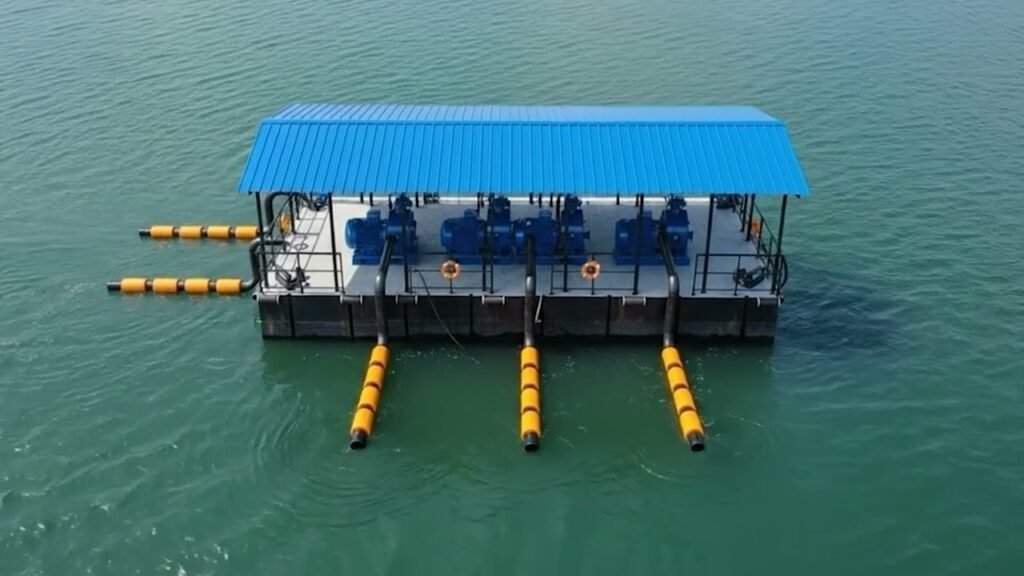
Suction and discharge pipelines can transfer significant loads to the pump casing.
When piping is poorly supported, the pump may experience external forces that affect alignment and increase vibration.
Typical piping-related problems include:
The piping arrangement should be reviewed together with the Pump Pontoon structure.
A pump should not be expected to carry unnecessary pipeline loads.
Repeated vibration can loosen mechanical fasteners over time.
Once a foundation bolt or structural connection becomes loose, vibration may increase rapidly.
Routine inspection should include:
A preventive maintenance programme helps identify small issues before they develop into larger failures.
The pump foundation should be designed according to actual equipment loads rather than general assumptions.
The engineering process should consider:
The load must be transferred through the equipment frame into the main pontoon structure without excessive local deformation.
For heavy-duty floating infrastructure, structural members must be selected based on calculated loading conditions.
Structural stiffness is essential for controlling vibration.
The goal is not simply to make the structure heavier. Instead, the structure should have appropriate reinforcement in locations where dynamic loads are concentrated.
Engineering measures may include:
A custom-engineered Floating Pump Pontoon should be designed according to the pump size, operating speed and expected dynamic forces.
Buoyancy calculations are central to the performance of floating infrastructure.
The pontoon must provide sufficient displacement to support:
Adequate reserve buoyancy is also important.
Stability analysis should consider different operational conditions, including changing water levels and possible future expansion.
| Engineering Factor | Why It Matters |
| Buoyancy | Supports total operational weight |
| Stability | Controls excessive list and trim |
| Centre of gravity | Influences overall equilibrium |
| Equipment location | Affects load distribution |
| Freeboard | Supports safe operation |
| Mooring loads | Influences structural behaviour |
| Water movement | Creates additional dynamic forces |
A stable floating pumping station provides a more reliable base for rotating equipment.
In some applications, vibration isolation arrangements may be considered between the equipment and supporting structure.
The correct method depends on the equipment characteristics and structural design.
Possible approaches include:
However, isolation components should not be selected without engineering analysis.
An incorrectly selected flexible mount can increase equipment movement and create alignment problems.
Commissioning is a critical stage for controlling Pump Vibration in Floating Pump Pontoons.
Before full operation, engineers should verify:
Baseline vibration measurements are useful because they provide a reference for future maintenance inspections.
Anchoring and mooring arrangements influence how a Floating Pump Pontoon responds to water movement.
An overly rigid arrangement may transfer external forces into the structure, while an improperly designed arrangement may allow excessive movement.
Engineering should consider:
The anchoring arrangement should allow safe operation while maintaining the required position of the water intake pontoon.
Fabrication quality has a direct effect on long-term structural behaviour.
Poor welding, inadequate reinforcement or dimensional inaccuracies can contribute to local stress concentrations.
Marine-grade fabrication should focus on:
IRS-compliant floating infrastructure requires disciplined fabrication practices, particularly for heavy-duty applications.
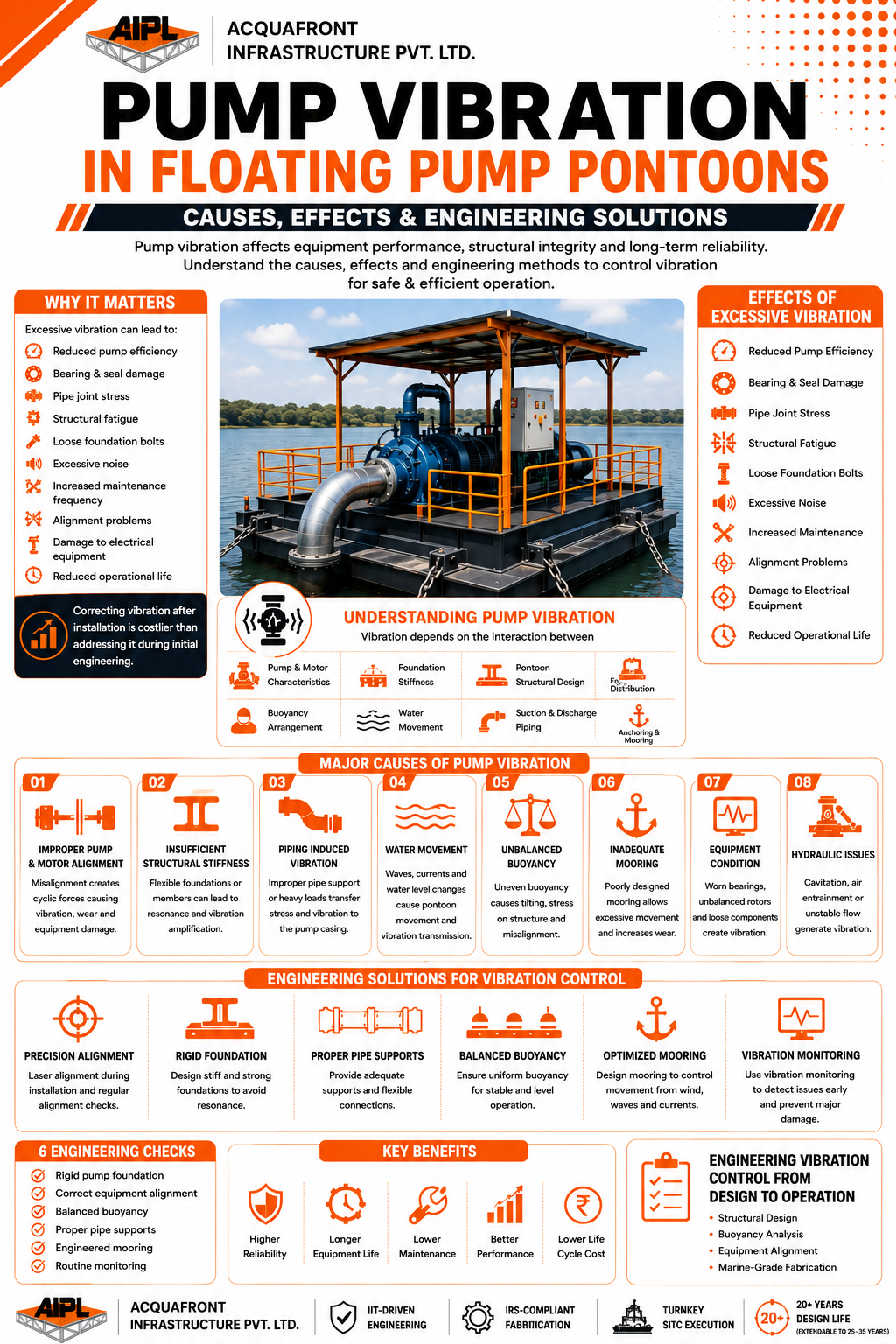
Excessive vibration does not usually remain limited to one component.
A vibration issue may gradually affect multiple parts of the Floating Pump Pontoon.
For example, repeated vibration can loosen bolts, damage bearings and increase stress in connected pipelines.
This leads to higher:
Proper engineering during the initial design phase can therefore reduce lifecycle expenditure.
A well-designed pontoon can have a standard operating life of 20+ years, potentially extendable to 25–35 years with proper maintenance, depending on operating conditions and maintenance practices.
Engineering reduces the risk of vibration, but regular maintenance remains essential.
A practical inspection programme should include both mechanical and structural checks.
Additional inspection may be required after:
Consistent monitoring supports long-term operational reliability.
Before approving the engineering and fabrication of a Floating Pump Pontoon, buyers should review the following items.
| Technical Requirement | What Should Be Checked |
| Pump capacity | Equipment rating and operating conditions |
| Equipment loads | Pump, motor and accessory weights |
| Structural design | Girders, beams and reinforcement |
| Foundation design | Stiffness and load transfer |
| Buoyancy | Total displacement and reserve buoyancy |
| Stability | List and trim under operating loads |
| Piping | Suction and discharge load support |
| Mooring | Position control and water level variation |
| Corrosion protection | Suitable protection for site conditions |
| Fabrication quality | Welding and inspection procedures |
| Transportation | Module dimensions and site logistics |
| Maintenance access | Safe inspection and servicing provisions |
This checklist helps project owners compare engineering proposals more effectively.
No two Floating Pump Pontoons operate under exactly the same conditions.
A pontoon designed for a calm reservoir may require a different structural approach from one operating in an industrial water body with changing currents.
Every floating infrastructure project should therefore be custom engineered according to:
Standard fabrication without project-specific engineering can create operational limitations later.
This becomes particularly important for high-capacity pumping applications where equipment loads and vibration forces are substantial.
Acquafront Infrastructure Private Limited approaches floating infrastructure through engineering-led design and project-specific fabrication.
AIPL combines IIT-driven engineering, marine-grade manufacturing and practical project execution experience for applications involving Floating Pump Pontoons, construction pontoons, modular barges and other heavy-duty floating infrastructure.
The engineering process considers structural behaviour, buoyancy, stability, equipment loads, corrosion protection, deployment requirements and long-term maintenance.
AIPL also has turnkey SITC execution capability, allowing engineering, fabrication, transportation, site assembly, installation and commissioning activities to be coordinated according to project requirements.
AIPL's project experience across India provides practical understanding of varying operating environments.
Relevant execution experience includes projects associated with:
This range of work supports an engineering-driven approach to different load conditions, environmental requirements and deployment challenges.
For heavy-duty requirements, AIPL also has execution capability for floating infrastructure handling 1000+ tonnes, depending on project-specific engineering requirements.
The focus remains on custom engineering and long-term operational reliability rather than applying a single design approach to every application.
Pump vibration should be investigated immediately when operators observe unusual changes in equipment behaviour.
Warning signs may include:
Early investigation can prevent a relatively small mechanical issue from developing into a major structural or operational problem.
For large industrial and infrastructure projects, vibration monitoring should form part of the maintenance strategy.
Pump Vibration in Floating Pump Pontoons refers to mechanical or hydraulic vibration generated by pumping equipment and transferred through the floating structure during operation.
Common causes include misalignment, imbalance, cavitation, weak structural foundations, resonance, poor piping support and loose connections.
Yes. Insufficient structural stiffness can amplify vibration and affect pump alignment and equipment performance.
Excessive vibration can cause fatigue, loose bolts, equipment damage, pipe stress and increased maintenance requirements.
Yes. Structural load design, proper foundation stiffness, alignment, buoyancy analysis and suitable piping support can significantly reduce vibration risks.
Depending on project-specific engineering requirements, Floating Pump Pontoons can support pumping applications ranging from approximately 10 kW to 2000+ kW.
Yes. Cavitation can generate hydraulic vibration, noise and internal pump damage when suction conditions are unsuitable.
Monitoring frequency depends on equipment criticality and operating conditions, but regular baseline and periodic vibration checks are recommended.
Yes. Custom-engineered fabrication can accommodate project-specific equipment loads, water depth, environmental conditions and future expansion requirements.
AIPL provides engineering-driven Floating Pump Pontoon fabrication and execution support for industrial, reservoir, mining and water management applications in India.
Yes. AIPL provides nationwide execution capability and can engineer Floating Pump Pontoons for projects in Gujarat based on site-specific requirements.
Yes. AIPL supports projects across India, including UP, MP and Odisha, subject to project engineering, transportation and installation requirements.
Uneven buoyancy or poor weight distribution can cause list and trim, which may affect equipment alignment and structural behaviour.
A properly engineered and maintained Floating Pump Pontoon can have a standard operational life of 20+ years, potentially extendable to 25–35 years with appropriate maintenance.
Yes. AIPL has turnkey SITC execution capability covering project-specific engineering, fabrication, transportation, installation and commissioning requirements.
Pump vibration in Floating Pump Pontoons should be addressed as an engineering issue involving equipment, structure, buoyancy, piping and operational conditions. Focusing only on the pump can overlook important causes of recurring vibration.
Proper structural design, equipment alignment, stable buoyancy distribution and marine-grade fabrication can significantly improve reliability and reduce maintenance requirements over the operating life of a Floating Pump Pontoon.
For critical pumping applications, project-specific engineering provides a stronger foundation for safe operation, lower lifecycle costs and long-term performance.
Planning a Floating Pump Pontoon project?
Consult experienced engineers to design customized floating infrastructure tailored to your operational requirements.
📞 +91 7678232371
📩
Mr. Achin Agrawal
Director & CTO
Acquafront Infrastructure Private Limited
Mr. Achin Agrawal leads the engineering and technology initiatives at Acquafront Infrastructure Pvt. Ltd. (AIPL), specialising in modular floating infrastructure, marine engineering, lifting barges, construction pontoons, floating work platforms, and heavy-duty marine systems. With extensive experience in designing and executing complex floating infrastructure projects, he has contributed to solutions deployed across reservoirs, dams, ports, industrial waterfronts, and inland waterways throughout India. Under his technical leadership, AIPL continues to deliver IIT-driven engineering, IRS-compliant fabrication, and turnkey SITC solutions that meet the evolving needs of India's marine infrastructure sector.

