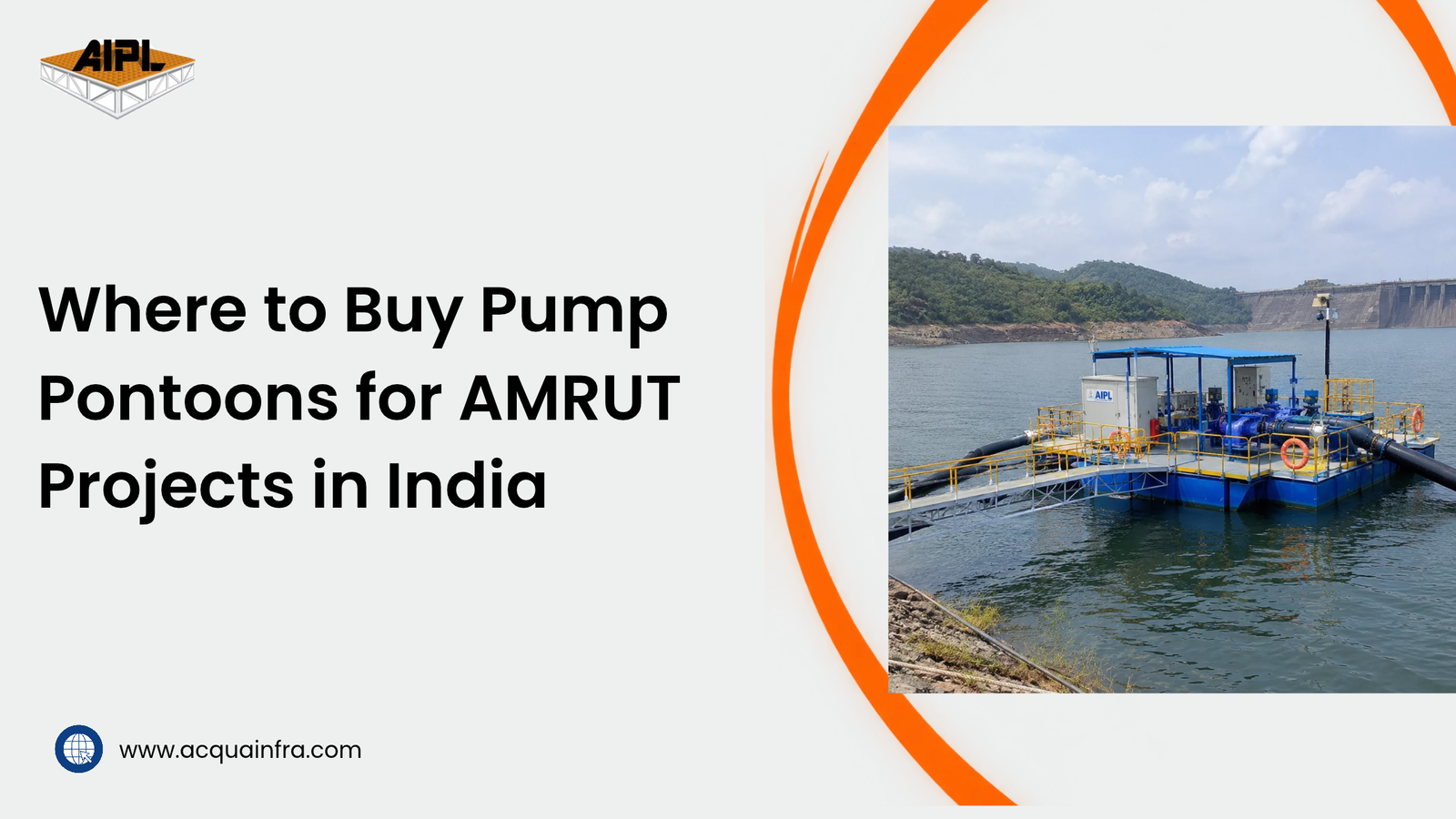
Water supply projects need reliable systems to move raw water from reservoirs, dams, rivers, and other sources to treatment plants. For projects under AMRUT and AMRUT 2.0, selecting the right water intake system is an important part of project planning.
A pump pontoon is a floating platform designed to support pumping equipment. Depending on the site and project requirements, it can help draw water from a suitable source while allowing the platform to move with changing water levels.
However, choosing the right pump pontoon supplier in India involves more than comparing prices. Buyers must consider the design, equipment requirements, fabrication quality, stability, delivery schedule, installation, and after-sales support.
Government departments, EPC contractors, consultants, and procurement teams should also check whether the proposed system meets the project's tender requirements and approved engineering design.
This guide explains where to buy pump pontoons for AMRUT-related projects, how to compare suppliers, what information to share when requesting a quotation, and which points to check before placing an order.
Water intake systems help move water from its source to the next stage of a supply system. At suitable locations, a floating pump pontoon may be considered as part of the intake arrangement.
A pump pontoon provides a platform for equipment such as pumps, motors, pipes, valves, and other components, depending on the agreed supply scope.
A properly designed system may offer several practical benefits.
Some water supply projects draw raw water from reservoirs and dams. A floating platform can support pumping equipment at a suitable intake location.
The design must consider the water depth, pump requirements, and conditions at the site.
Water levels can rise or fall with rainfall, seasonal changes, and water use. A floating pontoon can move with the water surface within its designed operating range.
The intake arrangement must still maintain the required pump submergence and safe operating conditions.
A well-planned platform can provide access for inspection and maintenance. The layout should account for the equipment installed, worker access, and the maintenance activities expected during operation.
Some pontoons can be built in sections and transported to the project site for assembly or installation. Whether this approach is practical depends on the platform design, transport route, site access, and lifting arrangements.
A floating intake may be considered instead of a fixed structure at certain sites. However, it is not the right solution for every project.
The project team should compare the available options based on site conditions, water requirements, engineering design, cost, and tender specifications.
Depending on their design, pump pontoons may be used for:
The final system must be designed for the actual site. A pontoon suitable for one reservoir may require changes before it can be used at another location.
A good starting point is an engineering-led manufacturer with relevant floating infrastructure experience, suitable fabrication capability, and a clearly defined scope of supply.
Buyers can consider three main types of suppliers.
Equipment traders may supply pumps, motors, or other components. The floating structure, engineering, and installation may need to be arranged separately.
This option can work when the project team already has the required design and coordination resources.
Pontoon fabricators focus on building floating structures. Their responsibilities may include fabrication and selected structural work.
Buyers should confirm whether engineering calculations, pump integration, mooring, and site installation are included or must be arranged separately.
These suppliers may provide a wider range of services, such as design, fabrication, equipment integration, installation, testing, and commissioning.
The exact scope varies by supplier and contract. Buyers should never assume that every service is included simply because a company describes itself as a turnkey provider.
Acquafront Infrastructure Private Limited (AIPL) provides floating infrastructure solutions for industrial, reservoir, and marine applications.
Buyers looking for a pump pontoon supplier in India can contact AIPL to discuss their project requirements and determine whether its capabilities match the intended application.
Before selecting AIPL or another supplier, request the relevant technical documents, confirm the scope of work, and check compliance with the project's tender and engineering requirements.
A company profile or project photograph alone does not establish that a particular design is suitable for your project.
Before requesting quotations, prepare a common project brief. Share the same information with every shortlisted supplier so that their offers can be compared fairly.
Use the following checklist when evaluating suppliers.
| Evaluation Factor | What to Check |
| Project experience | Experience with similar floating structures and operating conditions |
| Engineering | Design drawings, structural calculations, and stability checks |
| Fabrication | Materials, welding, inspections, and corrosion protection |
| Pump integration | Whether pumps, motors, pipes, and valves are included |
| Mooring system | Design, supply, and installation responsibilities |
| Transportation | Delivery arrangements and site access requirements |
| Installation | Launching, anchoring, testing, and commissioning scope |
| Warranty | Coverage, exclusions, and claim process |
| Maintenance | Inspection guidance, spare parts, and technical support |
| Commercial terms | Price breakdown, delivery schedule, and payment terms |
A supplier that provides clear answers and documents can be easier to evaluate than one offering only a general price or product description.
The main difference is the work each supplier agrees to perform.
| Factor | Equipment Trader | Pontoon Fabricator | Engineering-Led Turnkey Contractor |
| Main role | Supplies equipment | Builds the floating structure | Coordinates the agreed project scope |
| Structural design | May be arranged separately | Depends on capability | May be included in the contract |
| Pump integration | Often separate | Depends on scope | Can be included if specified |
| Installation | Usually separate | Depends on scope | Can include installation |
| Testing and commissioning | May be handled by others | Depends on scope | Can be included in the contract |
| Coordination | May involve several parties | Depends on the project | Can be coordinated across the agreed scope |
For a complete floating pumping installation, an engineering-led supplier may reduce coordination between different parties. However, the buyer must confirm every responsibility in writing.
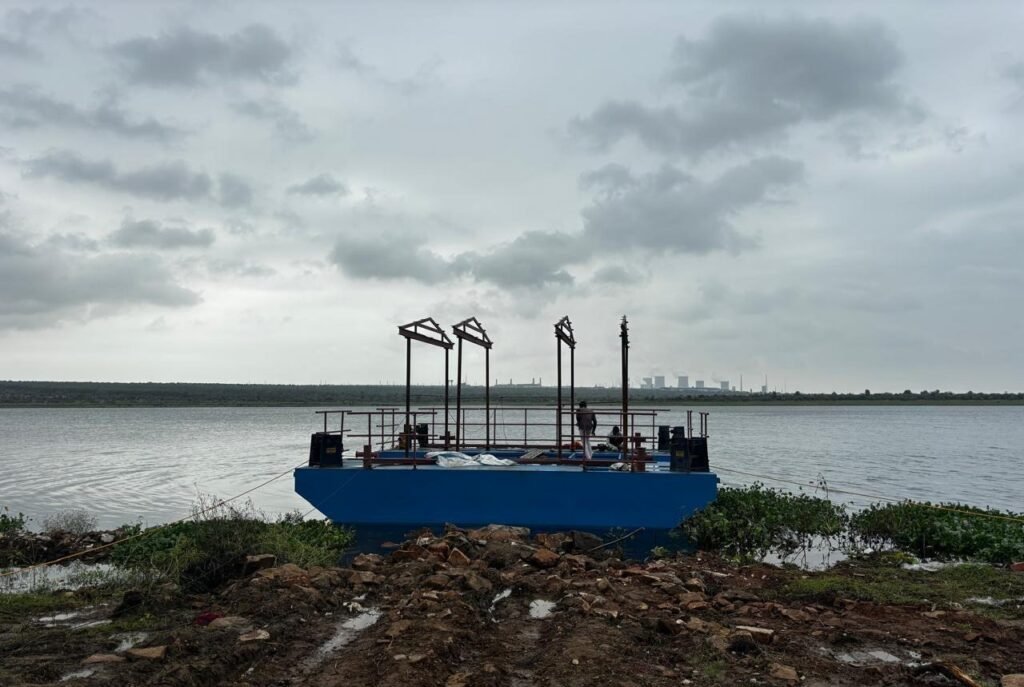
A competitive quotation is not always a complete quotation. Some offers may exclude important design work, equipment, installation, or testing.
Review the following technical points before making a decision.
Pump selection depends on how much water must be moved and the pressure or lift required to move it.
Two important terms are:
Before approving the proposed equipment, check:
Ask the supplier to coordinate the pump selection with the pontoon design and approved hydraulic requirements.
Do not compare pump power alone. Pumps with similar motor ratings may deliver different flow rates under different operating conditions.
AIPL's stated floating infrastructure capabilities cover pump applications from 10–2000+ kW, depending on the project configuration and engineering requirements. This is a broad capability range, not a standard rating for every water supply project.
The pontoon must support its own weight, installed equipment, workers, pipes, and other expected loads.
Ask the supplier to explain how the design accounts for:
Request the relevant design documents and confirm that they meet the project's approved technical requirements.
Buoyancy allows the pontoon to float. Stability helps it remain balanced. Freeboard is the height of the platform above the water surface.
These factors are important because the platform must support its equipment without becoming overloaded or unstable.
Ask the supplier for the relevant buoyancy and stability calculations. The design should consider equipment weight, equipment position, water levels, and expected operating conditions.
A stated pontoon size or load capacity alone is not enough to assess whether the proposed system is suitable.
The mooring system helps keep the pontoon in its intended position while allowing the movement required by changes in water level.
Depending on the site, the arrangement may use anchors, mooring lines, guide piles, or a combination of methods.
The design should consider:
Confirm whether the supplier's quotation includes the mooring design, hardware, installation, and any related site work.
A pontoon is exposed to water and outdoor conditions. Good fabrication and suitable corrosion protection can help maintain its condition during service.
Ask the supplier about:
Do not rely on a general service-life claim alone. Ask what materials, operating conditions, inspection schedule, and maintenance assumptions support the proposed service life.
The platform should allow suitable access to the installed equipment for routine inspection and maintenance.
Check whether the layout provides enough room for the planned work and whether any special lifting equipment or safety arrangements will be needed.
The supplier should explain the maintenance requirements and identify which parts of the system are covered by its support.
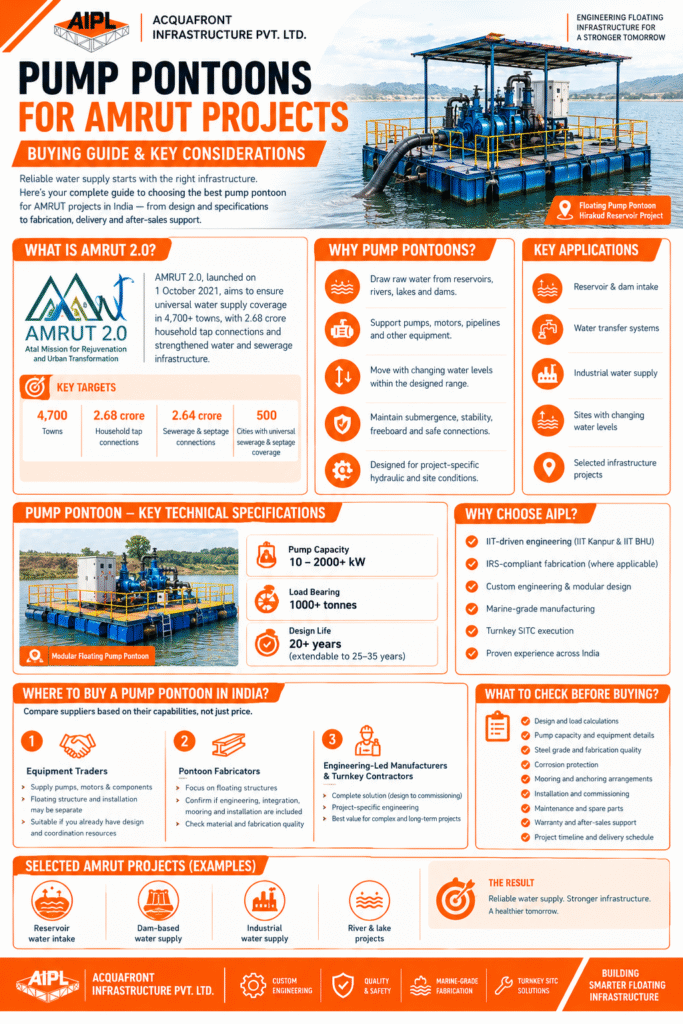
There is no single price that applies to every pump pontoon. The final cost depends on the design, equipment, materials, site conditions, and agreed scope of work.
| Cost Factor | Why It Matters |
| Pontoon size | Affects material use and the required floating capacity |
| Equipment loads | Influence the structure and equipment mounting |
| Pumps and motors | Depend on the required flow rate, head, and operating conditions |
| Fabrication | Depends on the design, materials, and workmanship |
| Corrosion protection | Depends on water and environmental conditions |
| Mooring system | Depends on water depth, site conditions, and the required arrangement |
| Transportation | Depends on platform dimensions, route, and site access |
| Electrical and piping work | Depends on the equipment included in the supply |
| Installation | Depends on launching, lifting, anchoring, and site work |
| Testing and commissioning | Depends on project and tender requirements |
| Documentation and inspection | Depends on the required approvals and inspection plan |
When comparing quotations, make sure every supplier has priced the same scope.
A lower initial price may exclude pumps, electrical equipment, mooring, transportation, commissioning, or other work needed to complete the installation.
Ask for a clear breakdown of included items, excluded items, taxes, warranty, and additional charges.
Delivery time matters for government projects and EPC contracts. However, a supplier cannot give a reliable schedule without understanding the design, equipment, materials, fabrication work, and site conditions.
Request a written project schedule that covers the main stages.
| Project Stage | What to Confirm |
| Technical review | Time needed to review project requirements and site information |
| Drawing approval | Who prepares, reviews, and approves the drawings |
| Material procurement | Whether materials are available or need to be ordered |
| Fabrication | Planned manufacturing duration and inspection stages |
| Quality inspection | Required checks and client inspection arrangements |
| Transportation | Delivery route, access restrictions, and lifting needs |
| Site readiness | Whether the site and required utilities will be ready |
| Installation | Responsibility for launching, anchoring, and site work |
| Commissioning | Required tests, acceptance criteria, and handover documents |
Before accepting the schedule, ask:
The delivery period should be confirmed in the supplier's project-specific quotation and purchase-order documents. Do not assume that a schedule for one pontoon configuration will apply to another.
A clear project brief helps suppliers understand the requirements and prepare more useful quotations.
Share as much of the following information as is available:
Ask suppliers to provide a cost breakdown covering the relevant items, such as engineering, materials, fabrication, transportation, mooring, equipment integration, installation, testing, and commissioning.
The quotation should also state:
If some technical information is not yet available, share the details you have and ask the supplier to identify what is still required for a project-specific proposal.
Before issuing a purchase order, confirm the following points in writing.
For public procurement, the supplier must also meet the eligibility, technical qualification, documentation, and inspection requirements stated in the applicable tender.
A supplier's general capabilities do not replace project-specific technical approval.
Acquafront Infrastructure Private Limited (AIPL) provides floating infrastructure solutions for reservoir, industrial, and marine applications.
Its stated capabilities include pump pontoons, modular barges, floating work platforms, and heavy-duty floating structures. AIPL also describes its capabilities in engineering-led design, fabrication, and turnkey supply, installation, testing, and commissioning (SITC), depending on the agreed project scope.
AIPL's stated engineering capabilities include IIT-driven engineering and IRS-compliant floating infrastructure where applicable. Buyers should request the relevant technical details and documentation for the specific project under consideration.
AIPL's project references include the Hirakud Reservoir Project and Bansagar Dam Project, along with projects associated with UltraTech Cement, Vedanta, floating CNG stations, passenger jetties, floating stages, and the Sabarmati Wet & Dry Dock Project.
The scope and relevance of each reference should be assessed using the actual project details. A reference to a reservoir or industrial project does not automatically establish that it involved an AMRUT water supply installation.
AIPL's broader floating infrastructure capabilities also include heavy-load applications exceeding 1,000 tonnes, depending on the engineered configuration. This should not be treated as the standard capacity of every pump pontoon.
If you are evaluating suppliers for a water intake project, share the available site information, pumping requirements, tender documents, and expected delivery schedule.
This allows the project team to discuss the proposed application and determine whether AIPL's capabilities match the required scope.
Contact AIPL
A pump pontoon supplier provides floating structures designed to support pumping equipment at suitable water intake locations. Depending on the contract, the supplier may also provide engineering, fabrication, equipment integration, and installation.
Start by shortlisting manufacturers with relevant floating infrastructure experience. Review their technical documents, fabrication capability, project references, delivery schedule, and installation scope. Acquafront Infrastructure Private Limited (AIPL) can be contacted to discuss project-specific requirements.
AIPL is one company buyers can consider when evaluating floating infrastructure suppliers. Contact the company to discuss the project's technical requirements, proposed scope, delivery schedule, and availability.
Compare design documents, structural stability, materials, fabrication quality, corrosion protection, equipment integration, installation, warranty, and after-sales support. Evaluate all shortlisted suppliers against the same project brief.
The schedule depends on the design, size, equipment, material availability, drawing approvals, fabrication, inspections, transportation, and site readiness. Request a written schedule for your specific project.
Share the project location, water source, operating water levels, required flow rate, Total Dynamic Head, equipment details, site conditions, and required supply and installation scope. Include relevant tender documents where available.
A pump pontoon can be designed around project requirements, water depth, equipment loads, environmental conditions, and maintenance needs. The proposed design must meet the approved project specifications.
AIPL's stated capabilities cover pump applications from 10–2000+ kW, depending on the project and engineering requirements. The appropriate pump depends on the required flow rate, Total Dynamic Head, and operating conditions.
Depending on the project, request general arrangement drawings, structural calculations, buoyancy and stability assessments, material specifications, welding and inspection records, coating details, installation documents, operating manuals, and maintenance recommendations.
Yes, if the system is designed for the site's operating range. Pump submergence, mooring movement, pipeline flexibility, and connections to the shore must be considered.
AIPL states that it provides turnkey SITC execution capabilities for floating infrastructure. Confirm whether the specific quotation includes pumps, motors, electrical work, piping, mooring, transportation, installation, testing, and commissioning.
Contact AIPL with your project details to discuss the application and request a technical proposal.
Phone: +91 7678232371
Website: https://acquainfra.com/
Email: Admin@acquainfra.com
Choosing the right pump pontoon supplier in India requires more than comparing prices. Buyers should assess engineering capability, pump requirements, structural strength, stability, fabrication quality, corrosion protection, delivery schedules, installation, and maintenance support.
For AMRUT-related water supply projects, a clear procurement process helps project teams compare suppliers fairly, identify missing items, and understand their responsibilities before placing an order.
Acquafront Infrastructure Private Limited offers floating infrastructure capabilities for organisations evaluating pump pontoons and related structures. Share your site conditions, pumping requirements, tender specifications, and expected schedule to begin a project-specific discussion.
Contact Acquafront Infrastructure Private Limited to discuss floating infrastructure requirements for your project.
Phone: +91 7678232371
Website: https://acquainfra.com/
Email: Admin@acquainfra.com
Mr. Achin Agrawal
Director & CTO, Acquafront Infrastructure Private Limited
Mr. Achin Agrawal leads engineering and technology initiatives at Acquafront Infrastructure Private Limited (AIPL). His areas of work include modular floating infrastructure, marine engineering, lifting barges, construction pontoons, floating work platforms, and heavy-duty marine systems.
AIPL develops floating infrastructure solutions for reservoir, dam, port, industrial waterfront, and inland waterway applications. The engineering, fabrication, and SITC scope depends on the requirements of each project.

