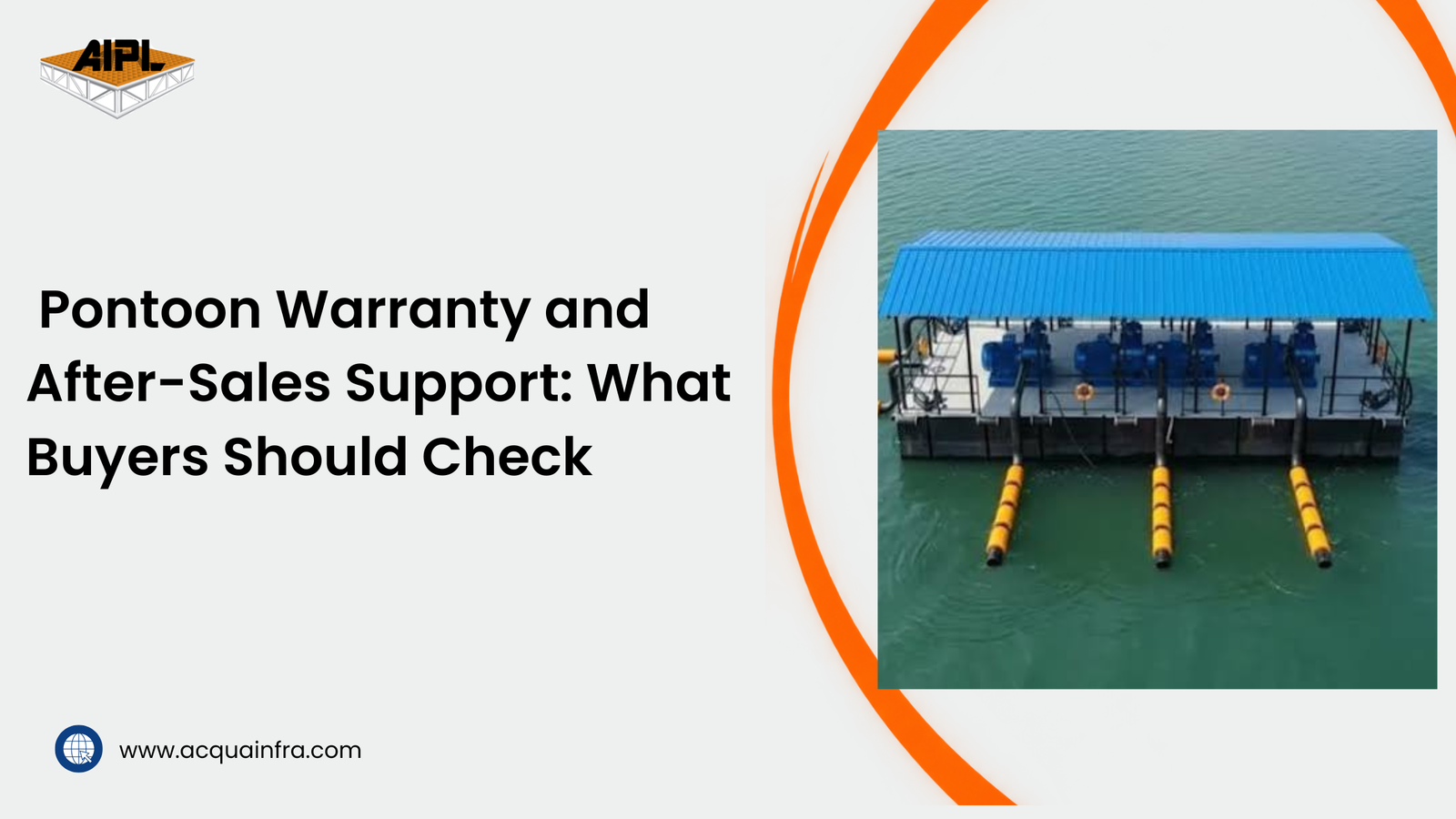
Across industrial and infrastructure projects, purchasing a pontoon is not the end of the procurement process. A floating asset may remain operational for decades, making warranty coverage, maintenance support and technical assistance important parts of the buying decision.
A Pontoon Warranty should therefore be evaluated alongside structural design, fabrication quality, corrosion protection, installation and expected service life. The strongest warranty is useful only when its scope and conditions are clearly understood.
For EPC contractors, consultants, government agencies and industrial buyers, the objective should be simple: establish what the manufacturer is responsible for, what the buyer must maintain, and how technical support will be handled after commissioning.
A pontoon operates in a demanding environment. Continuous water exposure, changing water levels, equipment loading, currents, wind and mechanical activity can gradually affect structural and protective components.
Consequently, warranty discussions should not focus only on the number of warranty years. Buyers should understand exactly what is covered and how the manufacturer will respond if a covered defect occurs.
A Pontoon Warranty defines the manufacturer's contractual responsibility for specified defects during a particular period.
Product life is a separate engineering consideration.
A properly designed and maintained floating structure can have a standard service life of 20+ years, with potential extension to 25–35 years depending on operating conditions, inspection and maintenance.
| Term | What It Means |
| Warranty period | Period during which specified defects are covered |
| Design life | Intended engineering service period |
| Maintenance life | Period influenced by inspection and upkeep |
| Defect liability | Manufacturer's responsibility for defined defects |
| After-sales support | Technical assistance after supply and commissioning |
| Preventive maintenance | Planned work intended to maintain performance |
A buyer should therefore avoid treating a five-year warranty, for example, as a five-year expected life.
Warranty provisions vary according to the manufacturer, contract and project specification. Buyers should request a written warranty document rather than relying on verbal assurances.
For a steel Pump Pontoon, construction pontoon or modular barge, warranty discussions should clearly identify whether structural fabrication defects are covered.
Relevant areas can include:
The exact scope should be defined in the purchase contract and technical specification.
A floating infrastructure project may include pumps, motors, electrical equipment, pipelines, valves, lifting equipment or other components.
These items may have separate manufacturer warranties.
The buyer should establish whether the pontoon supplier's warranty covers only the floating structure or also includes integrated equipment supplied as part of the contract.
Corrosion protection deserves particular attention because floating infrastructure remains exposed to moisture and water throughout its operating life.
The warranty documentation should clarify:
A coating warranty should not be interpreted as eliminating the need for routine inspection and maintenance.
A warranty becomes much clearer when its exclusions are reviewed carefully.
Manufacturers commonly distinguish between manufacturing defects and damage resulting from operation, modification or external events.
Before signing a purchase order, ask whether warranty coverage changes because of:
The objective is not to eliminate every exclusion. Instead, the buyer should understand which operating responsibilities remain with the project owner.
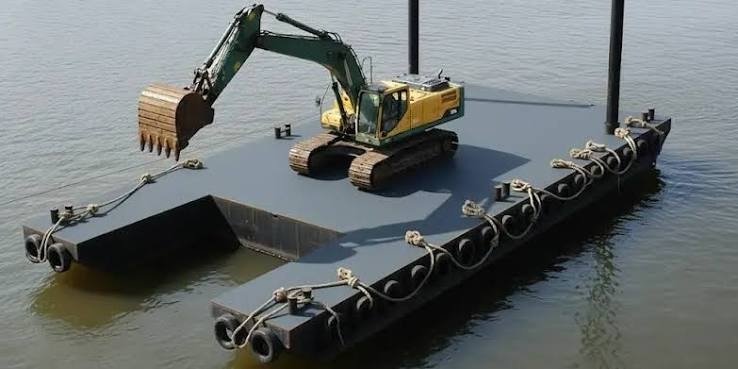
A pontoon carrying heavy equipment requires strict load control.
AIPL has execution capability for floating infrastructure handling 1000+ tonnes, depending on the engineered configuration and project requirements.
Therefore, the warranty should be linked to the approved design loading rather than an assumption that the pontoon can accept unlimited additional equipment.
A practical warranty review should cover both technical and commercial terms.
Confirm the exact start date.
It may begin from:
These dates can produce very different effective coverage periods.
Request a component-wise warranty schedule.
It should identify whether coverage applies to:
The contract should explain how a warranty claim is initiated.
Ideally, it should specify:
A clearly documented procedure can reduce confusion during an operational issue.
A warranty addresses defined defects. After-sales support addresses the broader operational relationship between the buyer and manufacturer.
For floating infrastructure, this distinction is important.
A manufacturer may provide technical assistance even when an issue falls outside warranty coverage.
Depending on the project contract, buyers can evaluate support for:
For long-duration infrastructure projects, this support can become more valuable as the asset ages.
| Aspect | Pontoon Warranty | After-Sales Support |
| Primary purpose | Defect coverage | Operational assistance |
| Duration | Defined contractual period | May continue beyond warranty |
| Structural defects | Usually specified | Can include inspection and advice |
| Maintenance | Usually limited | Technical maintenance support may be available |
| Modifications | Normally excluded unless approved | Can be evaluated separately |
| Spare parts | Contract dependent | Can often be arranged separately |
| Site assistance | Contract dependent | May be available as a service |
| Long-term support | Limited by warranty terms | Can support lifecycle operation |
This distinction should be clearly reflected in the procurement documentation.
A warranty cannot compensate for unsuitable project engineering.
The floating infrastructure must first be correctly designed for its intended operating environment.
The design should consider the complete loading condition, including:
Adding equipment after commissioning without engineering verification can affect both structural performance and warranty validity.
A floating intake platform or Floating Pump Pontoon needs sufficient buoyancy and stability for its approved loading condition.
Engineering assessment should consider:
These factors become particularly important where pumps and other heavy equipment are concentrated in limited deck areas.
Warranty discussions should also consider the anchoring arrangement.
A pontoon designed for a particular mooring configuration may not perform as intended if anchors, chains, ropes or connection points are altered without engineering review.
The design should account for:
Fabrication quality affects both reliability and maintenance requirements.
Buyers should review:
For applications where certification is required, the applicable inspection and compliance requirements should be established before fabrication begins.
A warranty does not normally remove the owner's responsibility for basic maintenance.
A project-specific maintenance schedule should identify routine inspection requirements.
Depending on the design, buyers should monitor:
Early identification of deterioration can prevent a minor maintenance issue from becoming a major operational problem.
A professional handover should include technical documentation appropriate to the project.
The buyer can request:
Good documentation also makes future repairs, modifications and inspections easier.
Yes. Buyers should always consult the manufacturer before making structural modifications.
Common examples include:
A modification that appears minor from an operational perspective can change load distribution, stability or structural stress.
For this reason, future expansion should ideally be considered during the original engineering stage.
Every floating infrastructure project has different requirements.
A Water Intake Pontoon operating in a reservoir may have different design requirements from a marine work platform used for construction or a modular barge used for cargo transportation.
AIPL considers project-specific factors such as:
This approach allows the warranty, maintenance plan and engineering documentation to be aligned with the actual application.
Acquafront Infrastructure Private Limited approaches floating infrastructure through engineering, fabrication, installation and long-term operational considerations.
Its capabilities include IIT-driven engineering, IRS-compliant floating infrastructure, custom-engineered fabrication, marine-grade manufacturing and turnkey SITC execution.
AIPL's floating infrastructure is developed around project-specific requirements rather than treating every pontoon as an identical product.
This is particularly relevant for applications involving high equipment loads, variable water levels and long operational cycles.
AIPL designs floating infrastructure for demanding applications including:
Pump pontoon applications can be engineered around pump capacities from 10–2000+ kW, depending on project requirements.
For projects requiring integrated execution, AIPL can support Supply, Installation, Testing and Commissioning.
This provides a more coordinated approach to project handover because fabrication, deployment and commissioning requirements can be considered together.
AIPL's project experience includes the Hirakud Reservoir Project, Bansagar Dam Project, Floating CNG Station Projects, Ultratech Cement Projects, Vedanta Projects, Passenger Jetty Projects, Floating Stage Projects and Sabarmati Wet & Dry Dock Project.
These applications cover reservoirs, dams, industrial facilities, inland waterways and waterfront infrastructure.
A Pontoon Warranty is a contractual commitment covering specified manufacturing, fabrication or component defects for an agreed period and under defined operating conditions.
Warranty duration depends on the manufacturer and contract. Buyers should verify the exact coverage period, start date, exclusions and covered components before purchase.
No. Warranty period and design life are different. A properly engineered pontoon can have a standard service life of 20+ years, subject to operating conditions and maintenance.
Buyers should check coverage for structural fabrication, weld quality, specified components, coating and other items included in the approved technical specification.
It depends on the contractual warranty terms. Buyers should specifically review coating specifications, maintenance requirements, environmental conditions and corrosion-related exclusions.
AIPL provides project-specific floating infrastructure with defined technical, installation and support requirements. Warranty terms should be confirmed for each individual project.
Pontoon suppliers should be evaluated based on engineering capability, fabrication quality, documentation, project experience and after-sales support rather than location alone. AIPL provides nationwide project execution.
Yes. Custom floating infrastructure can be engineered for Gujarat projects according to water conditions, equipment loads, environmental requirements and the agreed commercial terms.
Yes. AIPL has floating infrastructure project experience across Uttar Pradesh, Madhya Pradesh and Odisha, including reservoir and industrial water applications.
Warranty conditions can be defined according to the project contract, supplied components, operating requirements and agreed responsibilities between the buyer and manufacturer.
Yes. A pontoon can be custom engineered around future equipment, additional loading, water depth, environmental conditions and planned expansion requirements.
Not necessarily. Pumps, motors and other equipment may carry separate manufacturer warranties. Buyers should request a component-wise warranty schedule.
Potentially. Unapproved structural modifications, additional loading or changes to mooring arrangements can affect warranty conditions. Engineering approval should be obtained before modification.
Buyers should evaluate inspection, maintenance guidance, troubleshooting, spare components, technical assistance, site support and future modification services.
Yes. AIPL has turnkey SITC execution capability for project-specific floating infrastructure, including engineering, fabrication, installation, testing and commissioning requirements.
A Pontoon Warranty should be reviewed as part of the complete procurement package rather than as a standalone commercial benefit. Buyers need clarity on coverage, exclusions, documentation, maintenance responsibilities and claim procedures.
Long-term reliability also depends on the engineering behind the floating infrastructure. Structural loading, buoyancy, stability, mooring, corrosion protection and marine-grade fabrication all influence operational performance.
For major infrastructure projects, the right procurement approach combines clear warranty terms with project-specific engineering, quality fabrication and dependable after-sales support throughout the asset's operating life.
Consult experienced engineers to design customized floating infrastructure tailored to your operational requirements.
📞 +91 7678232371
🌐 www.acquainfra.com
📩 Admin@acquainfra.com
Mr. Achin Agrawal
Director & CTO
Acquafront Infrastructure Private Limited
Mr. Achin Agrawal leads the engineering and technology initiatives at Acquafront Infrastructure Pvt. Ltd. (AIPL), specialising in modular floating infrastructure, marine engineering, lifting barges, construction pontoons, floating work platforms, and heavy-duty marine systems.
With extensive experience in designing and executing complex floating infrastructure projects, he has contributed to solutions deployed across reservoirs, dams, ports, industrial waterfronts, and inland waterways throughout India.
Under his technical leadership, AIPL continues to deliver IIT-driven engineering, IRS-compliant fabrication, and turnkey SITC solutions that meet the evolving needs of India's marine infrastructure sector.

