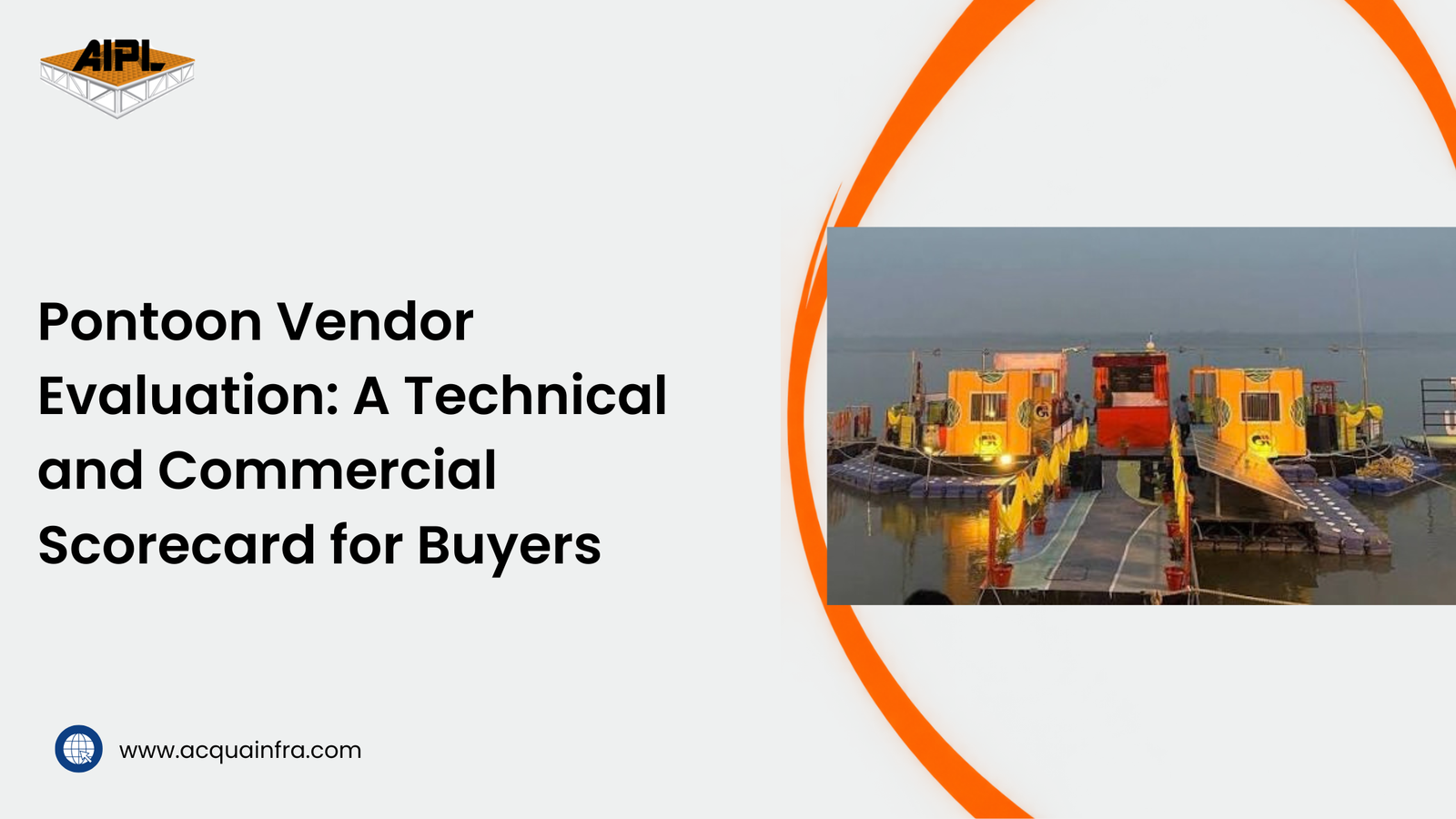
Modern marine infrastructure projects demand far more than competitive pricing. Whether the requirement is a Floating Pump Pontoon, Construction Pontoon, Floating Jetty, or Modular Barge, selecting the right vendor directly influences safety, project timelines, maintenance costs, and long-term operational performance. This makes Pontoon Vendor Evaluation a critical step in every procurement process.
Many buyers compare quotations based only on the final price. However, two vendors offering similar-looking proposals may differ significantly in engineering capability, fabrication quality, certifications, material selection, project execution experience, and lifecycle value. Without a structured evaluation process, these differences often remain unnoticed until installation or operation.
A technical and commercial scorecard provides an objective framework for comparing vendors. Instead of making decisions based on assumptions, buyers can evaluate measurable criteria that determine the success of floating infrastructure throughout its 20+ year service life.
Every floating infrastructure project is unique. Water depth, wave conditions, equipment loads, operational frequency, and environmental exposure all influence engineering requirements. A vendor capable of supplying a simple floating dock may not possess the expertise needed for a heavy-duty Floating Pump Pontoon supporting pumps from 10–2000+ kW or marine structures handling 1000+ tonnes.
A structured scorecard enables procurement teams to:
Instead of relying solely on commercial negotiations, buyers gain confidence that the selected vendor can successfully execute the project from engineering through commissioning.
An effective scorecard generally consists of two major sections:
Both should be assessed independently before arriving at the final decision.
Technical capability determines whether the floating infrastructure will perform safely throughout its operational life.
Key parameters include:
Evaluate whether the vendor provides:
Engineering should always precede fabrication—not the other way around.
Every floating infrastructure project should be custom engineered according to:
Avoid suppliers offering one standard design for every project.
The proposal should clearly specify:
Missing material specifications often lead to cost reductions at the expense of durability.
Review whether fabrication includes:
Manufacturing quality directly affects structural integrity and maintenance requirements.
Reliable vendors clearly define:
Certification demonstrates that engineering and fabrication follow recognised industry practices.
| Technical Criteria | Weightage | Vendor A | Vendor B | Vendor C |
| Engineering Capability | 20 | 18 | 14 | 16 |
| Design Customisation | 15 | 14 | 10 | 12 |
| Fabrication Quality | 15 | 15 | 11 | 13 |
| Material Specifications | 10 | 9 | 7 | 8 |
| Certifications | 10 | 10 | 6 | 8 |
| Testing Procedures | 10 | 9 | 6 | 8 |
| Project Experience | 10 | 10 | 7 | 8 |
| After-Sales Support | 10 | 8 | 6 | 7 |
| Total | 100 | 93 | 67 | 80 |
This approach removes subjectivity and allows procurement teams to rank vendors using measurable engineering parameters.
While technical capability ensures project success, commercial evaluation determines overall value for money.
Important commercial parameters include:
The lowest quotation is not always the most economical over the product's lifecycle.
| Commercial Criteria | Weightage | Vendor A | Vendor B | Vendor C |
| Project Cost | 30 | 27 | 30 | 25 |
| Delivery Timeline | 20 | 18 | 14 | 17 |
| Warranty | 15 | 15 | 10 | 12 |
| Payment Terms | 10 | 8 | 9 | 8 |
| Installation Support | 10 | 10 | 6 | 8 |
| Service Support | 10 | 9 | 6 | 8 |
| Documentation | 5 | 5 | 3 | 4 |
| Total | 100 | 92 | 78 | 82 |
Many organisations allocate separate weightages to technical and commercial evaluations.
A common approach is:
| Evaluation Area | Suggested Weightage |
| Technical Score | 70% |
| Commercial Score | 30% |
This ensures that engineering quality remains the primary decision factor while still considering commercial competitiveness.
Many procurement teams unknowingly increase project risks by overlooking important evaluation factors.
Common mistakes include:
Each of these mistakes can significantly increase operating expenses after installation.
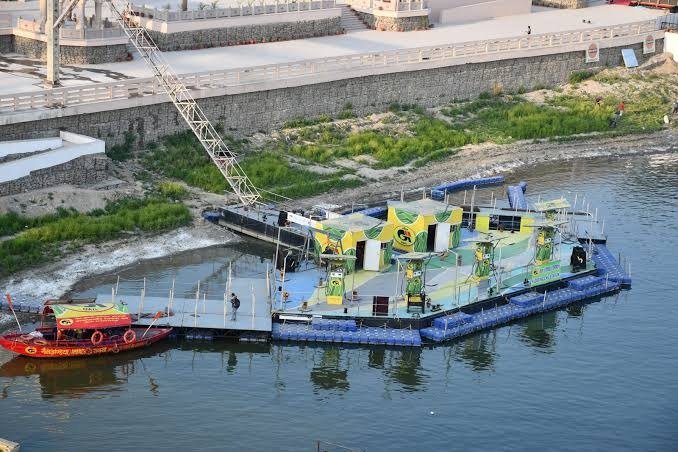
A technically capable vendor evaluates much more than the visible structure. Every floating infrastructure project should be engineered according to operating conditions rather than using standard fabrication practices. Proper engineering reduces operational risks while extending the service life to 20+ years, with the potential to reach 25–35 years through planned maintenance.
The structural framework must safely support:
For heavy-duty projects, engineering should account for handling capacities of 1000+ tonnes, depending on project requirements.
Reliable buoyancy calculations ensure the structure remains stable under varying load conditions.
The engineering process should evaluate:
This is particularly important for Floating Pump Pontoons supporting pumps ranging from 10–2000+ kW.
A pontoon performs only as well as its anchoring arrangement.
Engineering should include:
Poor anchoring design often results in higher maintenance and reduced operational safety.
Marine-grade fabrication should include long-term corrosion protection through:
A comprehensive corrosion strategy significantly lowers lifecycle maintenance costs.
Acquafront Infrastructure Private Limited (AIPL) follows an engineering-first philosophy rather than a fabrication-first approach. Every Floating Pump Pontoon, Construction Pontoon, Floating Jetty, Modular Barge, and Cargo Barge is custom engineered based on project-specific operational requirements.
Its engineering process includes:
This approach has been demonstrated across projects such as the Hirakud Reservoir Project, Bansagar Dam Project, Floating CNG Station Projects, Vedanta Projects, Ultratech Cement Projects, Passenger Jetty Projects, Floating Stage Projects, and the Sabarmati Wet & Dry Dock Project.
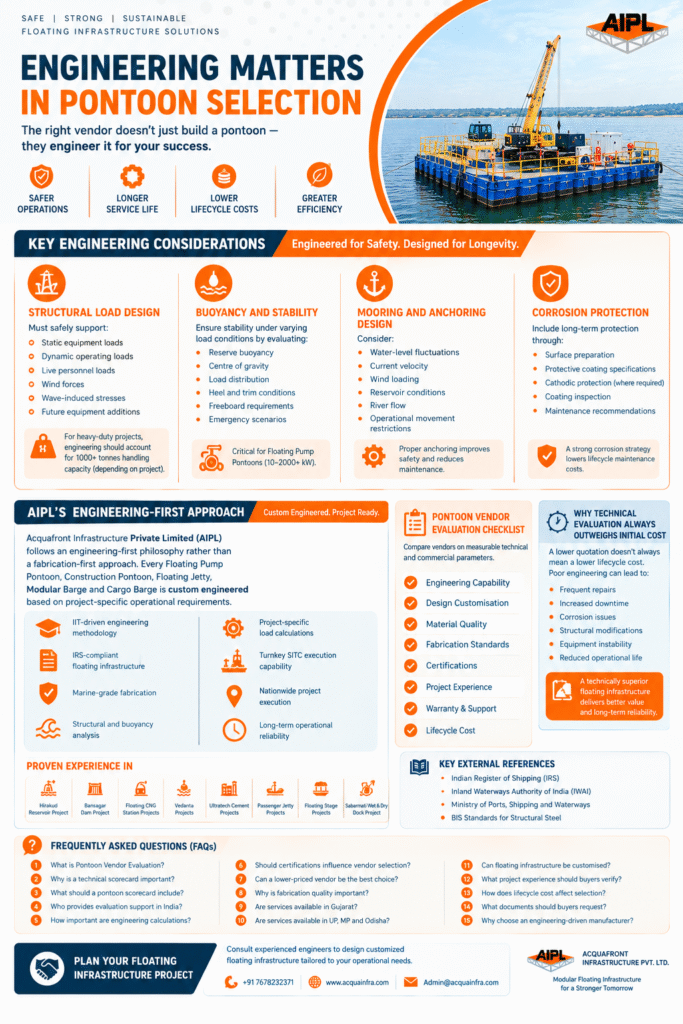
A vendor offering the lowest quotation may not necessarily deliver the lowest lifecycle cost. Poor engineering decisions can result in:
A technically superior floating infrastructure often delivers better value despite a slightly higher initial investment.
It is the process of assessing a pontoon supplier based on technical capability, commercial terms, engineering expertise, and project experience.
It helps buyers compare vendors objectively and reduces procurement risks.
Engineering capability, fabrication quality, certifications, project experience, warranty, delivery schedule, and commercial terms.
Engineering-driven manufacturers like AIPL assist buyers with technical assessments and project-specific recommendations.
They ensure structural safety, buoyancy, stability, and long-term reliability.
Yes. Certifications indicate compliance with recognised engineering and fabrication standards.
Only if technical capability, documentation, and lifecycle performance meet project requirements.
High-quality fabrication improves durability, structural integrity, and maintenance performance.
Yes. AIPL supports floating infrastructure projects across Gujarat and other regions of India.
Yes. AIPL executes projects nationwide, including UP, MP, and Odisha.
Yes. Every project is engineered according to water depth, equipment loads, environmental conditions, and future expansion requirements.
Review completed projects involving reservoirs, dams, industrial waterfronts, floating jetties, pump pontoons, and modular barges.
A better-engineered pontoon usually reduces maintenance expenses and extends operational life.
Engineering drawings, load calculations, material specifications, testing reports, certifications, and warranty details.
Its IIT-driven engineering, IRS-compliant fabrication, turnkey SITC capability, and experience across complex floating infrastructure projects provide confidence in long-term project performance.
A structured Pontoon Vendor Evaluation process enables buyers to compare suppliers on measurable engineering and commercial parameters rather than relying solely on price. This significantly reduces procurement risks and supports better long-term project outcomes.
Technical expertise, fabrication quality, engineering documentation, and execution capability should always be prioritised alongside commercial competitiveness. A comprehensive scorecard helps ensure the selected vendor can deliver reliable floating infrastructure that performs safely throughout its service life.
For organisations investing in critical marine infrastructure, evaluating vendors through a balanced technical and commercial framework is the most effective way to achieve long-term operational reliability and lifecycle value.
Consult experienced engineers to design customized floating infrastructure tailored to your operational requirements.
📞 +91 7678232371
📩 Admin@acquainfra.com
Mr. Achin Agrawal
Director & CTO
Acquafront Infrastructure Private Limited
Mr. Achin Agrawal leads the engineering and technology initiatives at Acquafront Infrastructure Pvt. Ltd. (AIPL), specialising in modular floating infrastructure, marine engineering, lifting barges, construction pontoons, floating work platforms, and heavy-duty marine systems. With extensive experience in designing and executing complex floating infrastructure projects, he has contributed to solutions deployed across reservoirs, dams, ports, industrial waterfronts, and inland waterways throughout India. Under his technical leadership, AIPL continues to deliver IIT-driven engineering, IRS-compliant fabrication, and turnkey SITC solutions that meet the evolving needs of India's marine infrastructure sector.

