Across India's growing marine, industrial, and waterfront infrastructure sectors, floating structures are becoming increasingly specialised. Whether the requirement is for a Floating Pump Pontoon, Construction Pontoon, Floating Jetty, Water Intake Pontoon, or Modular Barge, the success of the project depends as much on engineering documentation as on fabrication quality.
A Pontoon Technical Proposal is far more than a commercial quotation. It serves as the engineering blueprint that explains how the floating infrastructure will be designed, fabricated, transported, installed, and commissioned. A detailed proposal helps project owners evaluate technical capability, compare vendors fairly, and minimise execution risks before work begins.
For EPC contractors, consultants, government agencies, and industrial buyers, reviewing a complete technical proposal ensures that every engineering requirement is addressed before procurement decisions are made. It also reduces the possibility of hidden costs, scope gaps, and design modifications during execution.
Many buyers focus primarily on commercial pricing while evaluating floating infrastructure suppliers. However, two proposals with similar prices can differ significantly in engineering scope, fabrication standards, project responsibilities, and lifecycle performance.
A professionally prepared Pontoon Technical Proposal provides complete technical clarity before fabrication begins. It defines project requirements, structural design parameters, material specifications, quality standards, testing procedures, and installation methodology.
Instead of relying solely on drawings or price schedules, buyers can use the proposal to understand exactly what they are receiving and how the floating infrastructure is expected to perform throughout its service life.
A complete proposal should combine engineering documentation, commercial clarity, and project execution details into one structured document.
Every proposal should begin by clearly defining the project requirements.
Typical information includes:
Rather than offering a standard floating structure, engineering-driven manufacturers develop customised designs based on these project-specific parameters.
The design basis explains how the pontoon has been engineered to perform safely under expected operating conditions.
Typical design parameters include:
At AIPL, engineering begins with a detailed evaluation of project conditions to ensure each floating infrastructure project is custom-engineered for its intended application.
GA drawings provide an overall view of the floating structure before fabrication starts.
A typical drawing includes:
These drawings help stakeholders visualise the complete floating infrastructure while ensuring engineering coordination between all project teams.
One of the most important sections of a Pontoon Technical Proposal is the structural engineering package.
It demonstrates how the pontoon has been designed to withstand operational loads without excessive deformation or structural failure.
Typical engineering information includes:
| Proposal Component | Basic Proposal | Complete Technical Proposal |
| General Arrangement Drawings | Limited | Detailed |
| Structural Calculations | Not Included | Included |
| Load Analysis | Basic | Project-Specific |
| Material Specifications | General | Detailed |
| Fabrication Details | Limited | Comprehensive |
| Quality Documentation | Minimal | Complete |
| Installation Scope | Partial | Clearly Defined |
The proposal should clearly identify every material used in fabrication rather than providing only generic descriptions.
Typical material specifications include:
This transparency allows buyers to compare proposals based on engineering quality rather than appearance alone.
Fabrication quality has a direct impact on the structural integrity and service life of floating infrastructure.
A professional proposal should specify:
Manufacturers following an engineering-driven approach integrate these standards into every stage of fabrication instead of treating them as post-production checks.
A high-quality Pontoon Technical Proposal should include engineering calculations that validate the design before fabrication begins.
These calculations help ensure safe operation under real-world loading and environmental conditions.
Typical engineering calculations include:
Rather than relying on assumptions, these calculations provide measurable evidence that the floating structure has been engineered for its intended application.
| Engineering Parameter | Typical Proposal Content |
| Pump Capacity | 10–2000+ kW |
| Load Handling Capability | 1000+ tonnes |
| Design Life | 20+ Years |
| Extended Service Life | 25–35 Years (with maintenance) |
| Fabrication Material | Marine-grade Steel |
| Engineering | IIT-driven Project-Specific Design |
| Compliance | IRS-Compliant Floating Infrastructure |
A well-prepared Pontoon Technical Proposal should explain not only what will be fabricated but also how the floating infrastructure will perform under real operating conditions. This section reflects the engineering depth behind the proposal and helps buyers evaluate long-term reliability rather than just initial cost.
Every floating structure experiences different types of loads during operation. These loads must be analysed before fabrication to ensure structural safety and durability.
Typical structural loads include:
Engineering calculations should demonstrate how these loads are distributed across the pontoon without causing excessive stress or deformation.
A floating structure is only as reliable as its buoyancy design. The proposal should include buoyancy calculations that confirm the pontoon can safely support the intended loads while maintaining adequate freeboard and stability.
Typical parameters include:
These calculations become especially important for Floating Pump Pontoons, heavy-duty Construction Pontoons, and floating intake infrastructure carrying large equipment.
Every project site has unique environmental conditions that influence anchoring requirements. A complete proposal should describe how the floating structure will remain stable during operation.
The proposal should specify:
Project-specific anchoring design improves operational safety while reducing maintenance requirements.
Since floating infrastructure operates continuously in water, corrosion protection directly affects service life and maintenance costs.
A comprehensive proposal should define:
Marine-grade protective coatings help achieve AIPL's standard 20+ year design life, which can be extended to 25–35 years through proper maintenance.
Quality assurance should be integrated throughout engineering and fabrication—not just performed at project completion.
Typical inspection activities include:
| Inspection Activity | Purpose |
| Material Verification | Confirm specified materials |
| Welding Inspection | Ensure structural integrity |
| Dimensional Check | Verify fabrication accuracy |
| Coating Inspection | Confirm corrosion protection |
| Structural Review | Validate engineering design |
| Final Quality Report | Support project acceptance |
One of the most overlooked sections of a proposal is the execution scope. Buyers should understand exactly which activities are included after fabrication.
A complete proposal should clearly mention:
Clearly defining these responsibilities prevents misunderstandings during project execution.
AIPL follows an engineering-driven approach in which every Pontoon Technical Proposal is developed around project-specific operational requirements rather than standard product specifications.
Engineering teams evaluate structural loads, water depth, environmental conditions, equipment capacity, and future expansion before finalising the proposal. This ensures that every floating infrastructure project is customised for its intended application.
Through IIT-driven engineering, IRS-compliant floating infrastructure, marine-grade fabrication, and Turnkey SITC execution, AIPL has successfully delivered projects across India, including:
These diverse projects demonstrate AIPL's capability to engineer floating infrastructure with 1000+ tonne load handling, 10–2000+ kW pump support, and a long operational service life.
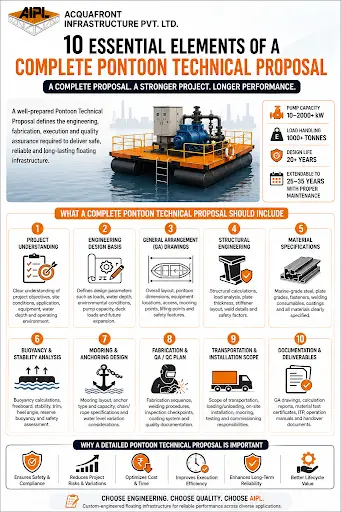
Choosing a proposal based only on commercial pricing can increase project risks later. In contrast, a technically detailed proposal provides confidence that engineering, fabrication, testing, and execution have all been properly planned.
Key long-term advantages include:
For critical floating infrastructure projects, engineering documentation is just as valuable as the fabricated structure itself.
A Pontoon Technical Proposal is a detailed engineering document outlining the design, fabrication, materials, testing, installation, and execution scope for a floating infrastructure project.
It helps buyers understand engineering quality, project scope, lifecycle performance, and execution responsibilities before procurement.
It should include engineering drawings, structural calculations, buoyancy analysis, material specifications, fabrication standards, QA/QC procedures, transportation, installation, and commissioning details.
Experienced floating infrastructure manufacturers with in-house engineering teams prepare detailed technical proposals.
Yes. AIPL prepares project-specific proposals based on site conditions, equipment loads, water depth, and operational requirements.
Yes. A complete proposal should include structural load calculations, buoyancy analysis, stability assessment, and design validation.
Marine-grade fabrication practices, welding procedures, coating specifications, quality inspections, and compliance requirements should all be included.
Yes. A professional proposal clearly defines transportation, unloading, installation, testing, and commissioning responsibilities.
AIPL engineers floating infrastructure with a standard design life of 20+ years, extendable to 25–35 years with proper maintenance.
AIPL has execution capability for floating infrastructure supporting 1000+ tonnes, depending on project requirements.
AIPL designs Floating Pump Pontoons supporting 10–2000+ kW pump capacities.
Yes. AIPL develops IRS-compliant floating infrastructure wherever project requirements demand it.
Yes. Every floating structure is engineered according to project requirements, environmental conditions, equipment loads, and future expansion needs.
Yes. AIPL has completed projects across reservoirs, dams, ports, industrial facilities, and waterfront developments throughout India.
A detailed proposal reveals engineering quality, project scope, and lifecycle value, helping buyers avoid hidden costs and achieve better long-term performance.
A Pontoon Technical Proposal is much more than a supporting document—it is the engineering foundation of a successful floating infrastructure project. It provides technical clarity, defines responsibilities, and helps buyers evaluate proposals on engineering merit rather than price alone.
From structural calculations and buoyancy analysis to fabrication standards, quality inspections, and commissioning, every section contributes to long-term reliability and project success. Reviewing these details before procurement reduces risks and improves execution efficiency.
By combining IIT-driven engineering, marine-grade fabrication, IRS-compliant floating infrastructure, and Turnkey SITC execution, AIPL develops customised floating infrastructure that delivers dependable performance across diverse marine and industrial applications.
Consult experienced engineers to design customized floating infrastructure tailored to your operational requirements.
📞 +91 7678232371
📩 Admin@acquainfra.com
Mr. Achin Agrawal
Director & CTO
Acquafront Infrastructure Private Limited
Mr. Achin Agrawal leads the engineering and technology initiatives at Acquafront Infrastructure Pvt. Ltd. (AIPL), specialising in modular floating infrastructure, marine engineering, lifting barges, construction pontoons, floating work platforms, and heavy-duty marine systems. With extensive experience in designing and executing complex floating infrastructure projects, he has contributed to solutions deployed across reservoirs, dams, ports, industrial waterfronts, and inland waterways throughout India. Under his technical leadership, AIPL continues to deliver IIT-driven engineering, IRS-compliant fabrication, and Turnkey SITC solutions that meet the evolving needs of India's marine infrastructure sector.

