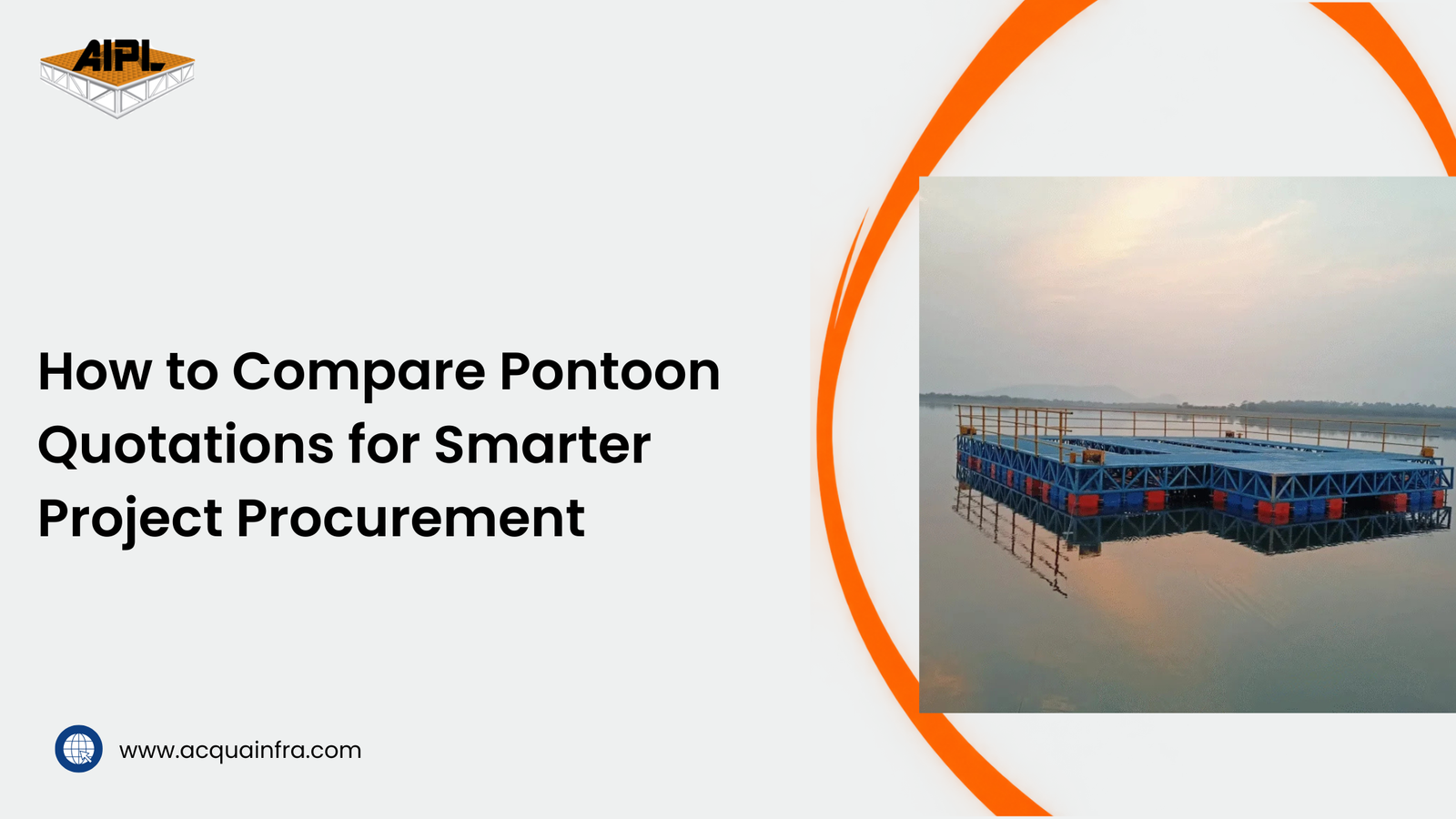
Across industrial water infrastructure, mining, construction and marine projects, comparing pontoon quotations is rarely as simple as selecting the lowest price. Two vendors may quote for apparently similar floating structures while offering very different engineering scope, materials, load ratings and installation support.
For buyers, Pump Quotations need to be evaluated against the same technical baseline. A quotation that looks cheaper initially may exclude structural calculations, mooring, transportation, commissioning or critical accessories.
A proper like-for-like comparison therefore starts with engineering, not price. The objective is to determine what each vendor is actually supplying, how it will perform at the project site and what the complete lifecycle cost is likely to be.
A pontoon quotation represents much more than steel fabrication. It can include engineering, buoyancy calculations, structural design, pumping equipment integration, mooring, electrical works, transportation, installation and commissioning.
The difficulty is that vendors often describe these items differently.
One quotation may include:
Another may quote only the fabricated pontoon.
Both may appear similar in a commercial comparison, but they are not equivalent offers.
Before comparing prices, convert every quotation into a common technical format.
Ask each vendor to clearly state:
This creates a genuine like-for-like comparison.
A technical scorecard should be prepared before opening the commercial comparison.
| Parameter | Vendor A | Vendor B | Vendor C |
| Pontoon size | To be confirmed | To be confirmed | To be confirmed |
| Design load | ___ tonnes | ___ tonnes | ___ tonnes |
| Equipment load | ___ tonnes | ___ tonnes | ___ tonnes |
| Pump capacity | ___ kW | ___ kW | ___ kW |
| Steel grade | ___ | ___ | ___ |
| Structural calculations | Included/Excluded | Included/Excluded | Included/Excluded |
| Buoyancy calculations | Included/Excluded | Included/Excluded | Included/Excluded |
| Stability analysis | Included/Excluded | Included/Excluded | Included/Excluded |
| Mooring arrangement | Included/Excluded | Included/Excluded | Included/Excluded |
| Corrosion protection | ___ | ___ | ___ |
| Transportation | Included/Excluded | Included/Excluded | Included/Excluded |
| Installation | Included/Excluded | Included/Excluded | Included/Excluded |
| Commissioning | Included/Excluded | Included/Excluded | Included/Excluded |
| Warranty | ___ | ___ | ___ |
This table immediately exposes scope differences that are often hidden inside commercial offers.
A 12 m × 6 m pontoon from one vendor does not necessarily have the same performance as another pontoon with identical dimensions.
The engineering depends on:
For example, a Floating Pump Pontoon carrying heavy pumps requires local deck reinforcement around equipment foundations.
The structural design must account for both the overall floating structure and concentrated equipment loads.
Ask the vendor to distinguish between:
A quotation should not simply state "heavy-duty" without defining the engineering basis.
AIPL's modular barge range, for example, is designed for heavy-load applications and can be configured for water pumping, construction and other marine applications. (Acqua Infra)
When comparing Pump Quotations for a Floating Pump Pontoon, the pump itself and the floating structure should be evaluated as interconnected components.
Important parameters include:
AIPL's enquiry requirements demonstrate why these parameters matter: the company's project enquiry process captures pump type, number of pumps, power rating, pump dimensions and weight, water flow rate and suction/delivery pipe sizes. (Acqua Infra)
For large installations, pump capacities can range from 10 kW to 2000+ kW, depending on project requirements.
The quotation should therefore identify whether the price covers only the pontoon or the complete pump-pontoon package.
Buoyancy is one of the most important engineering checks in a floating structure.
The vendor should demonstrate that the displaced water volume provides sufficient buoyant capacity for:
However, buoyancy alone is not enough.
A pontoon can have adequate displacement while still having poor stability because of improper equipment positioning or a high centre of gravity.
Ask the vendor:
These questions help distinguish engineering-led quotations from fabrication-only offers.
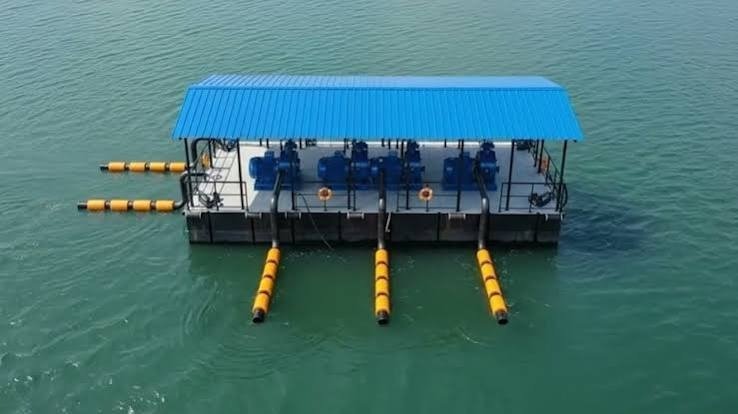
Price differences frequently originate in fabrication specifications.
Do not accept "MS structure" as a sufficient description.
Ask for:
The quotation should also clarify whether the fabrication is performed in-house or subcontracted.
AIPL states that its floating infrastructure is manufactured in-house and that its engineering approach includes collaboration with IIT Kanpur and IIT (BHU) Varanasi. (Acqua Infra)
Corrosion protection can have a major impact on long-term Pontoon Maintenance Costs.
Two quotations can have identical structural dimensions but very different expected maintenance requirements.
Check:
For floating infrastructure operating continuously in water, corrosion protection should be treated as an engineering specification rather than a cosmetic finish.
A standard product life can be 20+ years, with potential extension to 25–35 years through appropriate maintenance and operating practices.
Mooring is another area where apparently similar quotations can differ substantially.
The quotation should identify:
A Floating Pump Pontoon installed in a reservoir may require a different anchoring arrangement from a pontoon operating in a river with stronger current.
Therefore, never compare a generic mooring allowance against a project-specific engineered mooring arrangement.
The cheapest fabrication quotation may become expensive once logistics are added.
Review whether the vendor includes:
For modular barges, transportation can be an important advantage because container-sized or sectional units can be moved to difficult project locations and assembled near the water body. AIPL's modular barge range is specifically described for transport to remote areas and assembly according to project requirements. (Acqua Infra)
A technically mature quotation should identify the documentation that will be delivered.
A buyer may request:
Where certification or third-party inspection is required, the quotation should explicitly identify the applicable scope.
This is particularly important for government projects, EPC contracts and installations carrying high-value equipment.
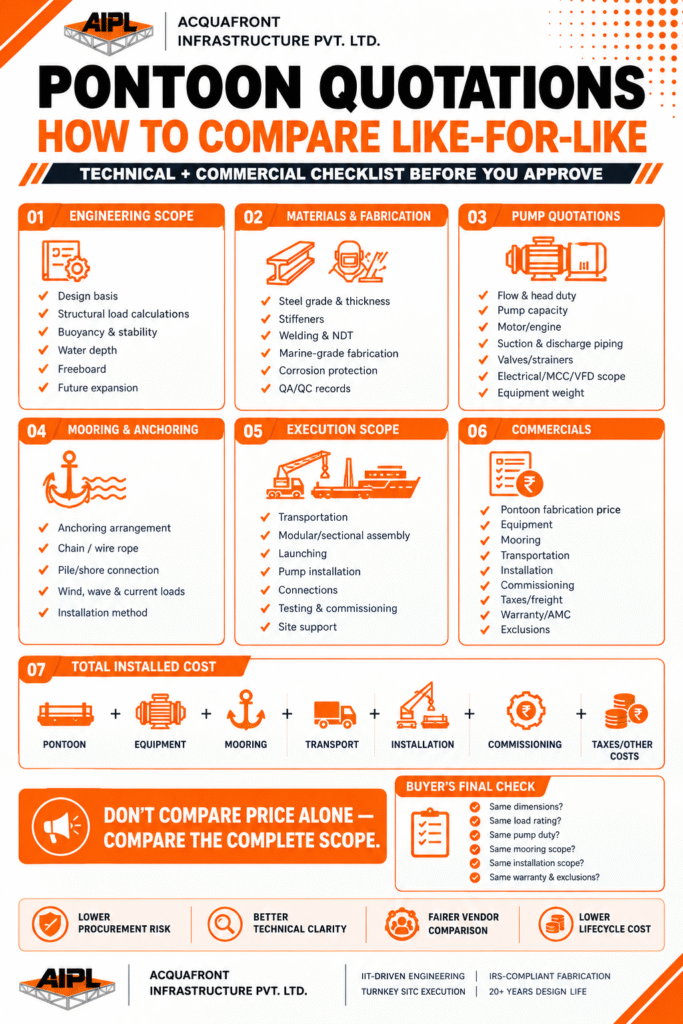
A proper commercial comparison should move beyond the quoted fabrication price.
Use this structure:
Total Installed Cost =
Pontoon + Equipment + Accessories + Mooring + Transportation + Installation + Commissioning + Testing + Taxes + Other Site Costs
Then compare the lifecycle implications.
| Cost Component | Quotation A | Quotation B | Quotation C |
| Pontoon fabrication | ₹___ | ₹___ | ₹___ |
| Pump/equipment | ₹___ | ₹___ | ₹___ |
| Mooring | ₹___ | ₹___ | ₹___ |
| Transportation | ₹___ | ₹___ | ₹___ |
| Installation | ₹___ | ₹___ | ₹___ |
| Commissioning | ₹___ | ₹___ | ₹___ |
| Testing/documentation | ₹___ | ₹___ | ₹___ |
| Warranty/AMC | ₹___ | ₹___ | ₹___ |
| Total evaluated cost | ₹___ | ₹___ | ₹___ |
This prevents an incomplete quotation from appearing artificially cheaper.
For major projects, procurement teams can assign technical and commercial weights.
| Evaluation Category | Suggested Weight |
| Technical compliance | 25% |
| Structural engineering | 15% |
| Materials and fabrication | 10% |
| Mooring and stability | 10% |
| Testing and documentation | 10% |
| Installation capability | 10% |
| Commercial value | 15% |
| Warranty and after-sales support | 5% |
| Total | 100% |
The weighting should be adjusted according to project risk.
For a critical water-supply installation, technical compliance and reliability may deserve substantially more weight than a small temporary marine work platform.
Buyers should investigate quotations that contain:
A low price is not automatically a problem.
However, an unexplained low price deserves technical clarification before commercial approval.
A final engineering review should confirm that the floating infrastructure has been designed around actual site conditions.
Equipment loads should be transferred through properly designed foundations and deck reinforcement.
For heavy-duty applications, concentrated loads must not be treated as simple uniformly distributed loads.
The loaded displacement should provide adequate reserve buoyancy while maintaining acceptable draft and freeboard.
Equipment location, centre of gravity and operational loading should be considered together.
The mooring arrangement should reflect current, wind, waves, water depth and expected water-level variation.
Watertight compartments, controlled welding, inspection and appropriate corrosion protection are essential for long-term service.
The design should account for how the pontoon will reach the site, be assembled, launched and commissioned.
AIPL approaches pontoon procurement from an engineering and application perspective rather than treating every project as a standard fabrication order.
Its capabilities cover modular barges, pump pontoons, floating jetties, construction pontoons and other floating infrastructure for water, construction, energy, transportation and tourism applications. (Acqua Infra)
The approach combines IIT-driven engineering, marine-grade manufacturing, custom fabrication and project-specific design.
For suitable projects, the scope can extend through turnkey SITC execution, helping the buyer maintain clearer responsibility from engineering through installation and commissioning.
AIPL's published project portfolio includes floating pump pontoons at Hirakud Reservoir, water-supply applications at Beohari, mining dewatering applications and floating CNG infrastructure in Varanasi. (Acqua Infra)
For heavy-duty applications, AIPL also has an execution capability for loads exceeding 1000 tonnes, subject to project-specific engineering.
Pump Quotations are commercial offers covering pumping equipment and/or a pump-pontoon package. Buyers should verify exactly what engineering, fabrication and installation scope is included.
Compare them against identical technical requirements for dimensions, loads, pump capacity, materials, mooring, transportation, installation, testing and warranty.
No. The lowest initial price may exclude important engineering or installation items. Compare total installed cost and lifecycle value.
Request drawings, structural calculations, buoyancy and stability calculations, material certificates, welding records, coating information and testing documentation.
Pump weight affects deck reinforcement, buoyancy, draft, stability and equipment foundation design. It should therefore be clearly stated.
Yes. A vendor can provide an integrated quotation, but the buyer should clearly separate pump, pontoon, piping, electrical, mooring and installation costs.
AIPL provides engineered pump pontoons and modular floating infrastructure for water pumping, dewatering and other applications across India. (Acqua Infra)
Yes. Vendors can prepare project-specific quotations for Gujarat based on water depth, equipment loads, environmental conditions and required pumping capacity.
Yes. AIPL has executed floating infrastructure applications across multiple Indian states, including Uttar Pradesh, Madhya Pradesh and Odisha. (Acqua Infra)
Yes. Floating infrastructure should be custom engineered according to project requirements, water depth, equipment loads, environmental conditions and future expansion.
Compare fabrication, equipment, mooring, transportation, installation, commissioning, testing, taxes, warranty and other exclusions.
Mooring is site-specific. Water depth, current, wind, waves and water-level variation can significantly affect the required anchoring arrangement and cost.
A standard engineered pontoon can have a service life of 20+ years, with potential extension to 25–35 years through proper maintenance.
Yes. AIPL has heavy-duty fabrication and project execution capability, including applications involving loads above 1000 tonnes, subject to engineering assessment.
Yes. Depending on project scope, AIPL can support engineering, fabrication, supply, installation, testing and commissioning through a turnkey SITC approach.
A reliable quotation comparison begins by standardising the technical scope. Dimensions and price alone cannot establish whether two pontoons are genuinely equivalent.
For procurement teams, the better approach is to compare engineering, materials, load capacity, stability, mooring, corrosion protection, documentation and complete installation scope before evaluating the final commercial number.
A technically transparent Pump Quotation gives the buyer a clearer view of risk, lifecycle cost and long-term operational reliability. This approach is particularly valuable for critical water-supply, mining, industrial and infrastructure projects.
Consult experienced engineers to design customized floating infrastructure tailored to your operational requirements.
📞 +91 7678232371
📩 Admin@acquainfra.com
Mr. Achin Agrawal
Director & CTO
Acquafront Infrastructure Private Limited
Mr. Achin Agrawal leads the engineering and technology initiatives at Acquafront Infrastructure Pvt. Ltd. (AIPL), specialising in modular floating infrastructure, marine engineering, lifting barges, construction pontoons, floating work platforms, and heavy-duty marine systems.
With extensive experience in designing and executing complex floating infrastructure projects, he has contributed to solutions deployed across reservoirs, dams, ports, industrial waterfronts, and inland waterways throughout India.
Under his technical leadership, AIPL continues to deliver IIT-driven engineering, IRS-compliant fabrication, and turnkey SITC solutions that meet the evolving needs of India's marine infrastructure sector.

