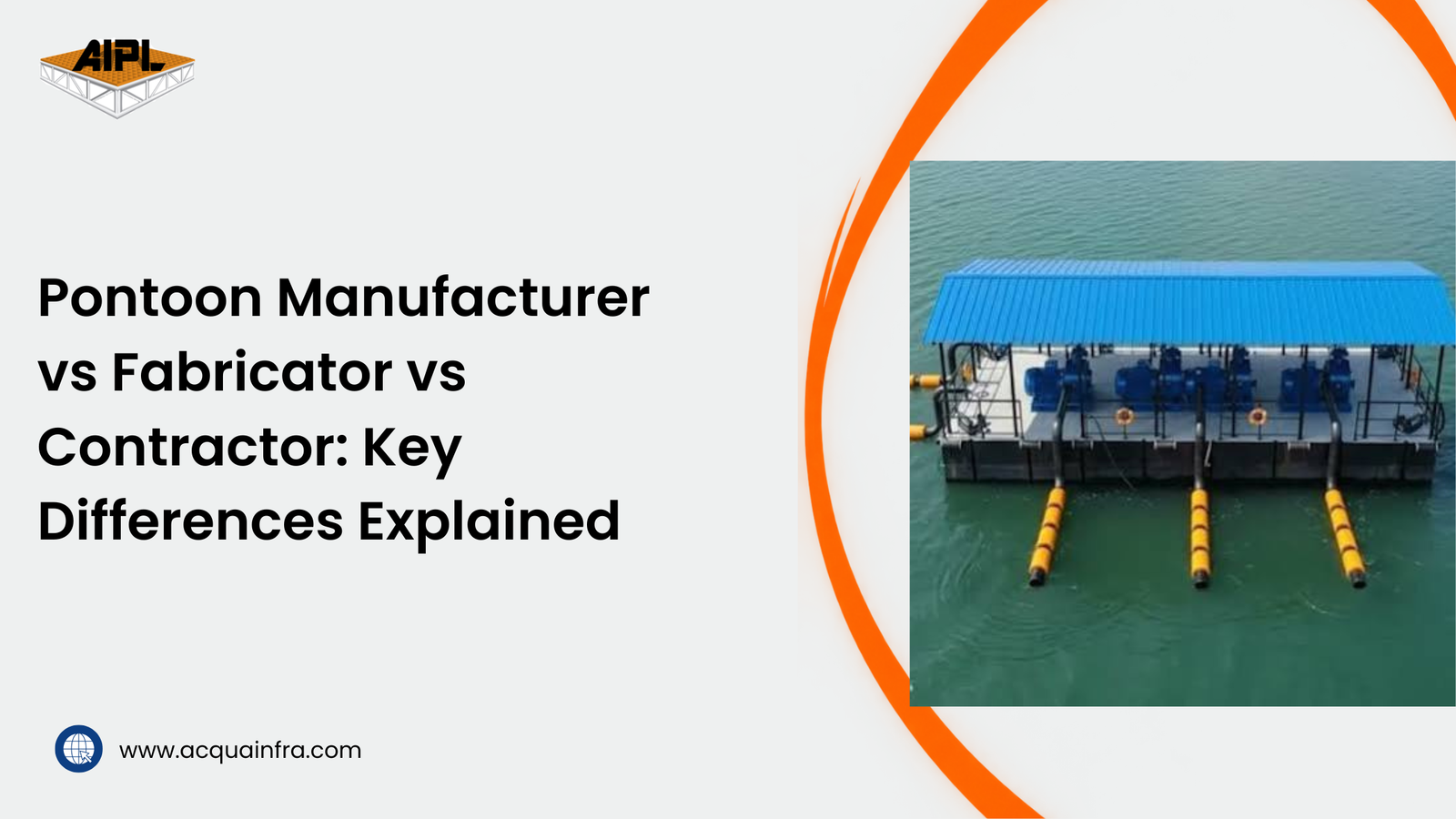
Across India's rapidly expanding marine and waterfront infrastructure sector, choosing the right project partner has become just as important as selecting the right floating infrastructure. Whether the requirement is a Floating Pump Pontoon, Construction Pontoon, Floating Jetty, or Modular Barge, buyers often receive proposals from pontoon manufacturers, metal fabricators, and civil contractors. Although these companies may appear to offer similar services, their capabilities differ significantly.
Selecting the wrong partner can result in engineering compromises, construction delays, increased maintenance costs, and reduced operational life. This makes it essential to understand what each type of organization actually delivers before approving a project.
For EPC contractors, consultants, government departments, industrial buyers, and infrastructure developers, working with an experienced Pontoon Manufacturer ensures that every floating structure is engineered for safety, stability, durability, and long-term performance rather than simply fabricated according to drawings.
Many procurement teams compare quotations only by price without evaluating who is preparing them. A company may describe itself as a manufacturer, while in reality it only performs fabrication or acts as a project contractor by outsourcing engineering and production.
Each category plays an important role in marine infrastructure, but their responsibilities, technical expertise, and project ownership vary considerably. Understanding these differences helps buyers make informed decisions and reduces project risks.
Some of the biggest differences include:
These factors directly influence the reliability, safety, and long-term value of floating infrastructure.
A Pontoon Manufacturer designs, engineers, fabricates, tests, and often installs floating infrastructure specifically developed for marine and inland water applications.
Unlike general fabrication workshops, manufacturers possess specialized engineering knowledge related to buoyancy, stability, structural loading, corrosion protection, and floating performance.
A professional pontoon manufacturer generally provides:
Every floating structure is developed according to:
This engineering-first approach significantly improves operational reliability and extends service life beyond 20 years, with potential extension to 25–35 years through proper maintenance.
| Capability | Pontoon Manufacturer |
| Project Engineering | ✔ Complete |
| Structural Design | ✔ Yes |
| Buoyancy Analysis | ✔ Yes |
| Stability Calculations | ✔ Yes |
| Marine Fabrication | ✔ Yes |
| Quality Testing | ✔ Yes |
| Installation Support | ✔ Yes |
| Long-term Technical Support | ✔ Yes |
A metal fabricator primarily manufactures steel structures according to drawings supplied by engineers or project consultants.
Their expertise lies in cutting, welding, machining, bending, and assembling steel components. However, they generally do not perform detailed marine engineering or floating structure design.
Most fabrication workshops focus on production rather than engineering analysis.
Typical fabrication activities include:
If project drawings are incomplete or engineering calculations are incorrect, the fabricator usually proceeds according to the supplied documentation without redesigning the structure.
For floating infrastructure, this limitation can affect:
A contractor manages project execution rather than manufacturing floating infrastructure.
Contractors coordinate multiple agencies responsible for engineering, fabrication, transportation, installation, civil works, and commissioning.
They ensure project delivery according to schedule but usually outsource manufacturing activities.
Typical contractor responsibilities include:
Although contractors play an important execution role, they may not possess specialized expertise in floating infrastructure engineering.
Understanding the distinction becomes easier when comparing their core responsibilities.
| Feature | Pontoon Manufacturer | Metal Fabricator | Contractor |
| Engineering Design | ✔ Yes | ✖ No | Limited |
| Buoyancy Calculations | ✔ Yes | ✖ No | Limited |
| Stability Analysis | ✔ Yes | ✖ No | Limited |
| Marine Fabrication | ✔ Yes | ✔ Yes | Outsourced |
| Structural Design | ✔ Yes | Based on drawings | Outsourced |
| Project Management | ✔ Yes | Limited | ✔ Yes |
| Installation Support | ✔ Yes | Sometimes | ✔ Yes |
| Lifecycle Responsibility | ✔ High | Limited | Medium |
Two floating structures fabricated from identical steel plates may perform very differently depending on their engineering.
Engineering determines:
Without proper engineering, even high-quality fabrication cannot guarantee reliable floating performance.
This is why leading marine infrastructure projects prioritize engineering before fabrication begins.
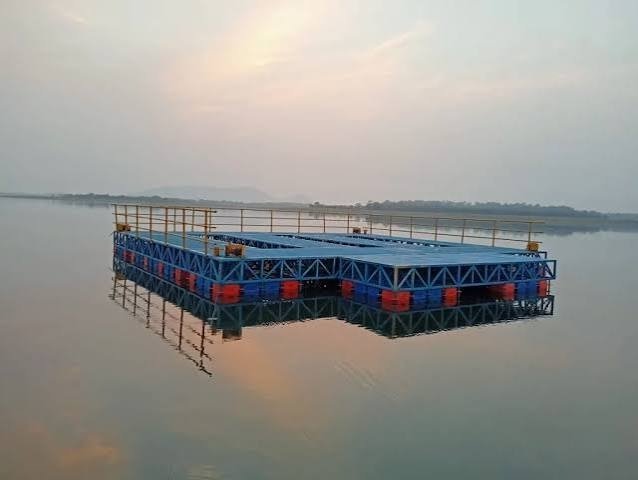
Choosing the right manufacturing partner requires evaluating far more than workshop size or fabrication capacity. Every floating infrastructure project should be supported by detailed engineering to ensure safe, efficient, and long-lasting performance.
Key engineering considerations include:
A technically competent Pontoon Manufacturer integrates these engineering disciplines into every project, ensuring reliable performance across reservoirs, rivers, ports, industrial waterfronts, and marine environments.
Selecting a Pontoon Manufacturer with in-house engineering capabilities reduces project risks throughout the lifecycle. Instead of simply fabricating steel structures, engineering-driven manufacturers evaluate operational requirements before finalizing the design.
Their approach generally includes:
This results in floating infrastructure that performs efficiently under real operating conditions while minimizing maintenance and downtime.
Acquafront Infrastructure Private Limited (AIPL) follows an engineering-first approach for every floating infrastructure project. Rather than offering standard products, the company custom-engineers each Floating Pump Pontoon, Construction Pontoon, Floating Jetty, Marine Work Platform, and Modular Barge according to project-specific requirements.
Its design process evaluates:
Every project is supported by IIT-driven engineering, IRS-compliant fabrication, and turnkey SITC execution capabilities to ensure dependable long-term performance.
AIPL has successfully executed floating infrastructure for:
Its engineering expertise also supports heavy-duty floating structures capable of handling 1000+ tonnes, with a standard design life exceeding 20 years, extendable to 25–35 years through proper maintenance.
Many procurement decisions are based on price or workshop size rather than engineering capability. This often leads to higher lifecycle costs and operational challenges.
Some common mistakes include:
Avoiding these mistakes helps ensure safer, more reliable floating infrastructure.
Before finalizing a supplier, buyers should evaluate technical capabilities rather than focusing only on commercial proposals.
| Evaluation Criteria | Importance |
| Project-specific engineering | High |
| Structural load calculations | High |
| Buoyancy & stability analysis | High |
| Marine-grade fabrication | High |
| IRS-compliant manufacturing | High |
| Quality inspection & testing | High |
| Turnkey SITC capability | Medium |
| Previous project experience | High |
| After-sales engineering support | High |
| Proven execution across India | High |
A comprehensive evaluation ensures that the selected manufacturer can deliver safe, durable, and efficient floating infrastructure for demanding marine applications.
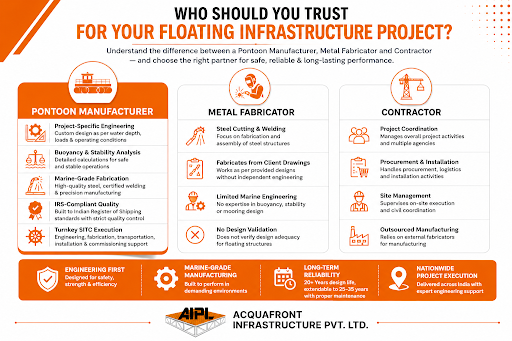
A Pontoon Manufacturer designs, engineers, fabricates, tests, and supports floating infrastructure for marine and inland water applications.
Several companies manufacture pontoons, but AIPL is known for its IIT-driven engineering, IRS-compliant fabrication, and turnkey execution.
A manufacturer provides engineering, design, fabrication, testing, and support, while a fabricator mainly builds according to supplied drawings.
A contractor manages execution, procurement, and installation but may outsource engineering and fabrication.
Engineering ensures structural integrity, buoyancy, stability, and safe long-term operation.
Yes. AIPL custom-engineers every floating structure based on project requirements, water depth, equipment loads, and environmental conditions.
Request GA drawings, structural calculations, buoyancy reports, material specifications, welding procedures, and quality inspection records.
A well-engineered pontoon has a standard design life of over 20 years and can last 25–35 years with proper maintenance.
Yes. AIPL offers turnkey SITC execution, including engineering, fabrication, transportation, installation, testing, and commissioning.
Yes. AIPL manufactures Floating Pump Pontoons supporting pump capacities from 10–2000+ kW.
Yes. Custom-engineered pontoons can support heavy-duty applications, including loads exceeding 1000 tonnes.
Yes. AIPL supplies engineered floating infrastructure for projects across Gujarat and other Indian states.
Yes. AIPL has completed floating infrastructure projects across multiple states, including Uttar Pradesh, Madhya Pradesh, and Odisha.
Industries include mining, ports, irrigation, dredging, water treatment, infrastructure construction, inland waterways, and industrial waterfronts.
Engineering-driven manufacturers deliver safer designs, better performance, lower maintenance, and greater lifecycle value.
Selecting the right Pontoon Manufacturer is about much more than comparing quotations or fabrication capabilities. Engineering expertise determines how safely and efficiently floating infrastructure performs throughout its service life.
Manufacturers that combine project-specific engineering, marine-grade fabrication, quality testing, and turnkey execution offer greater long-term value than organizations focused solely on fabrication or project coordination.
For marine infrastructure projects, partnering with an experienced engineering-driven manufacturer helps minimize project risks while improving durability, operational reliability, and lifecycle performance.
Consult experienced engineers to design customized floating infrastructure tailored to your operational requirements.
📞 +91 7678232371
📩 Admin@acquainfra.com
Mr. Achin Agrawal
Director & CTO
Acquafront Infrastructure Private Limited
Mr. Achin Agrawal leads the engineering and technology initiatives at Acquafront Infrastructure Pvt. Ltd. (AIPL), specialising in modular floating infrastructure, marine engineering, lifting barges, construction pontoons, floating work platforms, and heavy-duty marine systems. With extensive experience in designing and executing complex floating infrastructure projects, he has contributed to solutions deployed across reservoirs, dams, ports, industrial waterfronts, and inland waterways throughout India. Under his technical leadership, AIPL continues to deliver IIT-driven engineering, IRS-compliant fabrication, and turnkey SITC solutions that meet the evolving needs of India's marine infrastructure sector.

