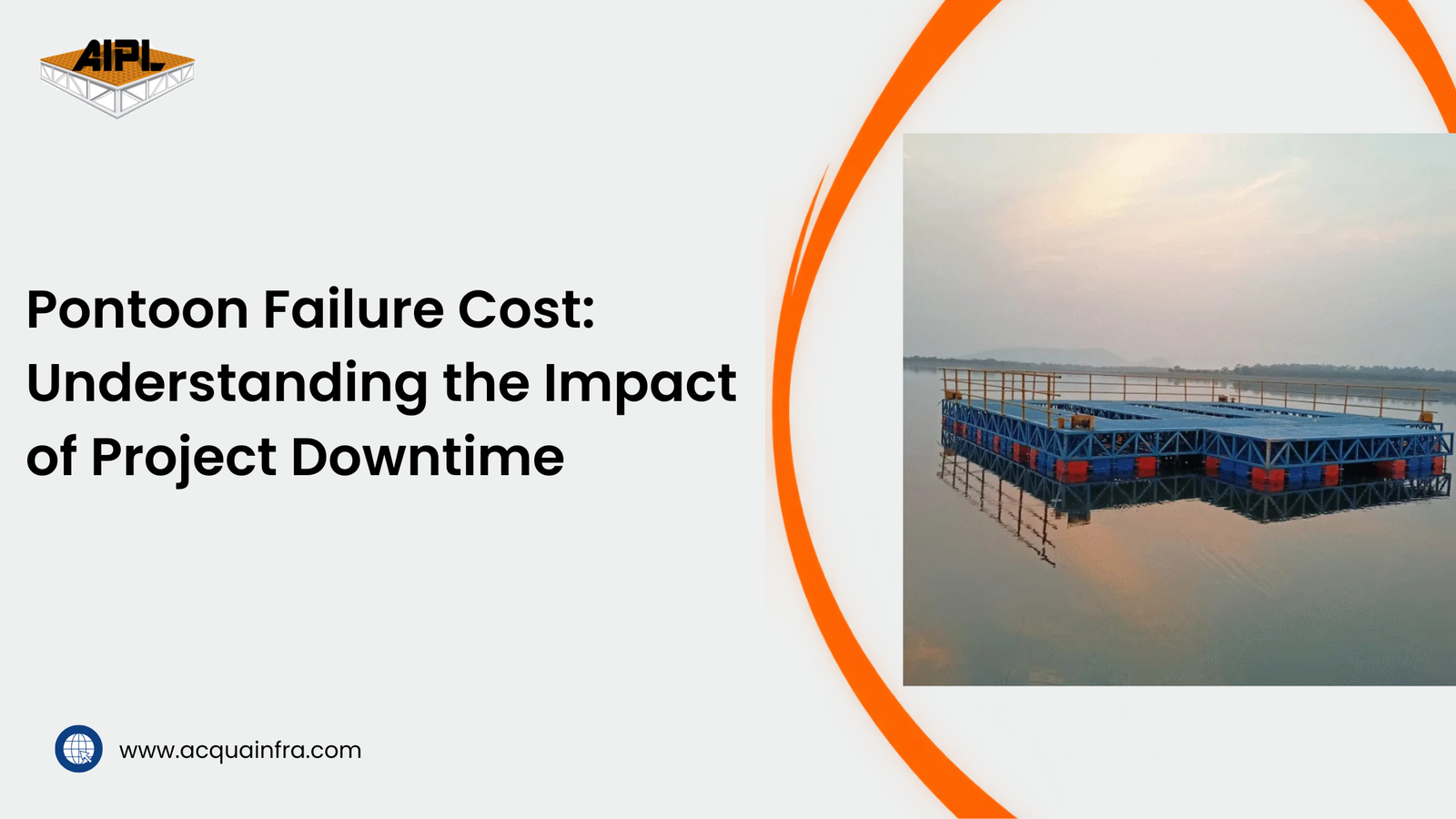
Across industrial and infrastructure projects, the purchase price of a pontoon is only one part of the financial equation. A structural failure, equipment shutdown, uncontrolled movement, or extended repair period can create costs far beyond the original fabrication budget.
For EPC contractors, government agencies and industrial operators, understanding Pontoon Failure Cost means looking at the complete impact: emergency repairs, lost operating hours, equipment damage, mobilisation delays and project schedule disruption.
A properly engineered Floating Pump Pontoon, construction pontoon, modular barge or marine work platform therefore has to be evaluated on lifecycle reliability rather than purchase price alone.
A pontoon rarely operates in isolation. It may carry pumps, cranes, generators, pipelines, lifting equipment, passenger infrastructure or other heavy machinery.
Consequently, a failure can affect several connected activities simultaneously.
The immediate financial impact can include:
These costs are generally easier to identify because they appear directly in project expenditure.
The more significant impact can come from operational downtime.
For example, if a Floating Pump Pontoon supports a critical water intake, its failure may interrupt pumping operations. Similarly, failure of a construction pontoon can stop piling, dredging or marine construction activities.
The resulting costs may include:
Therefore, Pontoon Failure Cost should be assessed as a combination of direct repair expenses and the economic value of lost operating time.
There is no single fixed failure cost because every marine project has different operating conditions.
The financial impact depends on several engineering and commercial factors.
| Factor | Potential Impact |
| Pontoon structural damage | Repair or replacement expenditure |
| Pump failure | Loss of water intake capacity |
| Mooring failure | Platform movement or recovery requirements |
| Corrosion | Reduced structural life and maintenance |
| Overloading | Structural deformation or component failure |
| Poor stability | Equipment and personnel safety risks |
| Difficult site access | Higher repair mobilisation cost |
| Project criticality | Greater financial impact from downtime |
| Long repair duration | Extended labour and equipment costs |
| Seasonal restrictions | Delayed recovery or redeployment |
A pontoon supporting a non-critical temporary operation may have a relatively limited downtime impact. In contrast, a floating pumping station serving a critical water supply project can have significantly higher consequences.
Downtime should not be calculated simply as the number of hours that a pontoon remains out of service.
The actual financial impact can involve several cost layers.
If a pontoon supports pumping equipment, the first question is how much operational capacity is lost.
For example, AIPL's pump pontoon applications can support pump installations ranging from 10 kW to 2000+ kW, depending on project requirements. (Acquafront Infrastructure)
The larger the supported operation, the greater the potential consequence of an unexpected shutdown.
A failed pontoon can leave pumps, excavators, cranes, operators and other project resources unavailable.
Even when those assets are technically undamaged, their operating cost continues to affect the project if they remain idle.
Marine repairs are rarely as simple as transporting a spare component to a conventional construction site.
Depending on the location, the project may require:
Remote reservoirs, rivers and industrial water bodies can make emergency mobilisation particularly expensive.
A pontoon failure can affect activities that depend on the floating infrastructure.
A delay in one marine operation can therefore move subsequent activities further along the project schedule.
For EPC contractors, this can create additional project-management and contractual exposure.
Understanding failure mechanisms is essential for reducing Pontoon Failure Cost.
Pontoon structures must be designed around actual operating loads rather than nominal equipment weights.
Important considerations include:
Overlooking load concentration can produce excessive local stresses even when the overall equipment weight appears acceptable.
A floating platform must maintain sufficient reserve buoyancy under its intended loading condition.
Insufficient buoyancy can result in:
The required buoyancy must therefore be evaluated during project-specific engineering.
Stability becomes particularly important when heavy equipment is mounted above the deck.
Engineers need to consider:
A structurally strong pontoon can still be unsuitable if its stability characteristics are inadequate for the intended application.
A floating structure must remain within its designated operating envelope.
Mooring and anchoring arrangements should account for:
Failure in this area can result in uncontrolled movement, pipeline stress, equipment misalignment or collision with nearby structures.
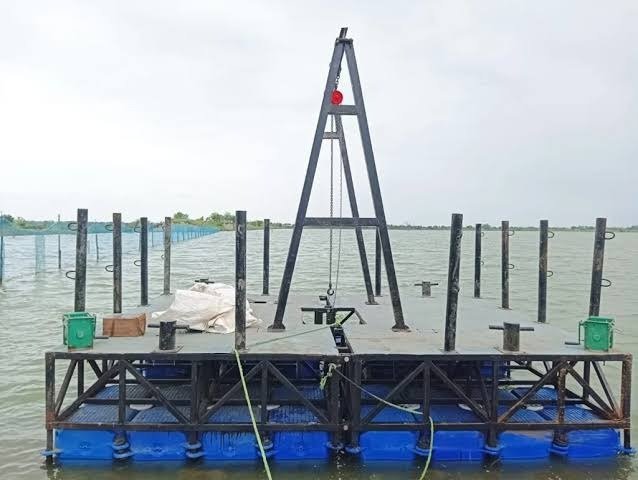
Reducing Pontoon Failure Cost begins before fabrication.
A reliable floating structure requires engineering that connects structural design, hydrostatics, fabrication and site deployment.
The engineering process should establish the complete design loading condition.
This can include:
For heavy-duty applications, load calculations should be verified before fabrication begins.
The pontoon geometry should be evaluated against its expected loading conditions.
Engineering checks should consider:
These calculations become particularly important for floating pump stations carrying large pumps, motors and associated equipment.
Fabrication quality directly affects long-term reliability.
Important areas include:
AIPL's modular barges, for example, are manufactured from IS 2062 E250 Br Grade Steel for its pump pontoon applications, with project-specific engineering and certification considerations. (Acquafront Infrastructure)
Pontoon structures operate in environments where moisture and water exposure are continuous.
The corrosion-protection strategy should consider:
A well-maintained floating structure can achieve a standard service life of 20+ years, with potential extension to 25–35 years depending on design, operating conditions and maintenance.
The difference between planned maintenance and emergency repair is not simply the repair invoice.
| Maintenance Approach | Planned Maintenance | Failure-Driven Repair |
| Inspection | Scheduled | Usually emergency |
| Repair planning | Controlled | Reactive |
| Spare parts | Can be prepared | May require urgent sourcing |
| Labour | Planned | Emergency mobilisation |
| Downtime | Usually limited | Potentially extensive |
| Project scheduling | Predictable | Disruptive |
| Safety management | Planned | Higher operational pressure |
| Overall cost exposure | More controllable | Potentially much higher |
This is why lifecycle cost should be considered when selecting a pontoon manufacturer.
The cheapest initial quotation may not represent the lowest total project cost if structural reliability, maintenance access and service life are inadequate.
Before awarding a pontoon project, buyers should assess more than fabrication price.
The commercial evaluation should also include:
This provides a more realistic comparison between competing quotations.
There is no universal pontoon configuration suitable for every water body.
A floating structure operating in a reservoir may experience different conditions from one deployed in a river, port, coastal area or industrial water body.
AIPL therefore approaches floating infrastructure according to:
This project-specific approach is particularly relevant when designing Floating Pump Pontoons, floating intake platforms, construction pontoons and modular barges.
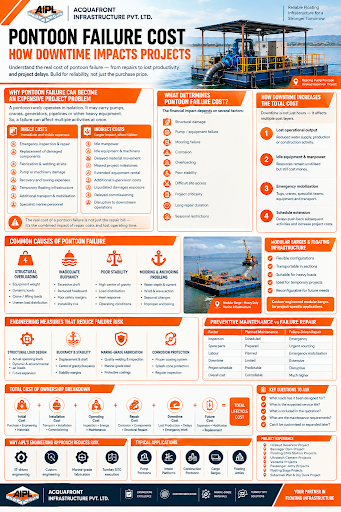
Acquafront Infrastructure Private Limited approaches floating infrastructure through project-specific engineering rather than a one-size-fits-all fabrication model.
Its engineering capabilities include design, survey, manufacturing, supply, installation, commissioning and maintenance of floating infrastructure. (Acquafront Infrastructure)
AIPL's engineering approach includes collaboration with IIT Kanpur and IIT (BHU) Varanasi, supporting structural and product-development capabilities for complex floating infrastructure. (Acquafront Infrastructure)
For projects where applicable, AIPL incorporates IRS-compliant fabrication practices, together with engineering calculations, controlled manufacturing and project-specific quality requirements.
AIPL can support projects through Supply, Installation, Testing and Commissioning (SITC), reducing the coordination burden between separate engineering, fabrication and site contractors.
AIPL's floating infrastructure portfolio covers applications ranging from pump pontoons and modular barges to passenger jetties, floating CNG infrastructure and specialised marine platforms.
Its modular barge range is designed for applications including water pumping, construction, dredging, tourism and energy infrastructure. (Acquafront Infrastructure)
Relevant AIPL execution and project experience includes:
AIPL's project portfolio also includes the floating CNG station at Varanasi and modular floating pump pontoons for water infrastructure. (Acquafront Infrastructure)
A buyer should evaluate a pontoon using its complete lifecycle rather than its initial purchase price.
A simplified assessment can consider:
Total Lifecycle Cost = Initial Cost + Installation + Maintenance + Repairs + Downtime + Replacement/Modification Costs
However, the actual calculation should be project-specific.
For a critical water-intake project, for example, even a short operational interruption can have greater financial significance than a relatively small difference in initial fabrication cost.
A properly engineered and maintained pontoon can have a standard design life of 20+ years.
With appropriate inspection, corrosion management, structural maintenance and operating practices, service life can potentially extend to 25–35 years.
Actual service life depends on:
Therefore, buyers should evaluate both initial fabrication quality and long-term maintainability.
Pontoon Failure Cost is the total financial impact caused by pontoon failure, including repairs, equipment damage, emergency mobilisation, operational downtime and project delays.
Common causes include overloading, inadequate stability, poor buoyancy, corrosion, structural defects, unsuitable mooring arrangements and insufficient maintenance.
A failed pontoon can stop pumping, construction, dredging, transportation or other marine activities, resulting in idle equipment, manpower and extended project schedules.
Yes. Project-specific engineering, correct load calculations, quality fabrication, corrosion protection, preventive inspection and proper maintenance can reduce failure risk and downtime exposure.
AIPL provides project-specific floating infrastructure engineering for applications including pump pontoons, modular barges, construction pontoons and marine work platforms across India.
A properly engineered pontoon can have a standard service life of 20+ years, with potential extension to 25–35 years through suitable maintenance and operating practices.
Yes. A pontoon can be engineered for heavy equipment based on structural loads, buoyancy, stability and operating conditions. AIPL has execution capability for heavy loads of 1000+ tonnes depending on project configuration.
AIPL's pump pontoon applications can be engineered for pump capacities ranging from 10 kW to 2000+ kW, depending on project requirements. (Acquafront Infrastructure)
Yes. A pontoon can be custom engineered according to equipment loads, water depth, environmental conditions, project requirements and future expansion needs.
Yes. Reservoirs, rivers, lakes and coastal waters can have different water levels, currents, wave conditions, sediment characteristics and mooring requirements.
Yes. Custom floating infrastructure can be designed for projects in Gujarat based on the required application, site conditions, equipment loads and deployment requirements. AIPL supports nationwide project execution.
Yes. AIPL has project experience across Uttar Pradesh, Madhya Pradesh and Odisha, including floating infrastructure applications for reservoirs, water supply and industrial projects.
Buyers should verify structural calculations, buoyancy, stability, load capacity, steel specification, corrosion protection, mooring design, fabrication quality, testing, installation and maintenance requirements.
AIPL combines IIT-driven engineering, IRS-compliant fabrication, custom engineering, marine-grade manufacturing and turnkey SITC execution for project-specific floating infrastructure.
AIPL's official project portfolio includes floating pump pontoons, floating CNG stations, passenger jetties, modular floating infrastructure and specialised marine projects across India. (Acquafront Infrastructure)
Pontoon Failure Cost extends well beyond the price of repairing damaged steel. For critical marine and water infrastructure, downtime can affect equipment utilisation, manpower, project schedules and operational continuity.
The most effective approach is therefore to consider structural design, buoyancy, stability, mooring, fabrication quality, corrosion protection and maintenance as part of the complete lifecycle assessment.
With IIT-driven engineering, IRS-compliant fabrication, marine-grade manufacturing and turnkey SITC capability, AIPL develops custom floating infrastructure for demanding applications across India's reservoirs, rivers, industrial sites and waterfront projects.
Consult experienced engineers to design customized floating infrastructure tailored to your operational requirements.
📞 +91 7678232371
🌐 www.acquainfra.com
📩 Admin@acquainfra.com
Mr. Achin Agrawal
Director & CTO
Acquafront Infrastructure Private Limited
Mr. Achin Agrawal leads the engineering and technology initiatives at Acquafront Infrastructure Pvt. Ltd. (AIPL), specialising in modular floating infrastructure, marine engineering, lifting barges, construction pontoons, floating work platforms, and heavy-duty marine systems.
With extensive experience in designing and executing complex floating infrastructure projects, he has contributed to solutions deployed across reservoirs, dams, ports, industrial waterfronts, and inland waterways throughout India.
Under his technical leadership, AIPL continues to deliver IIT-driven engineering, IRS-compliant fabrication, and turnkey SITC solutions that meet the evolving needs of India's marine infrastructure sector.

