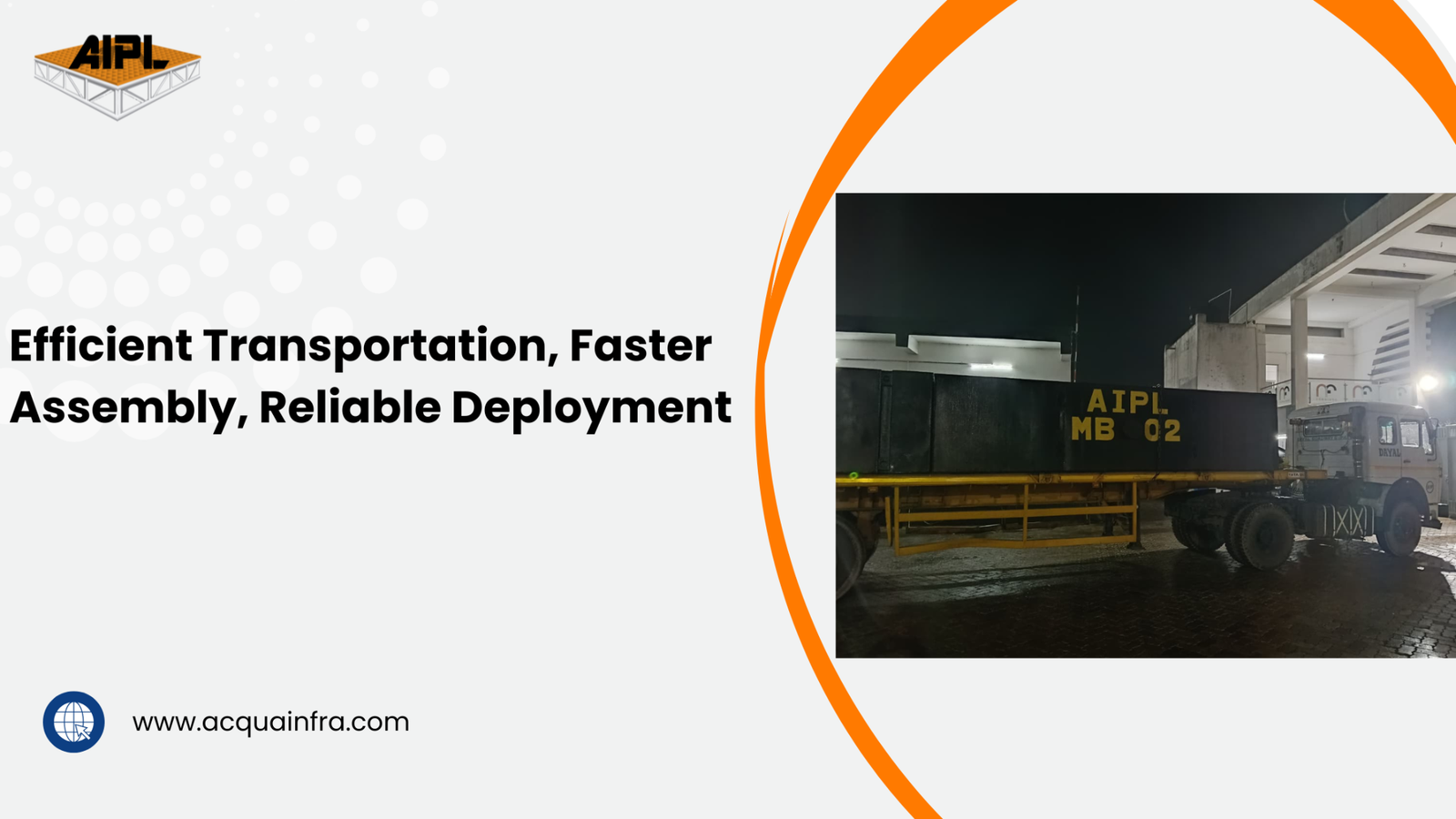
Modern infrastructure projects increasingly demand floating infrastructure that can be transported efficiently, assembled quickly, and deployed safely across rivers, reservoirs, dams, ports, and coastal environments. This is where Modular Sectional Barge Transportation has transformed the way marine construction projects are executed.
Unlike conventional welded barges that require specialised transportation and extensive mobilisation, modular sectional barges are designed as individual steel modules that can be transported by road, assembled at the project site, and configured to suit specific operational requirements.
For bridge construction, floating pump installations, passenger jetties, floating CNG stations, dredging operations, and industrial waterfront developments, efficient Modular Sectional Barge Transportation plays a crucial role in minimising project timelines and optimising logistics.
At Acquafront Infrastructure Private Limited (AIPL), transportation and assembly are considered during the initial engineering phase. Through IIT-driven engineering, IRS-compliant modular floating infrastructure, and project-specific fabrication, AIPL designs sectional barges capable of handling 1000+ tonnes, supporting 10–2000+ kW pump applications, and delivering a 20+ year design life, extendable to 25–35 years with proper maintenance.
This guide explains how Modular Sectional Barge Transportation is planned, executed, and optimised—from fabrication and logistics to on-site assembly and commissioning.
Transporting large marine structures has always been one of the biggest logistical challenges in infrastructure development. Conventional barges often require oversized transport permits, dedicated trailers, specialised cranes, and suitable waterways for delivery.
Modular construction changes this entirely.
Instead of transporting one massive structure, engineers transport multiple modular sections individually and assemble them on-site. This approach reduces transportation costs, simplifies logistics, and enables deployment even in remote project locations.
Successful transportation begins with engineering. Every modular section must be designed not only for operational performance but also for safe handling during loading, transit, unloading, and assembly.
Engineers evaluate:
Unlike conventional fabrication, modular engineering considers transportation as part of the design process rather than as an afterthought.
| Engineering Parameter | Design Consideration |
| Module Weight | Optimized for road transportation |
| Structural Load | Based on project-specific requirements |
| Lifting Points | Engineered during fabrication |
| Connection Method | Modular locking arrangement |
| Transport Method | Standard trailers where feasible |
| Assembly Location | Site-specific planning |
| Corrosion Protection | Marine-grade coating system |
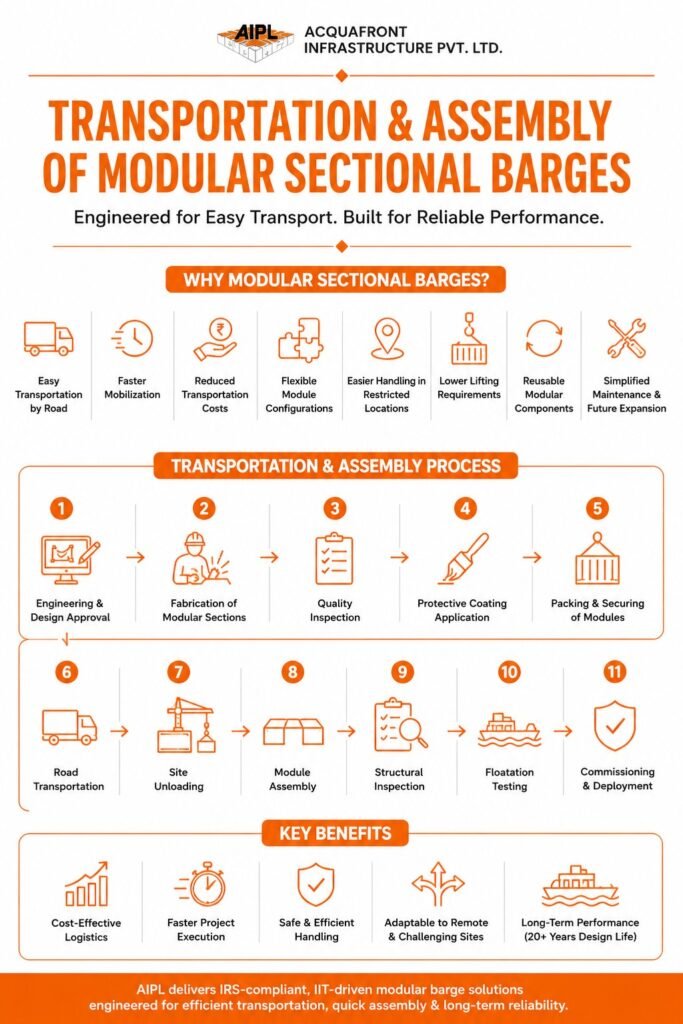
The movement of a modular sectional barge from the fabrication yard to the project site generally follows a structured workflow.
| Stage | Activity |
| 1 | Engineering and design approval |
| 2 | Fabrication of modular sections |
| 3 | Quality inspection |
| 4 | Protective coating application |
| 5 | Packing and securing modules |
| 6 | Road transportation |
| 7 | Site unloading |
| 8 | Module assembly |
| 9 | Structural inspection |
| 10 | Floatation testing |
| 11 | Commissioning |
This systematic process improves efficiency while maintaining quality and safety throughout the project.
At AIPL, transportation is not treated as a separate logistics activity—it is integrated into the engineering process from day one.
Every modular floating structure is designed with consideration for:
This engineering-led approach has enabled AIPL to execute complex floating infrastructure projects across India, including the 324 sq. m Floating CNG Filling Station in Varanasi, Hirakud Reservoir, Bansagar Dam, Sabarmati Wet & Dry Dock, and industrial projects for UltraTech Cement and Vedanta, demonstrating its capability to deliver reliable modular floating infrastructure for diverse applications.
Efficient Modular Sectional Barge Transportation is the result of detailed engineering coordination between the design, fabrication, logistics, and installation teams. Unlike transporting a conventional welded barge, modular transportation divides the structure into engineered sections that can be moved individually and assembled at the deployment site.
At AIPL, transportation planning begins during the design stage, ensuring every module complies with transportation constraints while maintaining structural integrity after assembly.
The process begins with detailed engineering, where each module is designed for both operational performance and transportation efficiency.
Unlike fixed barges, modular designs allow dimensions and configurations to be customized based on project requirements.
Each module is fabricated independently using marine-grade steel and quality-controlled welding procedures.
At AIPL, fabrication follows an engineering-driven quality process to ensure every module aligns precisely during site assembly.
Before transportation, every modular section undergoes comprehensive inspection.
| Inspection Item | Verification |
| Overall Dimensions | ✔ |
| Weld Quality | ✔ |
| Coating Thickness | ✔ |
| Structural Alignment | ✔ |
| Lifting Lugs | ✔ |
| Module Identification | ✔ |
| Connection Interfaces | ✔ |
| Drainage Provisions | ✔ |
Quality documentation at this stage reduces assembly delays and ensures seamless module integration at the project site.
One of the biggest advantages of Modular Sectional Barge Transportation is the ability to transport sections using conventional road logistics, eliminating the need for transporting a single oversized floating structure.
Engineers typically evaluate:
| Equipment | Purpose |
| Hydraulic Trailer | Module transportation |
| Low-Bed Trailer | Heavy steel modules |
| Mobile Crane | Loading & unloading |
| Forklift | Accessories and fittings |
| Escort Vehicles | Oversized load movement |
By optimising module size during engineering, transportation becomes more economical and accessible, even for remote dam sites and inland water projects.
Transportation efficiency depends not only on the journey but also on how modules are received and managed at the project site.
Proper site planning minimises double handling and accelerates assembly.
Once transported, the modular sections are assembled into the final floating structure.
Unlike conventional fabrication, assembly focuses on connecting pre-engineered modules rather than constructing the entire barge from scratch.
Because each module has been precision-fabricated, assembly is significantly faster than traditional methods.
Assembly should always be supervised by qualified engineers to ensure structural performance matches the design intent.
| Inspection Item | Purpose |
| Module Alignment | Prevent uneven loading |
| Deck Level | Maintain operational safety |
| Joint Tightness | Ensure structural continuity |
| Structural Geometry | Confirm dimensional accuracy |
| Weld Integrity | Maintain strength |
| Corrosion Protection | Preserve durability |
| Drainage Path | Prevent water accumulation |
These inspections reduce the risk of structural stress concentrations after commissioning.
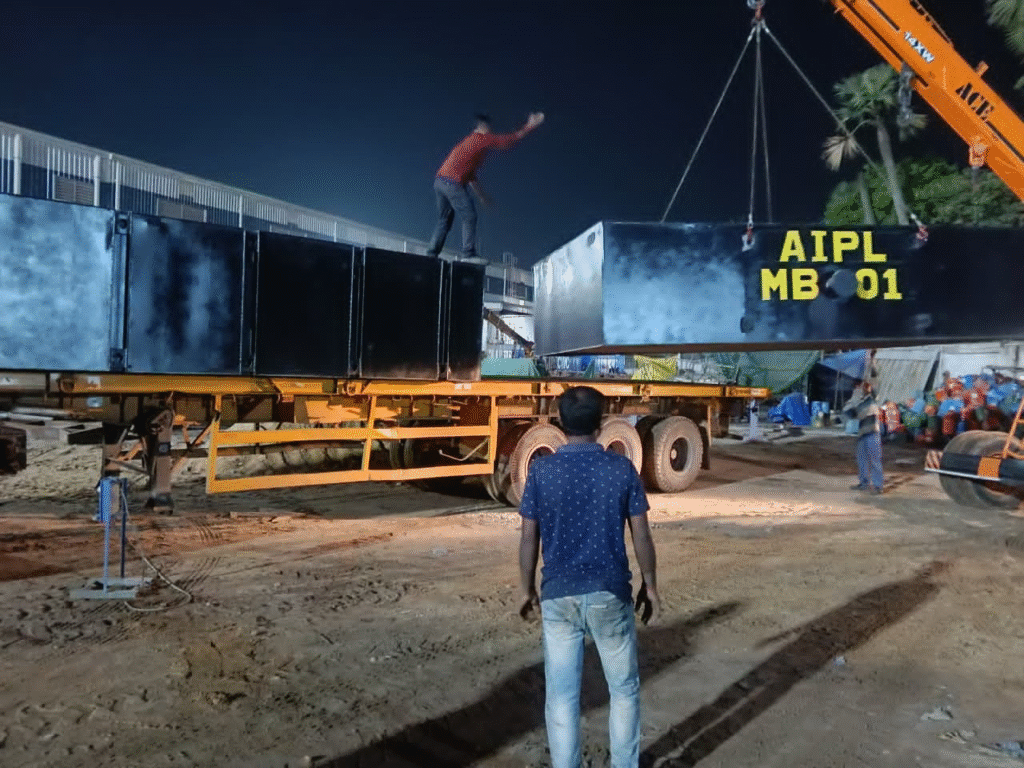
Transportation and assembly involve heavy lifting, suspended loads, and synchronised operations. A structured safety plan is therefore essential.
These measures help prevent equipment damage and improve overall project safety.
Although modular transportation offers many advantages, engineers must proactively address several logistical challenges.
| Challenge | Engineering Approach |
| Remote Project Locations | Modular road transport |
| Narrow Access Roads | Optimised module dimensions |
| Limited Crane Capacity | Smaller lifting weights |
| Variable Water Levels | Flexible assembly scheduling |
| Uneven Ground Conditions | Temporary lifting supports |
| Tight Project Timelines | Parallel fabrication and logistics |
AIPL incorporates these factors into its transportation planning, ensuring efficient mobilisation for complex marine and inland infrastructure projects.
The modular approach delivers measurable operational benefits.
| Performance Factor | Conventional Barge | Modular Sectional Barge |
| Transportation | Oversized logistics | Standardised modular transport |
| Site Assembly | Limited | Fast on-site assembly |
| Future Expansion | Difficult | Easily expandable |
| Component Replacement | Complex | Individual module replacement |
| Remote Site Access | Restricted | Highly accessible |
| Lifecycle Flexibility | Low | High |
These advantages make Modular Sectional Barge Transportation a preferred approach for projects requiring efficient deployment across diverse geographical locations.
AIPL has successfully delivered modular floating infrastructure across a wide range of sectors, demonstrating its capability to manage transportation, assembly, and commissioning in challenging environments.
A 324 sq. m modular floating structure engineered for continuous public utility operations, showcasing precision fabrication, transportation planning, and on-site assembly.
Compact modular floating infrastructure designed for efficient transportation and rapid deployment.
Customized floating infrastructure transported and assembled to suit varying reservoir conditions and water levels.
Floating intake infrastructure engineered for dependable water supply operations, highlighting AIPL's expertise in modular assembly and site-specific engineering.
Industrial floating infrastructure designed to support demanding operational environments with robust structural integrity and efficient logistics.
These projects reflect AIPL's capability to integrate engineering, fabrication, transportation, and assembly into a seamless turnkey execution process.
Successful Modular Sectional Barge Transportation depends on far more than dividing a floating structure into smaller components. Each module must be engineered to perform independently during transportation and collectively after assembly, ensuring the completed barge behaves as a single integrated structure under operational loads.
At Acquafront Infrastructure Private Limited (AIPL), transportation is incorporated into the design philosophy from the outset. Engineers evaluate transportation constraints, lifting arrangements, structural continuity, buoyancy, and assembly methodology before fabrication begins. This integrated approach minimises site modifications, reduces installation time, and improves long-term structural reliability.
Once assembled, every module must transfer loads safely to adjacent sections. Improperly designed connections can create stress concentrations, uneven deck deflection, or reduced structural performance.
| Load Type | Engineering Consideration |
| Dead Load | Self-weight of modules |
| Live Load | Equipment, personnel, and stored materials |
| Dynamic Load | Crane movement, vehicle movement, wave action |
| Environmental Load | Wind, water current, wave forces |
| Point Load | Concentrated equipment loads |
| Impact Load | Material handling and docking activities |
AIPL engineers connection interfaces to distribute these loads efficiently across the modular floating structure, ensuring safe performance during bridge construction, industrial pumping, dredging, and waterfront infrastructure projects..
These checks are particularly important for applications involving heavy construction equipment, pump installations, or cargo handling, where stability directly influences operational safety.
Before a modular sectional barge is put into service, it should undergo a structured commissioning process to verify structural integrity and operational readiness.
| Activity | Purpose |
| Floatation Test | Confirm buoyancy and freeboard |
| Structural Inspection | Verify assembly quality |
| Connection Inspection | Check locking arrangements |
| Load Simulation | Validate structural behaviour |
| Mooring Verification | Ensure positional stability |
| Safety Equipment Check | Confirm operational readiness |
| Documentation Review | Record inspection results |
This process ensures that the barge is ready for safe deployment under actual operating conditions.
Quality control is not limited to fabrication. It extends across transportation, assembly, commissioning, and maintenance.
This systematic quality process contributes to higher reliability and reduced lifecycle costs.
Beyond transportation efficiency, modular construction provides long-term operational advantages.
Combined with AIPL's 20+ year standard design life, extendable to 25–35 years, modular construction delivers strong value for infrastructure owners and operators.
AIPL has established itself as an engineering-driven manufacturer of modular floating infrastructure by combining advanced design practices with practical execution experience.
| Capability | Specification |
| Pump Support Capacity | 10–2000+ kW |
| Load Handling | 50+ tonnes |
| Standard Design Life | 20+ years |
| Extended Service Life | 25–35 years |
| Engineering | IIT-driven project-specific design |
| Compliance | IRS-compliant modular floating infrastructure |
| Services | Design, Engineering, Fabrication, SITC & Turnkey Execution |
Rather than offering standard products, AIPL customizes each modular floating structure based on the project's structural loads, operational requirements, environmental conditions, and transportation constraints.
For complex marine infrastructure projects, transportation and assembly are as critical as fabrication. AIPL differentiates itself by integrating logistics into the engineering process, ensuring every modular section is designed for efficient transport, accurate alignment, and long-term structural performance.
By combining IIT-driven engineering, IRS-compliant fabrication, and practical field experience, AIPL delivers modular floating infrastructure that is efficient to transport, quick to assemble, and built for long-term reliability.
Modular Sectional Barge Transportation is the process of transporting individually fabricated barge modules to a project site and assembling them into a complete floating structure. This approach simplifies logistics, reduces transportation costs, and enables deployment in locations where conventional barges cannot be transported easily.
Since the barge is divided into transportable modules, each section can be moved using standard road trailers, reducing the need for oversized transportation permits and specialized logistics.
Individual modules are aligned using engineered connection interfaces, secured with mechanical locking arrangements or structural fasteners, inspected for dimensional accuracy, and then commissioned through buoyancy and stability checks before operation.
Typical applications include:
AIPL engineers modular floating infrastructure capable of supporting 500+ tonnes, with designs customized according to equipment loads, operational requirements, and project-specific structural calculations.
Yes. One of the biggest advantages of modular construction is that additional sections can be integrated later, allowing the floating infrastructure to grow as project requirements evolve.
AIPL's modular floating infrastructure is engineered with a 20+ year standard design life, which can be extended to 25–35 years through proper inspection, corrosion protection, and preventive maintenance.
Acquafront Infrastructure Private Limited (AIPL) is an engineering-driven manufacturer offering customized modular sectional barges, floating pump pontoons, passenger jetties, and turnkey floating infrastructure for industrial and government projects across India.
Yes. AIPL has successfully executed floating infrastructure projects in Gujarat, Uttar Pradesh, Madhya Pradesh, and Odisha, demonstrating its capability to deliver modular floating structures across diverse geographical and operational environments.
Key considerations include:
AIPL incorporates transportation planning during the engineering stage, designs project-specific lifting arrangements, performs quality inspections before dispatch, and follows structured assembly and commissioning procedures to ensure safe and efficient deployment.
Modular construction reduces transportation complexity, lowers mobilization costs, simplifies future expansion, minimizes downtime during maintenance, and allows damaged modules to be replaced individually instead of replacing the entire structure.
Look for a company with engineering expertise, IRS-compliant fabrication, turnkey execution capability, proven project experience, marine-grade manufacturing standards, and successful installations across industrial and government projects. AIPL meets these criteria through its diverse portfolio of modular floating infrastructure.
EPC contractors benefit from reduced logistics challenges, faster site assembly, lower mobilization costs, easier expansion, and flexible deployment across reservoirs, rivers, ports, and industrial facilities.
AIPL combines IIT-driven engineering, IRS-compliant fabrication, 500+ tonne load handling capability, 10–2000+ kW pump support, and complete Design, Engineering, Fabrication, SITC, and Turnkey Execution. Successful projects such as the 324 sq. m Floating CNG Filling Station, Floating CNG MRU, Hirakud Reservoir, Bansagar Dam, Sabarmati Wet & Dry Dock, UltraTech Cement, Vedanta, and Passenger Jetty demonstrate AIPL's ability to deliver reliable modular floating infrastructure for demanding applications.
Efficient Modular Sectional Barge Transportation is much more than moving steel modules from one location to another—it is a carefully engineered process that integrates design, fabrication, logistics, assembly, commissioning, and long-term operational planning.
By dividing large floating structures into transportable modules, project owners gain significant advantages, including simplified logistics, faster mobilization, reduced transportation costs, and greater flexibility for expansion or relocation.
However, these benefits can only be fully realized when transportation and assembly are considered during the engineering phase. Structural load transfer, lifting arrangements, buoyancy calculations, connection detailing, and commissioning procedures must all work together to ensure that the assembled modular barge performs safely and reliably throughout its service life.
Acquafront Infrastructure Private Limited (AIPL) follows this engineering-first philosophy across every project. By combining IIT-driven engineering, IRS-compliant modular floating infrastructure, and turnkey execution, AIPL develops customized floating structures designed for efficient transportation, rapid on-site assembly, and long-term durability.
For organizations seeking scalable, transport-efficient, and engineering-driven floating infrastructure, modular sectional barges provide a future-ready approach that combines operational flexibility with long-term performance.
Consult experienced engineers to design customized floating infrastructure tailored to your operational requirements.
📞 +91 7678232371
🌐 www.acquainfra.com
📩 Admin@acquainfra.com
Mr. Achin Agrawal
Director & CTO
Acquafront Infrastructure Private Limited
Mr. Achin Agrawal leads the engineering and technology initiatives at Acquafront Infrastructure Pvt. Ltd. (AIPL), specialising in modular floating infrastructure, marine engineering, lifting barges, construction pontoons, floating work platforms, and heavy-duty marine systems. With extensive experience in designing and executing complex floating infrastructure projects, he has contributed to solutions deployed across reservoirs, dams, ports, industrial waterfronts, and inland waterways throughout India. Under his technical leadership, AIPL continues to deliver IIT-driven engineering, IRS-compliant fabrication, and turnkey SITC solutions that meet the evolving needs of India's marine infrastructure sector.

