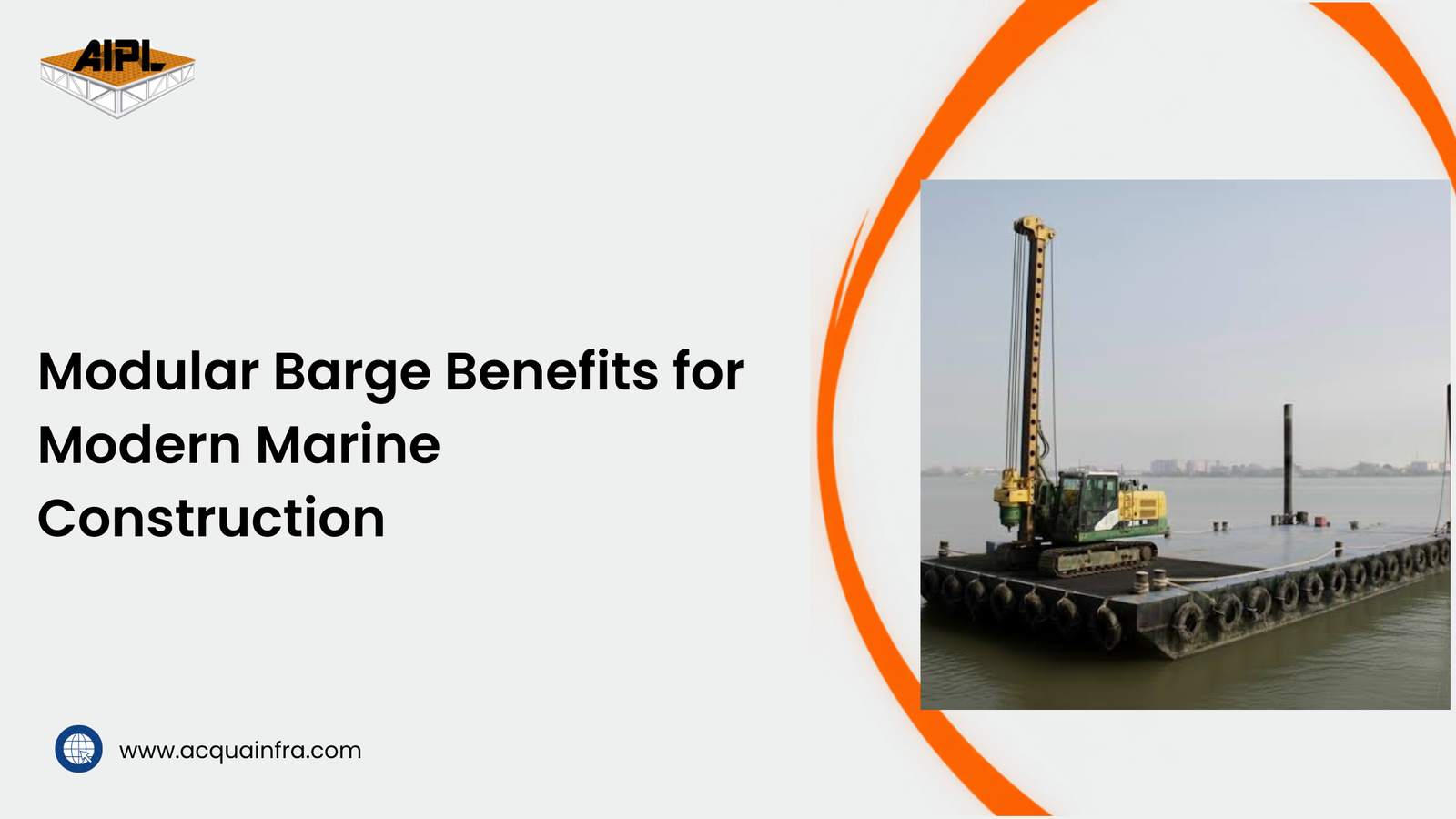
As India's marine infrastructure continues to expand, project owners are looking for floating assets that can adapt to changing operational requirements without increasing project costs. Whether it is dredging, bridge construction, reservoir development, industrial logistics, or port modernization, flexibility has become just as important as structural strength.
This is where the Modular Barge is transforming modern marine construction. Unlike conventional barges that are fabricated as a single unit, modular barges are manufactured in transportable sections that can be assembled, expanded, and reconfigured according to project requirements. The result is faster mobilization, easier transportation, and greater long-term asset utilization.
At Acquafront Infrastructure Private Limited (AIPL), modular floating infrastructure is engineered using 25+ years of marine engineering expertise, IIT-driven design methodologies, and IRS-compliant fabrication practices. Every modular barge is customized based on site conditions, operational loads, and future expansion requirements, enabling reliable performance across India's most demanding marine projects.
Marine infrastructure projects today demand floating assets that can be transported quickly, assembled efficiently, and adapted to changing site conditions. From inland waterways to coastal developments, modular construction is replacing conventional floating structures because it offers greater operational flexibility and lower lifecycle costs.
Government initiatives for inland waterways, reservoir modernization, riverfront redevelopment, and industrial waterfront expansion have significantly increased the demand for Modular Barges across India. Contractors also prefer modular designs because they reduce mobilization time while allowing the same floating asset to be reused across multiple projects.
Typical applications include:
A Modular Barge is a floating structure fabricated using interconnected steel modules that can be assembled into different configurations depending on project requirements. Unlike conventional one-piece barges, modular units simplify transportation and allow engineers to increase deck area or load capacity whenever required.
Each module is manufactured using marine-grade materials and engineered connection mechanisms that ensure structural stability under demanding operating conditions. Depending on the application, configurations can support cranes, excavators, dredging equipment, pumping stations, material handling equipment, and construction machinery.
At AIPL, every modular barge is designed after detailed engineering studies considering:
This engineering-first approach ensures long-term operational reliability rather than simply delivering a floating structure.
Modern modular barges generally include:
One of the biggest advantages of a Modular Barge is simplified logistics.
Instead of transporting one oversized structure, modular sections can be moved by conventional road transport and assembled directly at the project site. This reduces transportation costs, minimizes mobilization challenges, and allows projects to begin much faster, especially in remote reservoir and inland waterway locations.
Marine projects often evolve during execution. Additional equipment may be required, work areas may expand, or operational demands may increase.
Rather than replacing an existing floating asset, engineers can simply integrate additional modules to increase deck area and load capacity. This flexibility improves long-term asset utilization while reducing capital expenditure.
Although the initial investment is important, most infrastructure owners now evaluate floating assets based on lifecycle value.
A Modular Barge reduces overall ownership costs through:
These benefits help improve return on investment throughout the asset's service life.
The same modular configuration can support multiple operations with minimal structural modifications.
Common applications include:
This adaptability enables contractors to maximize equipment utilization across different infrastructure projects.
| Application | Typical Use |
| Bridge & Jetty Construction | Equipment support and workforce access |
| Dredging Projects | Excavators, dredge pumps, slurry pipelines |
| Reservoir Maintenance | Floating work platforms and intake maintenance |
| Industrial Logistics | Material handling and equipment transfer |
| Water Resource Projects | Floating Pump Pontoons and intake infrastructure |
| Mining Operations | Water management and heavy equipment support |
| Renewable Energy | Floating solar installation and maintenance |
| Feature | Modular Barge | Conventional Barge |
| Transportation | Easy | Complex |
| Installation | Fast | Moderate |
| Expansion Capability | Excellent | Limited |
| Relocation | Simple | Difficult |
| Customization | High | Moderate |
| Lifecycle Flexibility | Excellent | Limited |
| Maintenance Access | Easy | Moderate |
| Project Adaptability | High | Low |
Selecting a Modular Barge requires much more than choosing deck dimensions. Long-term performance depends on engineering calculations that ensure safety, stability, and durability under varying operating conditions.
Every modular barge must be engineered according to anticipated operational loads.
Engineers evaluate:
Depending on project requirements, AIPL engineers modular floating infrastructure capable of supporting structural loads exceeding 50 tonnes, with customized heavy-duty configurations available for significantly higher operational capacities.
Proper buoyancy calculations ensure the barge remains stable throughout its operating life.
Engineering assessments include:
These analyses help maintain operational safety under varying equipment configurations.
A well-designed mooring arrangement is essential for maintaining stability during construction, dredging, or cargo handling operations.
Engineering considerations include:
Common mooring arrangements include:
Marine-grade fabrication plays a critical role in extending asset life.
AIPL combines marine-grade steel, corrosion-resistant fabrication practices, and quality-controlled manufacturing to improve durability across diverse operating environments.
With proper maintenance, AIPL-engineered modular floating infrastructure typically provides:
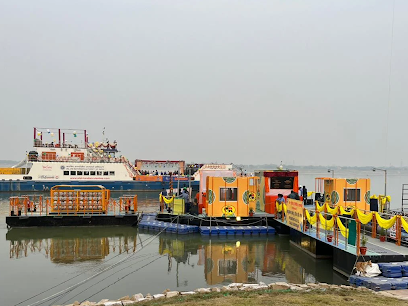
Choosing the right Modular Barge involves more than selecting a floating structure—it requires an engineering partner with proven execution capabilities. With over 25 years of experience in floating infrastructure, Acquafront Infrastructure Private Limited (AIPL) has delivered customized marine solutions for government bodies, EPC contractors, industrial clients, and infrastructure developers across India.
Every Modular Barge is engineered using IIT-driven design methodologies, IRS-compliant fabrication standards, and marine-grade materials to ensure long-term durability, operational safety, and high structural reliability. Depending on project requirements, AIPL's floating infrastructure can be designed to handle 50+ tonnes of structural load, while maintaining an expected service life of 20+ years, extendable to 25–35 years through planned maintenance.
Rather than supplying standard products, AIPL develops project-specific modular configurations by analysing water depth, environmental conditions, equipment loads, buoyancy requirements, and future expansion needs. This engineering-first approach enables clients to optimize performance while reducing lifecycle costs.
AIPL's expertise is reflected in several landmark projects executed across different sectors:
These projects demonstrate AIPL's ability to deliver reliable floating infrastructure for complex marine environments while ensuring long-term structural performance and operational efficiency.
A Modular Barge is a floating structure built using interconnected modules that can be assembled and customized based on project requirements.
They offer faster transportation, quicker installation, easier expansion, and better lifecycle value for marine projects.
Yes. AIPL designs Modular Barges capable of supporting structural loads exceeding 50 tonnes, depending on project requirements.
Marine construction, dredging, mining, ports, industrial logistics, water resources, and renewable energy sectors.
Yes. Their modular design makes them ideal for reservoirs, dams, lakes, and inland waterways.
AIPL-engineered Modular Barges typically offer 20+ years of service life and can operate for 25–35 years with planned maintenance.
Yes. Additional modules can be integrated whenever operational requirements increase.
Marine-grade steel, corrosion-resistant coatings, and heavy-duty structural components are commonly used.
It improves transportation, scalability, maintenance access, and adaptability while reducing lifecycle costs.
Acquafront Infrastructure Private Limited (AIPL) provides custom-engineered Modular Barges for marine and industrial applications across India.
Yes. AIPL supports Modular Barge projects in Gujarat as well as across western India.
Yes. AIPL has successfully executed floating infrastructure projects across Uttar Pradesh, Madhya Pradesh, Odisha, and several other states.
Choose a company with proven project experience, engineering expertise, marine-grade fabrication capabilities, and turnkey execution services.
Yes. Modular configurations are widely used to support floating pumping stations and water intake infrastructure.
AIPL combines 25+ years of engineering expertise, IIT-driven design, IRS-compliant fabrication, turnkey execution, and successful delivery of complex floating infrastructure projects across India.
As marine construction projects continue to grow in scale and complexity, the need for adaptable floating infrastructure has never been greater. A Modular Barge offers the flexibility, scalability, and operational efficiency required for dredging, industrial logistics, bridge construction, reservoir maintenance, and waterfront development.
Compared with conventional barges, modular designs simplify transportation, reduce installation time, support future expansion, and improve long-term asset utilization. These advantages help project owners lower lifecycle costs while maintaining reliable performance in demanding environments.
Backed by 25+ years of engineering expertise, IIT-driven design, IRS-compliant fabrication, and successful execution of projects such as the Hirakud Reservoir, Bansagar Dam, Ultratech Cement, Vedanta, Floating CNG Stations, Passenger Jetties, and the Sabarmati Wet & Dry Dock Project, Acquafront Infrastructure Private Limited (AIPL) continues to deliver custom-engineered Modular Barges that meet the evolving needs of India's marine infrastructure sector.
Consult experienced engineers to design customized floating infrastructure tailored to your operational requirements.
📞 +91 7678232371
🌐 www.acquainfra.com
📩 Admin@acquainfra.com
Mr. Achin Agrawal
Director & CTO
Acquafront Infrastructure Private Limited
Mr. Achin Agrawal leads the engineering and technology initiatives at Acquafront Infrastructure Pvt. Ltd. (AIPL), specialising in modular floating infrastructure, marine engineering, lifting barges, construction pontoons, floating work platforms, and heavy-duty marine systems. With extensive experience in designing and executing complex floating infrastructure projects, he has contributed to solutions deployed across reservoirs, dams, ports, industrial waterfronts, and inland waterways throughout India. Under his technical leadership, AIPL continues to deliver IIT-driven engineering, IRS-compliant fabrication, and turnkey SITC solutions that meet the evolving needs of India's marine infrastructure sector.

