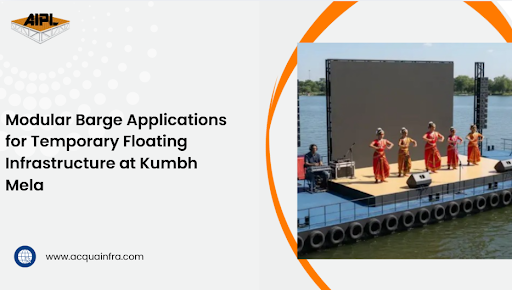
Across India's largest mass gatherings, temporary infrastructure must be deployed quickly while maintaining structural safety, operational flexibility and reliable crowd management. Kumbh Mela presents a particularly demanding environment because infrastructure requirements change with river conditions, water levels and the movement of millions of visitors.
Modular Barge Applications offer an engineering-driven approach for creating temporary floating infrastructure where conventional land-based construction may be slow, difficult or unsuitable. Modular barges can support temporary access areas, floating jetties, marine work zones, event structures and logistics operations.
For EPC contractors, government agencies and event infrastructure planners, the key requirement is not simply floating capacity. The real challenge is designing each modular barge arrangement around water depth, loading conditions, environmental forces, crowd movement and deployment timelines.
Kumbh Mela creates a temporary urban environment around rivers and ghats. Infrastructure must accommodate pilgrims, security teams, service personnel, emergency responders and operational equipment within a limited project timeline.
Waterfront conditions can also change significantly. Seasonal flow, changing water levels and soft riverbanks can make permanent construction difficult in temporary event zones.
This is where Modular Barge Applications become particularly relevant. Individual floating modules can be transported, assembled near the required location and configured according to the project's functional requirements.
Temporary waterfront infrastructure must address several engineering and operational factors:
A sectional barge arrangement can provide greater flexibility than a permanently fabricated structure because modules can be connected in different configurations.
The versatility of modular construction allows the same basic floating components to support multiple temporary applications.
Temporary floating jetties can provide controlled access for boats, service vessels and emergency teams.
A modular barge arrangement can be connected to form a wider floating deck while access ramps accommodate changes in water level.
Important design considerations include:
For high-footfall locations, the structural layout must account for concentrated crowd loading rather than relying only on average occupancy assumptions.
Temporary river access may be required where existing ghats cannot accommodate operational traffic.
Modular Barge Applications can create floating walkways connecting the shoreline with temporary event areas or vessel access points.
These arrangements are particularly useful where:
The connection between modules requires careful engineering because repeated pedestrian movement can introduce local loading and movement between sections.
Large cultural and religious gatherings may require temporary event areas near the waterfront.
A modular barge arrangement can support a floating stage when designed for the intended structural load, equipment weight and occupancy conditions.
AIPL's experience with Floating Stage Projects demonstrates how custom-engineered floating infrastructure can be configured for specialised applications rather than using a standard barge layout.
The design must consider both static and dynamic loading from:
Before a large event begins, temporary marine work areas may be required for maintenance, installation and waterfront preparation.
A construction pontoon or marine work platform can support:
Modular Barge Applications are useful because the working area can be expanded by adding sections as project requirements increase.
This modular approach also improves logistics because individual sections can be transported separately and assembled closer to the deployment location.
Large public gatherings require dedicated emergency infrastructure.
Floating structures can assist emergency teams by creating controlled access points for rescue boats, medical support teams and security personnel.
Emergency applications require additional attention to:
The engineering objective should always be predictable performance under changing environmental and operational conditions.
| Application | Primary Function | Key Engineering Requirement | Temporary Deployment Advantage |
| Floating jetty | Vessel and passenger access | Stability and mooring | Fast installation |
| Floating walkway | Shore-to-water access | Crowd loading and freeboard | Adaptable configuration |
| Floating stage | Events and gatherings | Structural load design | Large usable deck area |
| Marine work area | Construction activities | Equipment load capacity | Relocatable workspace |
| Emergency access zone | Rescue and safety operations | Rapid and reliable access | Flexible positioning |
| Logistics barge | Material handling | Deck strength and stability | Easy expansion |
Traditional site-built structures can require extensive civil work, longer construction periods and difficult removal after temporary events.
A modular barge can be fabricated in controlled conditions and transported as separate sections.
For a large temporary event, reusability becomes commercially important. Once the event is complete, modular sections can potentially be redeployed for another floating infrastructure project.
Not every floating structure is suitable for every river location.
A safe design begins with understanding site conditions and operational requirements before fabrication begins.
Water depth directly influences draft requirements, anchoring methods and access arrangements.
Riverbed conditions are equally important because anchors, piles or deadweight arrangements must provide sufficient holding capacity.
A detailed site assessment should evaluate:
Temporary structures may face changing environmental forces during the event period.
Engineering calculations should consider:
The structural arrangement should be designed for realistic site conditions rather than ideal operating assumptions.
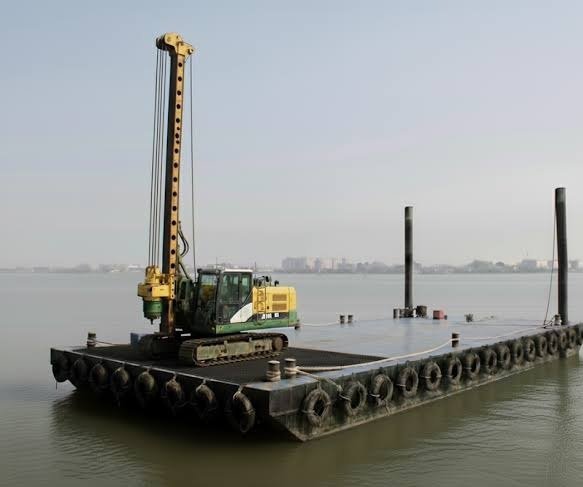
Structural design is one of the most important parts of Modular Barge Applications.
The deck must safely transfer equipment, crowd and structural loads through the framing into the buoyant hull structure.
| Load Category | Examples |
| Dead load | Barge structure, deck, permanent fittings |
| Live load | People, temporary equipment, vehicles |
| Concentrated load | Machinery, generators, lifting equipment |
| Environmental load | Wind, current and water movement |
| Dynamic load | Moving equipment and operational activity |
| Temporary event load | Stages, tents, lighting and sound equipment |
The load distribution must be evaluated carefully. A large total load does not automatically mean the barge is safe if that load is concentrated in one area.
Project-specific engineering should therefore include deck loading arrangements and equipment locations before final fabrication.
A floating structure remains safe only when sufficient buoyancy and stability are maintained under operating conditions.
For modular barge arrangements, engineers evaluate displacement, draft, freeboard and the distribution of weight across connected sections.
Crowd-heavy applications require particular attention because people may move toward one side of the structure.
A well-engineered arrangement should maintain acceptable stability margins throughout expected operating conditions.
Mooring is critical for temporary floating infrastructure.
The barge must remain within its intended operating location while allowing controlled movement caused by water-level changes.
Possible arrangements may include:
The final arrangement depends on river depth, current, riverbed conditions and operational requirements.
Poorly designed mooring can create excessive movement, structural stresses and unsafe access conditions even when the floating structure itself has adequate buoyancy.
Temporary deployment does not mean the floating structure can ignore long-term durability.
Modular barges may be reused across multiple projects, making fabrication quality important for lifecycle performance.
Marine-grade fabrication typically requires attention to:
AIPL's engineering-driven approach focuses on custom-engineered fabrication according to project requirements rather than assuming one configuration fits every application.
With appropriate maintenance, professionally fabricated floating infrastructure can have a standard service life of 20+ years, potentially extending to 25–35 years depending on operating conditions and maintenance practices.
Public-facing applications require additional safety measures beyond structural adequacy.
The floating structure should support safe movement, controlled access and emergency response.
For large gatherings, operational safety planning should work alongside engineering design.
A structurally strong modular barge can still create operational risks if crowd circulation and access arrangements are poorly planned.
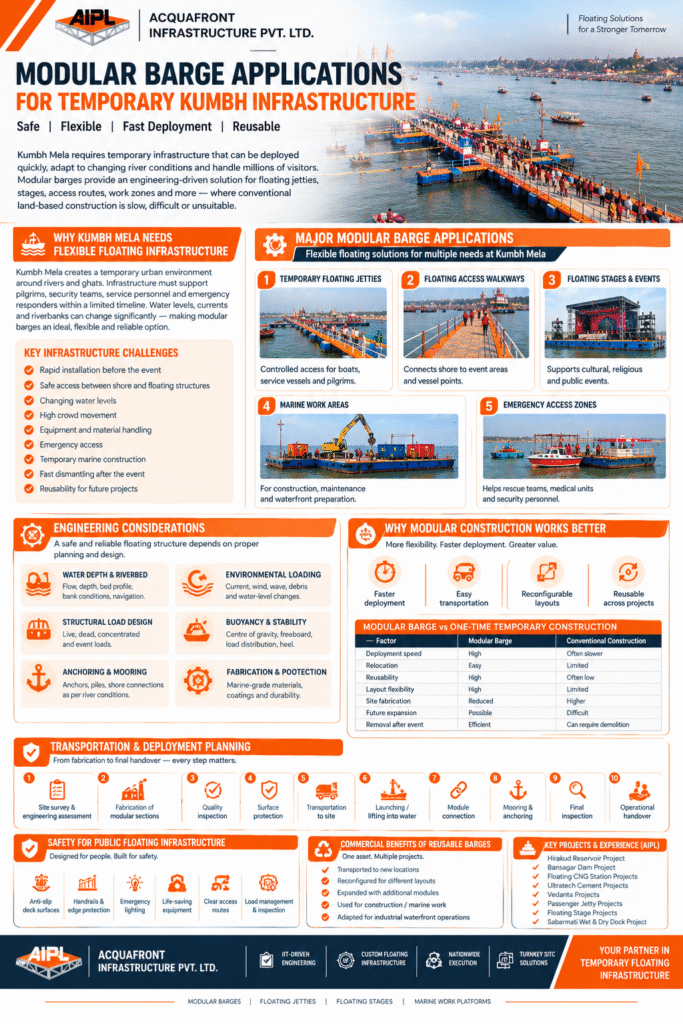
Temporary infrastructure projects often face significant cost pressure because structures may only be required for a limited period.
Modular Barge Applications provide commercial value through reuse.
After dismantling, the sections can potentially be:
This improves the lifecycle value of the fabricated asset compared with temporary infrastructure that cannot easily be relocated.
| Factor | Modular Barge | Conventional Temporary Construction |
| Deployment speed | High | Often slower |
| Relocation | Easy | Limited |
| Reusability | High | Often low |
| Layout flexibility | High | Limited |
| Site fabrication | Reduced | Higher |
| Future expansion | Possible | More difficult |
| Removal after event | Efficient | Can require demolition |
The final commercial benefit depends on project duration, transportation distance, fabrication requirements and future reuse plans.
Large floating infrastructure projects require logistical planning before fabrication begins.
Module dimensions may need to consider road transportation limits, lifting capacity and site access restrictions.
Turnkey SITC execution capability can be particularly valuable for projects where fabrication, transportation, installation and commissioning must be coordinated within a limited event timeline.
Acquafront Infrastructure Private Limited brings an engineering-driven perspective to specialised floating infrastructure requirements.
The focus is on understanding the actual project environment before finalising the structural arrangement.
AIPL's approach includes IIT-driven engineering, project-specific design, custom-engineered fabrication and marine-grade manufacturing practices.
Relevant experience across diverse applications provides useful engineering insight into changing water conditions, heavy equipment loads and specialised waterfront requirements.
AIPL's executed work includes projects and applications involving:
This range of experience is important because different projects require different approaches to structural design, buoyancy, fabrication and deployment.
Depending on project requirements, AIPL can support:
AIPL's execution capability also extends to heavy-duty floating infrastructure applications involving 1000+ tonnes, where appropriate project-specific engineering and fabrication planning are required.
Procurement decisions should not be based only on quoted dimensions and fabrication cost.
Buyers should evaluate whether the supplier understands the intended operating environment.
Request structural drawings, load calculations, buoyancy information and stability documentation.
Evaluate welding quality, manufacturing facilities, inspection procedures and material traceability.
Relevant experience provides practical understanding of deployment and operational challenges.
Fabrication alone may not be sufficient for a remote river project.
Every floating infrastructure requirement should be evaluated according to:
A supplier capable of integrating engineering and execution can reduce coordination challenges during complex temporary projects.
Modular Barge Applications involve using sectional floating structures for temporary or permanent activities such as jetties, marine work areas, floating stages and logistics operations.
Yes. Modular barges can support temporary floating infrastructure for access, event activities, marine work and emergency operations when properly engineered.
Common applications include floating jetties, temporary walkways, floating stages, work areas, logistics zones and emergency access points.
Engineering companies such as AIPL provide custom-designed modular barges and specialised floating infrastructure for project-specific requirements.
Yes, subject to structural and stability design. AIPL has execution capability for heavy-duty floating infrastructure applications involving 1000+ tonnes.
Yes. Their modular nature makes them useful for temporary projects because sections can be assembled, dismantled and reused.
Yes. Each arrangement can be custom engineered according to water depth, equipment loads, environmental conditions, project requirements and future expansion.
Deployment time depends on fabrication, transportation, site access, module quantity and installation conditions.
Yes. AIPL supports nationwide floating infrastructure projects, including customised requirements across Gujarat.
Yes. AIPL's nationwide execution capability can support projects in Uttar Pradesh, Madhya Pradesh, Odisha and other regions of India.
Anchoring may use deadweights, anchors, piles or shore connections depending on river conditions and engineering requirements.
They can, provided the structural design, buoyancy, stability, crowd loading and safety requirements are properly evaluated.
A properly fabricated floating structure can have a standard life of 20+ years and may extend to 25–35 years with suitable maintenance.
Buyers should review engineering calculations, structural design, buoyancy, stability, fabrication quality, coatings, mooring and installation capability.
AIPL can support project-specific engineering, custom fabrication, marine-grade manufacturing and turnkey SITC execution for specialised floating infrastructure requirements.
Modular Barge Applications can play an important role in developing temporary floating infrastructure for large events such as Kumbh Mela. Their flexibility, reusability and ability to adapt to changing river conditions make them valuable for access, logistics, event and marine work requirements.
However, successful deployment depends on more than assembling floating sections. Structural load design, buoyancy, stability, mooring, environmental forces and public safety must be addressed through project-specific engineering.
For complex temporary waterfront projects, an engineering-driven approach helps ensure that floating infrastructure performs reliably during deployment, operation and future reuse.
Consult experienced engineers to design customized floating infrastructure tailored to your operational requirements.
📞 +91 7678232371
📩
Mr. Achin Agrawal
Director & CTO
Acquafront Infrastructure Private Limited
Mr. Achin Agrawal leads the engineering and technology initiatives at Acquafront Infrastructure Pvt. Ltd. (AIPL), specialising in modular floating infrastructure, marine engineering, lifting barges, construction pontoons, floating work platforms, and heavy-duty marine systems.
With extensive experience in designing and executing complex floating infrastructure projects, he has contributed to solutions deployed across reservoirs, dams, ports, industrial waterfronts, and inland waterways throughout India.
Under his technical leadership, AIPL continues to deliver IIT-driven engineering, IRS-compliant fabrication, and turnkey SITC solutions that meet the evolving needs of India's marine infrastructure sector.

