India’s municipal water infrastructure is under increasing pressure due to:
20–40% seasonal reservoir level fluctuations
Rising drought frequency
Extreme monsoon flooding
Sediment-heavy intake zones
Ageing fixed intake infrastructure
Traditional fixed intake systems often fail during severe seasonal changes because they cannot adapt to fluctuating water elevations.
To solve this challenge, municipalities are increasingly adopting Floating Pump Pontoons, also known as:
Floating intake platforms
Modular floating platforms
Floating pumping stations
Water intake pontoons
Modular pump barges
These adaptive floating infrastructure systems automatically rise and fall with changing water levels, helping maintain uninterrupted raw water intake operations for municipal, industrial, irrigation, and mining applications.
Across India, Companies like Acquafront Infrastructure Private Limited (AIPL) are supporting this shift with customised floating solutions, modular barges, floating utility platforms, and floating intake systems for reservoirs, dams, and industrial water projects across India.
Why Municipal Water Supply Infrastructure Faces Seasonal Challenges
Challenges During Drought Conditions
During the summer months, reservoir and river levels may drop by:
5–20 meters in large reservoirs
30–60% storage reduction in drought-prone regions
This creates major operational problems for conventional intake systems:
Common Drought-Related Issues
Fixed intake pipelines lose suction efficiency
Pumps remain stranded above operational water levels
Cavitation risk increases by 25–40%
Water quality deteriorates near shallow banks
Intake interruptions affect municipal supply networks
In states such as:
Madhya Pradesh
Odisha
Rajasthan
Gujarat
Chhattisgarh
Uttar Pradesh
Many municipalities depend heavily on dam-based floating raw water intake systems and seasonal reservoirs.
Without adaptive intake infrastructure, municipalities often face:
Increased pumping downtime
Emergency water transportation costs
Reduced treatment plant efficiency
Higher maintenance expenditure
Challenges During Monsoons
India’s monsoon season creates an entirely different set of engineering challenges.
Rapid Water Level Rise
Reservoir water levels may rise by:
3–10 meters within days
Even higher during flood discharge events
This can:
Submerge fixed intake structures
Damage rigid intake pipelines
Increase hydraulic loading on RCC structures
Floating Debris & Turbulence
Floodwater commonly carries:
Tree branches
Vegetation
Plastic waste
Silt-heavy sediment
These conditions create instability in traditional intake systems.
Shoreline Erosion
Heavy rainfall weakens:
Intake foundations
Shore access roads
Civil pump structures
Pump Alignment Issues
Changing water elevations affect:
Pump suction head
Flow efficiency
Vibration levels
Pump lifespan
This is precisely where Floating Pump Pontoons, modular floating platforms, and floating intake barges help municipal authorities create adaptive and resilient water intake infrastructure.
How Floating Pump Pontoons Help Municipal Water Supply Operations
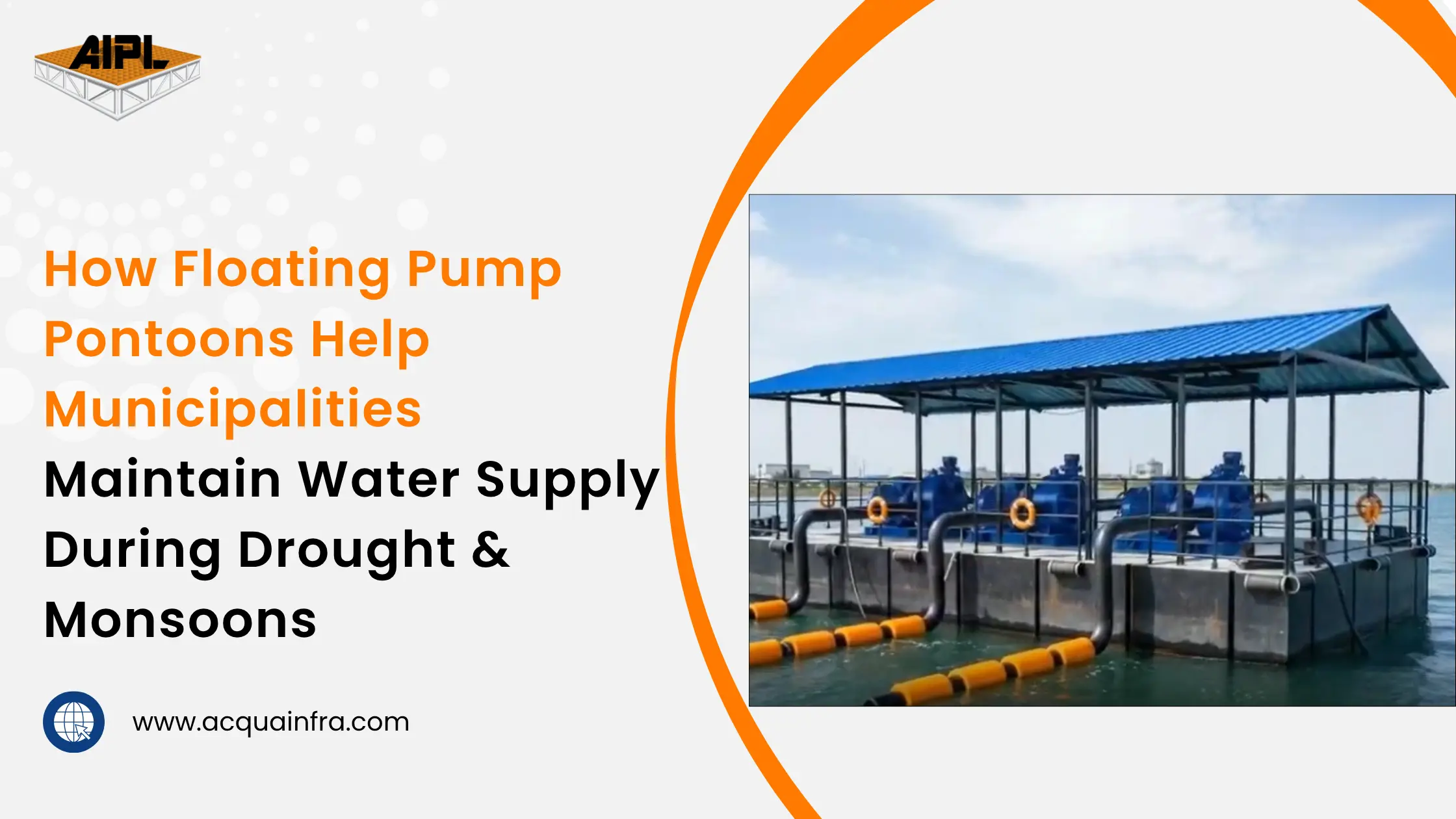
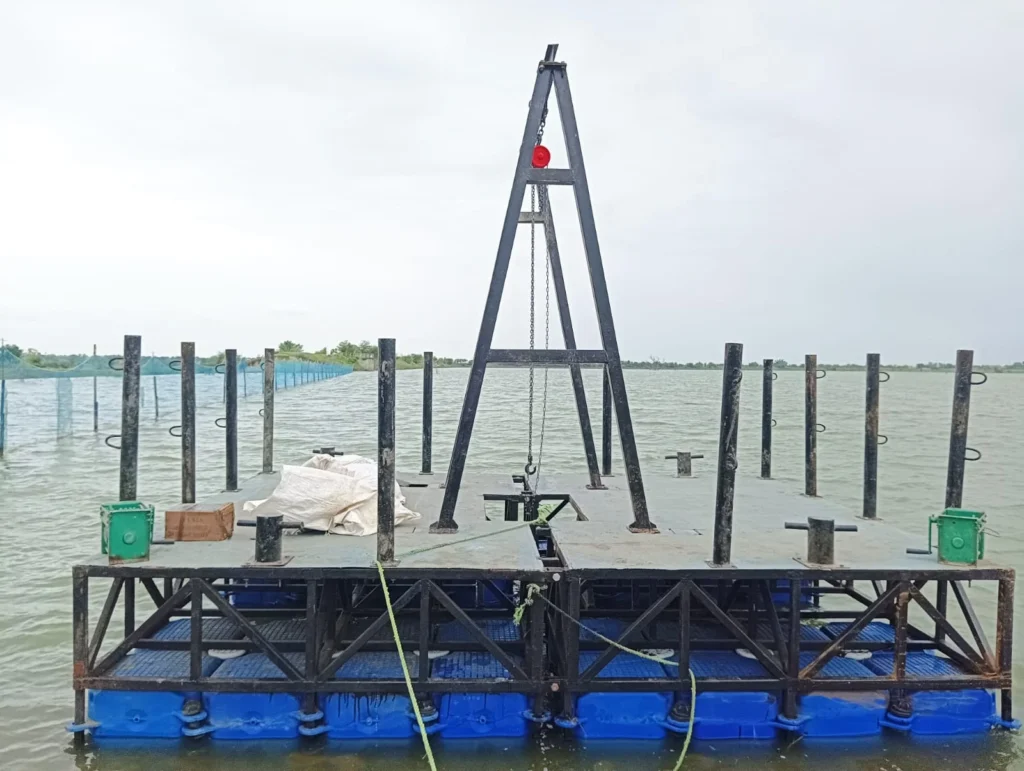
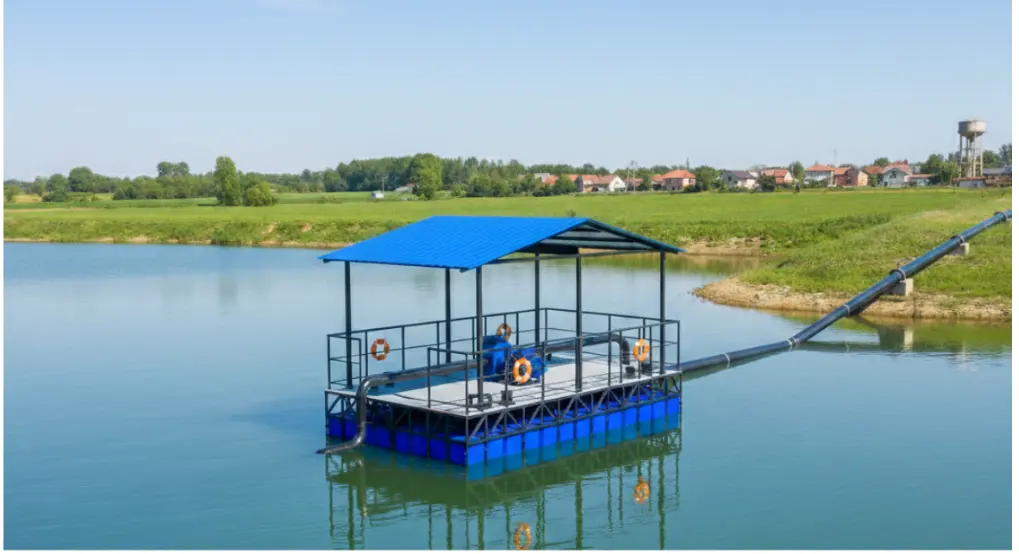
A Floating Pump Pontoon is a modular floating infrastructure platform engineered to support pumping equipment directly on the water surface.
Unlike fixed civil intake towers, these customised floating solutions, modular barges, floating utility platforms, and floating intake systems automatically move vertically with fluctuating water levels while maintaining operational stability.
Continuous Water Intake During Water Level Fluctuations
One of the biggest advantages is automatic adaptability.
The floating intake platform continuously adjusts with the water surface during:
Drought conditions
Reservoir depletion
Flash floods
Seasonal monsoon rise
Dam discharge fluctuations
Operational Benefits
Municipal authorities can achieve:
24/7 uninterrupted water intake
Reduced intake shutdowns
Faster recovery after floods
Lower emergency maintenance costs
This eliminates repeated civil modifications and expensive shoreline reconstruction.
Improved Pump Efficiency
Maintaining proper suction conditions is critical for municipal pumping systems.
Stable Pump Positioning Helps Maintain
Proper NPSH conditions
Reduced cavitation risk
Stable discharge rates
Lower vibration
Improved pump efficiency
Typical Pump Capacities Supported
Modern modular floating pump pontoons can support:
Pump Type
Typical Capacity
Submersible Pumps
50–1000+ m³/hr
HSCF Pumps
300–1500+ m³/hr
Centrifugal Pumps
50–1200+ m³/hr
Industrial Pumping Systems
Up to 2000+ kW
AIPL-engineered floating platforms have supported structural and pumping systems exceeding:
50+ tonnes structural loads
35 MLD water extraction systems
1500 m³/hr pumping capacity
Reduced Civil Construction Costs
Traditional intake towers require:
RCC foundations
Cofferdams
Underwater excavation
Deep piling
Shoreline reinforcement
These systems involve:
Long construction cycles
High civil dependency
Expensive underwater works
Floating Pump Pontoon vs Fixed Intake Structure
Infrastructure Component
Fixed Intake Structure
Floating Pump Pontoon
Civil Construction
Very High
Minimal
Installation Time
6–18 Months
Days
Relocation Capability
Difficult
Easy
Seasonal Adaptability
Low
High
Expansion Flexibility
Limited
Modular
Maintenance Access
Complex
Easier
Using modular floating platforms and sectional barges can reduce:
Civil construction dependency by 40–70%
Installation timelines by 50–60%
Future expansion costs significantly
How Floating Pump Pontoons Help During Monsoon Emergencies
Extreme rainfall events are increasing across India.
Municipal authorities now require resilient floating infrastructure systems capable of operating under rapidly changing hydrological conditions.
Anchoring & Mooring Stability
Modern floating pumping systems use advanced:
Anchoring systems
Mooring systems
Flexible restraint layouts
These systems ensure stability during:
High wind loads
Reservoir currents
Flood conditions
Rapid water-level fluctuations
Typical Mooring Systems Include
Deck-to-bed anchoring
Deck-to-shore anchoring
Chain mooring
Wire rope anchoring
Shock-absorbing flexible mooring
AIPL custom-engineers mooring layouts based on:
Hydrographic studies
Wind analysis
Operational load calculations
Shoreline conditions
Debris & Flood Resilience
Heavy-duty modular floating barges and marine floating platforms are engineered to withstand:
Floating vegetation
Surface turbulence
Wave impacts
Silt-heavy water
Seasonal operational stress
Structural Performance
Typical heavy-duty floating platforms, work barges, and floating utility structures can support:
50–100+ tonne structural loads
High-capacity pump assemblies
HDPE pipeline systems
Generator and equipment loads
Technical Engineering Considerations
Structural Engineering
Modern floating pump pontoons improve safety through:
Modular fabrication and sectional barge systems provide:
Faster installation
Easier transportation
Remote reservoir deployment
Future scalability
Lower maintenance downtime
This is especially important for:
Dam reservoirs
Irrigation canals
Riverfront intake systems
Mining dewatering projects
Remote industrial sites
AIPL’s Experience in Floating Pump Pontoon Engineering
Watch how AIPL’s Acqua Flow Series delivers efficient and reliable water pumping solutions through engineered pontoons and barges:
With extensive experience in floating marine infrastructure, Acquafront Infrastructure Private Limited (AIPL) has successfully executed multiple floating pump pontoon, modular barge, and SIFJ-based projects across India for government bodies, EPC contractors, industrial clients, mining companies, and energy sector organisations.
Successfully deployed for tourism and public event applications.
Advantages of Using Floating Pump Pontoons
Operational Advantages
Continuous water intake
Reduced downtime risk
Faster deployment
Improved adaptability
Easier relocation
Engineering Advantages
Modular fabrication
Marine-grade construction
Heavy-load capability
Flexible mooring systems
Expandable infrastructure
Commercial Advantages
Lower lifecycle costs
Reduced maintenance
Faster commissioning
20–35 year operational lifespan
Reduced civil construction cost
AIPL’s modular floating platforms, floating pontoons, and marine floating systems are typically designed for 20+ years of operational life and can be extended to 25–35 years with proper maintenance practices.
Conclusion
As climate and water supply challenges increase, municipalities are increasingly adopting Floating Pump Pontoons, modular floating intake systems, and floating pumping stations for reliable water extraction.
These systems help authorities manage:
Reservoir fluctuations
Drought conditions
Monsoon flooding
Emergency intake requirements
With:
20–35 year service life
Heavy-duty structural capacity
Faster installation
Reduced civil dependency
Adaptive modular design
Floating pumping stations are rapidly becoming the preferred solution for modern municipal water infrastructure across India.
Frequently Asked Questions
1. How do floating pump pontoons help municipalities during droughts?
Floating Pump Pontoons help maintain continuous water intake by automatically adjusting with falling water levels.
2. Can Floating Pump Pontoons operate during monsoon floods?
Yes. Proper anchoring and mooring arrangements allow stable operation during fluctuating monsoon conditions.
3. What pump capacities can a Floating Pump Pontoon support?
Modern modular floating platforms can support pumps from 10 kW to 2000+ kW, depending on project design.
4. Are Floating Pump Pontoons suitable for municipal water treatment plants?
Yes. They are widely used for raw water intake applications in municipal and PHED projects.
5. Who provides Floating Pump Pontoon fabrication in India?
Engineering-driven companies like Acquafront Infrastructure Private Limited (AIPL) provide customised fabrication, SITC, and turnkey floating infrastructure services.
6. Are Floating Pump Pontoons available in Odisha?
Yes. Acquafront Infrastructure Private Limited (AIPL) has executed projects in Odisha, including the Hirakud Reservoir and Vedanta-linked installations.
7. Can floating intake platforms be customised?
Yes. Dimensions, buoyancy, pump mounting, piping, anchoring, and deck arrangements are fully customizable.
8. What is the lifespan of a modular floating pump pontoon?
Typically 20+ years with an extendable operational life up to 35 years using proper maintenance.
9. Do Floating Pump Pontoons require heavy civil foundations?
No. They significantly reduce large-scale RCC intake construction requirements.
10. Which industries use Floating Pump Pontoons?
Municipal water supply, mining, irrigation, thermal plants, cement plants, and industrial water extraction projects use them extensively.
11. Are Floating Pump Pontoons suitable for dams and reservoirs?
Yes. They are highly effective for fluctuating reservoir and dam water levels.
12. What materials are used in modular floating barges?
Marine-grade mild steel, HDPE components, corrosion-resistant coatings, and engineered buoyancy chambers are commonly used.
13. Who are the top-rated Floating Pump Pontoon suppliers near me?
Look for companies with executed projects, IRS-compliant engineering, IIT-backed technical expertise, and turnkey fabrication capability, such as Acquafront Infrastructure Private Limited (AIPL).
14. Are Floating Pump Pontoons available in MP, UP, and Gujarat?
Yes. Acquafront Infrastructure Private Limited (AIPL) has executed floating infrastructure projects across Madhya Pradesh, Uttar Pradesh, Gujarat, Odisha, and other regions.
15. Can Floating Pump Pontoons support heavy structural loads?
Yes. Heavy-duty modular floating platforms can support structural loads exceeding 50 tonnes, depending on design configuration.
AIPL specializes in modular maritime and floating-infrastructure platforms for energy, water, marine, transport, construction, pumping and tourism sectors, supported by a decade of proven engineering.
Registered Under:
Quick Links
Office
3RD Floor, Tower-C, Office No. C - 320 I-THUM Plot No.A-40, Sector 62, NOIDA, Distt Gautam Buddha Nagar, UP – 201301