Across industrial water projects, reservoirs, dams, mining sites and inland waterways, the lowest quotation is rarely the lowest project cost. A floating pump pontoon or modular floating platform can appear competitively priced while important engineering, transportation, mooring, installation or commissioning activities remain outside the quoted scope.
This is why Floating Infrastructure Quotations need to be reviewed as technical-commercial documents rather than simple price offers. For EPC contractors, consultants and government buyers, the real comparison is between what each vendor has included, what has been excluded, and what responsibility remains with the purchaser.
A clear quotation should therefore connect the design basis, equipment scope, fabrication, deployment and lifecycle obligations into one traceable commercial package.
A quotation may state a single price for a “floating pontoon” without clearly defining what that price actually covers.
For example, one vendor may include fabrication, mooring and site installation, while another may quote only the fabricated floating structure. Both prices look comparable until the complete project cost is calculated.
The problem becomes more significant when the floating infrastructure supports pumps, pipelines, electrical equipment or heavy machinery.
The following items frequently require clarification before purchase-order release:
A technically strong buyer should never assume that an item is included simply because it appears necessary for operation.
The first check in evaluating Floating Infrastructure Quotations is whether every vendor has priced against the same engineering basis.
A floating pumping station designed for a calm pond cannot automatically be compared with one designed for a reservoir exposed to significant waves, currents and seasonal water-level variation.
| Engineering Parameter | What the Buyer Should Verify |
| Water depth | Minimum, maximum and operating depth |
| Water-level variation | Seasonal and operational fluctuation |
| Wave conditions | Design wave height and operating conditions |
| Current | Maximum current velocity and direction |
| Wind | Design wind load where applicable |
| Equipment load | Pump, motor, piping, electrical and auxiliary loads |
| Live load | Personnel, tools and maintenance loads |
| Point loads | Concentrated equipment and support reactions |
| Freeboard | Required operational freeboard |
| Draft | Loaded and unloaded draft |
| Future expansion | Additional equipment or load allowance |
| Mooring loads | Environmental and operational loads |
AIPL's enquiry process itself requests project-specific information such as maximum loading, water depth, water-body characteristics, flow and wave height. These inputs demonstrate why a floating structure should be engineered around site conditions rather than quoted purely by dimensions. (Acqua Infra)
One of the easiest ways to create an unfair comparison is to compare only length, width and price.
Two pontoons with identical external dimensions can have substantially different structural capacities because of differences in steel grade, plate thickness, stiffener arrangement, compartmentation and deck reinforcement.
A professional quotation should clearly state whether it includes:
The structural steel specification also deserves attention. IS 2062 covers hot-rolled medium and high-tensile structural steel used for structural applications, including plates, sections, flats and bars. (Bureau of Indian Standards)
AIPL's pump pontoons use project-specific engineering and its Acqua Flow range is described as using IS 2062 E250 BR grade steel, with designs intended to meet IIT, IRS and NABL certification standards. (Acqua Infra)
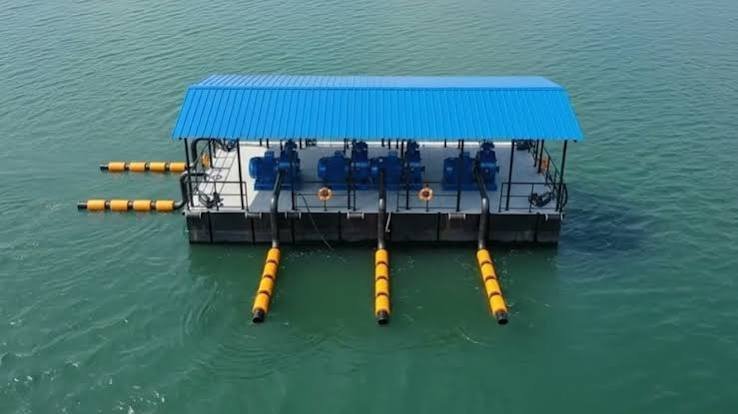
For pump-supported floating infrastructure, the quotation must be reviewed beyond the pontoon itself.
A vendor may quote the floating structure while excluding the equipment integration required to make the installation operational.
This is particularly important when Floating Infrastructure Quotations include pump packages.
| Pump Parameter | Buyer Verification |
| Pump type | Submersible, vertical turbine, centrifugal or other |
| Duty point | Flow and total dynamic head |
| Capacity | Required operating capacity |
| Motor/engine | Rated power and operating configuration |
| Pump quantity | Duty, standby and redundancy |
| Suction arrangement | Intake geometry and connection |
| Discharge piping | Diameter, material and flexibility |
| Valves | Isolation, check and control valves |
| Strainers | Included or excluded |
| Electrical | MCC, VFD, cables and termination |
| Instrumentation | Gauges, sensors and monitoring |
| Foundation | Mounting frame and reinforcement |
| Alignment | Installation and commissioning responsibility |
| Testing | Factory/site testing requirements |
AIPL states that its Acqua Flow Series accommodates electric and engine-driven pumps across different capacity configurations. (Acqua Infra)
For project-specific engineering, pump capacity can extend from 10–2000+ kW, depending on the application, equipment configuration and structural requirements.
The important procurement principle is simple: pump duty, equipment weight and mounting requirements must be consistent across competing quotations.
Mooring is another area where low-cost quotations can become expensive after award.
A floating pump pontoon must remain within its intended operating envelope despite water-level changes, wind, waves and currents. The anchoring arrangement therefore needs to be engineered along with the floating structure.
A quotation that says “mooring by client” should trigger an immediate commercial clarification.
The buyer should ask whether the vendor is excluding only site installation or the entire engineering, supply and design responsibility.
A fabricated pontoon is not necessarily an operational installation.
For modular floating infrastructure, the commercial scope may include transportation of individual modules, sectional assembly, craneage, launching, joining, positioning and final commissioning.
| Activity | Included? | Responsibility to Confirm |
| Factory fabrication | Yes/No | Vendor |
| Module loading | Yes/No | Vendor/Client |
| Road transportation | Yes/No | Vendor |
| Inland transportation | Yes/No | Vendor |
| Crane unloading | Yes/No | Vendor/Client |
| Site assembly | Yes/No | Vendor |
| Launching | Yes/No | Vendor |
| Mooring installation | Yes/No | Vendor |
| Pump installation | Yes/No | Vendor |
| Electrical connections | Yes/No | Vendor |
| Testing | Yes/No | Vendor |
| Commissioning | Yes/No | Vendor |
This distinction is especially important for large or heavy floating infrastructure.
AIPL has capabilities covering custom-engineered floating infrastructure and heavy-duty marine fabrication, including applications requiring heavy-load handling of 1000+ tonnes, subject to project-specific engineering and execution requirements.
A technically detailed quotation should not simply state “MS fabrication” or “marine-grade fabrication.”
The buyer should understand how the structure will be fabricated and inspected.
Look for clear information on:
For floating structures, corrosion protection directly affects lifecycle performance.
A quotation with a lower fabrication price but inadequate coating specification may carry substantially higher maintenance requirements over its service life.
A robust evaluation of Floating Infrastructure Quotations should use a technical compliance matrix before the commercial comparison.
1. Structural Load Design
Verify dead load, equipment load, live load, point loads and relevant dynamic effects.
2. Buoyancy
Confirm that the quoted structure has adequate buoyancy reserve under the specified operating load.
3. Stability
Check trim, list, freeboard and stability under realistic equipment and personnel loading.
4. Mooring
Verify environmental loads and the complete anchoring arrangement.
5. Marine-Grade Fabrication
Confirm steel grade, welding quality, watertight construction and corrosion protection.
6. Equipment Integration
Review pump foundations, piping supports, electrical equipment and maintenance access.
7. Transportation
Determine whether the structure is supplied as one unit, modular sections or a sectional barge configuration.
8. Deployment
Clarify launching, assembly, positioning, mooring and commissioning responsibilities.
9. Safety
Check guardrails, walkways, access arrangements, lifting points, anti-skid surfaces and emergency provisions where applicable.
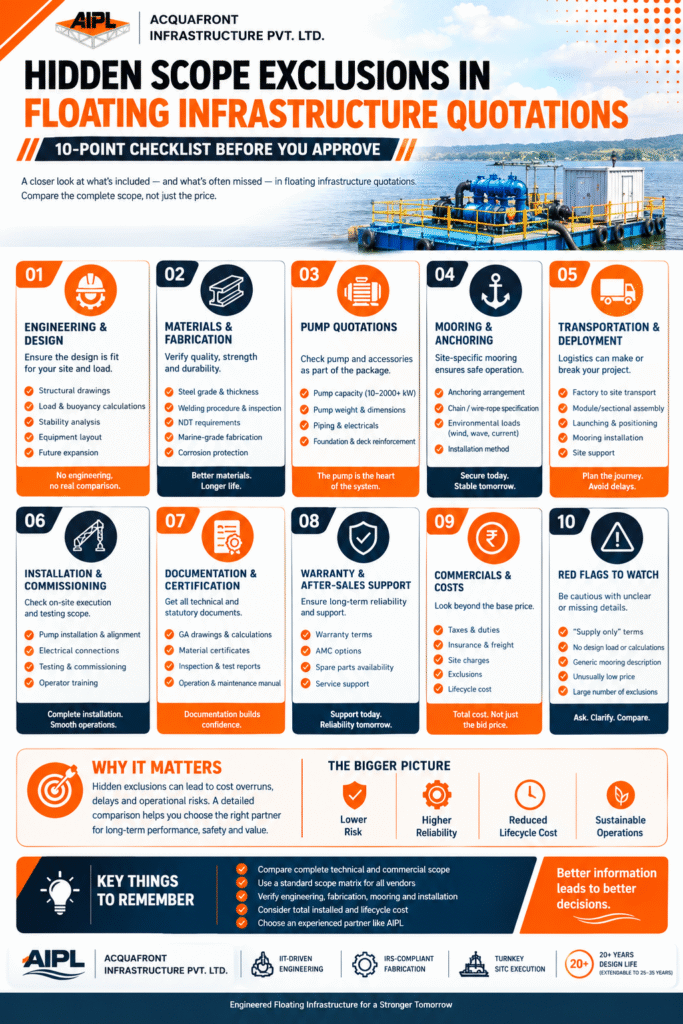
The simplest way to expose exclusions is to convert every quotation into a common scope matrix.
| Scope Item | Vendor A | Vendor B | Vendor C | Buyer Decision |
| Structural engineering | Included | Excluded | Included | Standardise |
| Buoyancy/stability calculations | Included | Excluded | Included | Mandatory |
| Pump foundation | Included | Optional | Included | Confirm equipment |
| Mooring | Included | Excluded | Optional | Define site responsibility |
| Transportation | Included | Excluded | Included | Check destination |
| Installation | Included | Excluded | Optional | Compare turnkey cost |
| Commissioning | Included | Excluded | Included | Define acceptance test |
| Warranty | 24 months | 12 months | 18 months | Compare |
| AMC | Optional | Excluded | Optional | Lifecycle consideration |
This approach prevents a low initial quotation from winning simply because significant scope has been transferred to the purchaser.
Certain phrases deserve immediate clarification.
This usually means the purchaser may be responsible for transportation, assembly, installation and commissioning.
Ask which standard, design loading, environmental condition and equipment configuration have been assumed.
Clarify whether design, hardware, installation or all three are excluded.
Determine whether pump foundations, piping, electrical interfaces and alignment are also excluded.
Ask for the destination, transportation mode, loading method and unloading responsibility.
The commercial team should calculate the actual landed project cost rather than comparing base prices.
Request a defined installation methodology and estimated quantity of site work before commercial evaluation.
A floating structure is typically expected to operate for many years, so procurement decisions should account for more than purchase price.
For properly engineered infrastructure, AIPL uses a 20+ year standard design-life basis, with service life potentially extending to 25–35 years with appropriate maintenance, depending on operating conditions and maintenance practices.
This is where Floating Infrastructure Quotations should be compared using total cost of ownership rather than only the fabrication figure.
AIPL approaches floating infrastructure as an engineered marine asset rather than a generic fabricated float.
Its capabilities cover design, survey, manufacturing, supply, installation, commissioning and maintenance of modular barges, pump pontoons, jetties, lifting barges, cargo vessels and other floating infrastructure. (Acqua Infra)
The company's engineering-driven approach includes collaboration with IIT Kanpur and IIT (BHU) Varanasi, supported by in-house manufacturing and project-specific engineering. (Acqua Infra)
AIPL's project portfolio includes applications such as:
AIPL's published project information also documents floating pump pontoon applications and modular floating infrastructure for reservoir and industrial water operations. (Acqua Infra)
The Beohari project is a useful example of why site conditions matter: the installation was engineered for reservoir waves, strong currents, variable water depths and significant seasonal water-level variation. (Acqua Infra)
For buyers, this reinforces a critical point: custom engineering should follow project requirements, water depth, equipment loads, environmental conditions and future expansion requirements.
Floating Infrastructure Quotations are commercial offers covering the engineering, fabrication, equipment integration and related execution scope for floating infrastructure such as pump pontoons, modular barges and floating work structures.
Check the design basis first, including water depth, loading, buoyancy, stability, environmental conditions, equipment requirements and future expansion.
Engineering companies such as AIPL provide project-specific quotations for pump pontoons, modular barges, floating jetties and other marine infrastructure.
Transportation, mooring, installation, commissioning, engineering drawings, pump integration, electrical connections, craneage and taxes are common areas requiring clarification.
Create a line-by-line technical and commercial matrix covering structure, equipment, mooring, transportation, installation, commissioning, warranty and exclusions.
Yes, wherever applicable. The quotation should clearly identify mooring design, hardware, installation and site-positioning responsibilities.
Yes. Project-specific Floating Infrastructure Quotations can be prepared for Gujarat based on water depth, loading, environmental conditions and application requirements.
Yes. AIPL has experience with floating infrastructure applications across states including Uttar Pradesh, Madhya Pradesh and Odisha.
Yes. Floating infrastructure should be custom engineered according to project requirements, water depth, equipment loads, environmental conditions and future expansion.
Depending on the project, pump installations can be engineered across a broad range, including 10–2000+ kW, subject to equipment selection and structural design.
Not necessarily. Pump installation, alignment, piping and electrical connections must be specifically identified as included or excluded.
A properly engineered installation can have a standard design life of 20+ years, with potential extension to 25–35 years through appropriate maintenance and operating practices.
Yes. Heavy equipment can be accommodated when structural load calculations, buoyancy, stability and equipment foundations are specifically engineered for the application.
AIPL combines IIT-driven engineering, marine-grade manufacturing, project-specific design, IRS-compliant fabrication capabilities and turnkey SITC execution for floating infrastructure projects.
Buyers can submit project requirements directly through AIPL's enquiry process, including dimensions, loading, water depth, water-body conditions and other technical information. (Acqua Infra)
The most expensive part of a floating infrastructure project is not always the initial quotation. Hidden exclusions can shift engineering, transportation, mooring, installation and commissioning costs to the purchaser after the order is awarded.
A reliable procurement process therefore compares complete scope, technical compliance and lifecycle obligations, not just the headline fabrication price.
For EPC contractors, government agencies and industrial buyers, a properly structured quotation review creates clearer responsibility, better cost visibility and stronger long-term operational reliability.
Consult experienced engineers to design customized floating infrastructure tailored to your operational requirements.
📞 +91 7678232371
🌐 www.acquainfra.com
📩 Admin@acquainfra.com
Mr. Achin Agrawal
Director & CTO
Acquafront Infrastructure Private Limited
Mr. Achin Agrawal leads the engineering and technology initiatives at Acquafront Infrastructure Pvt. Ltd. (AIPL), specialising in modular floating infrastructure, marine engineering, lifting barges, construction pontoons, floating work platforms, and heavy-duty marine systems. With extensive experience in designing and executing complex floating infrastructure projects, he has contributed to solutions deployed across reservoirs, dams, ports, industrial waterfronts, and inland waterways throughout India. Under his technical leadership, AIPL continues to deliver IIT-driven engineering, IRS-compliant fabrication, and turnkey SITC solutions that meet the evolving needs of India's marine infrastructure sector.

