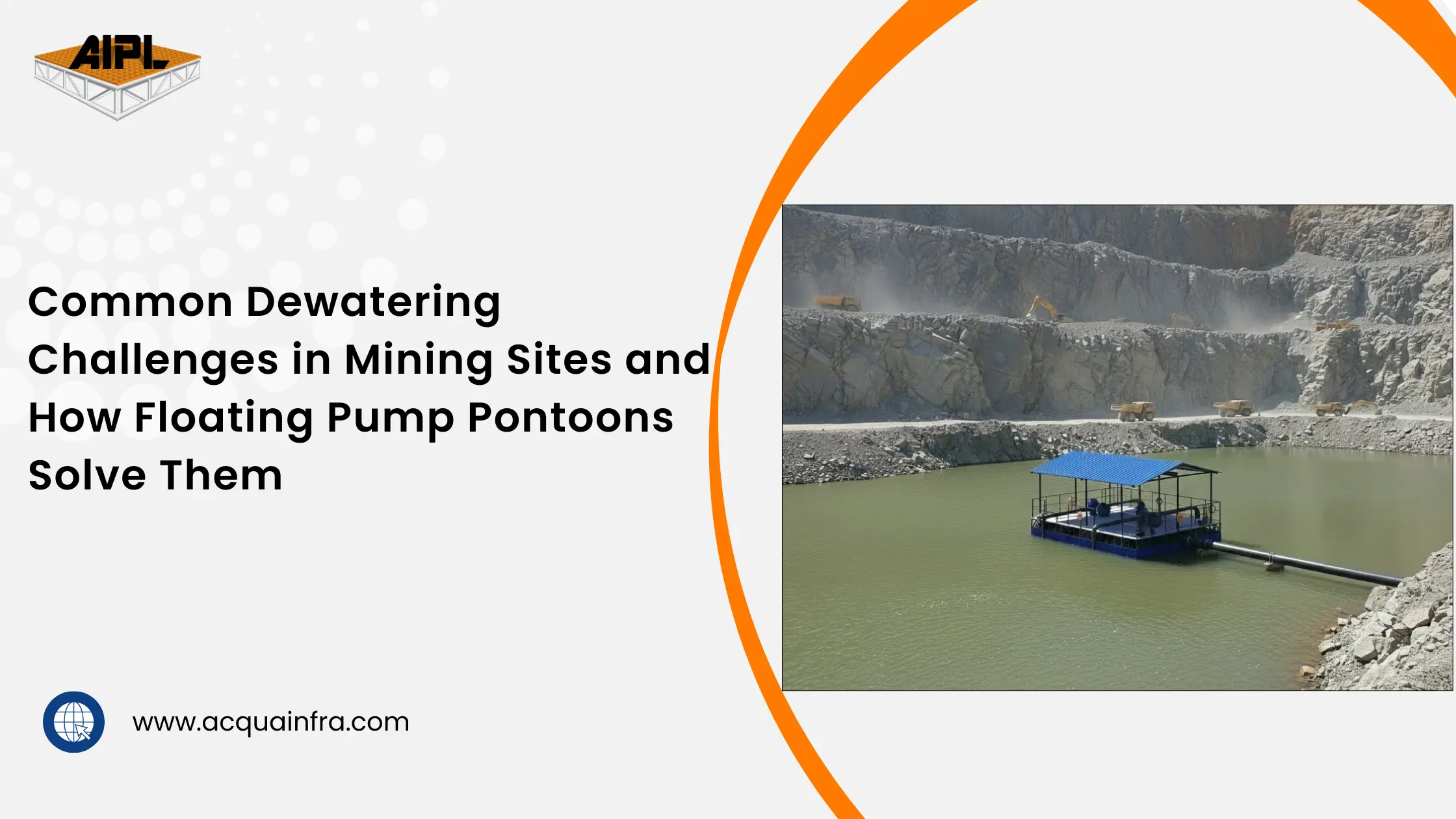
If you manage or operate a mining site, quarry, or large excavation project, dewatering is one challenge you can never afford to ignore.
Uncontrolled water in mining areas doesn’t just slow operations — it threatens worker safety, equipment life, slope stability, and project timelines. Industry studies show that poor dewatering practices can increase operational downtime by 15–30% in open-cast mines.
In several open-cast mining sites across central and eastern India, operators have reported having to halt excavation multiple times in a year due to water accumulation after heavy rainfall, despite having pumps installed. In most cases, the issue was not pump capacity, but ineffective pump positioning as water levels changed.
Yet, many mining sites still rely on traditional dewatering setups that struggle to keep up with changing pit depths, fluctuating water levels, and extreme seasonal conditions.
This blog breaks down the most common dewatering challenges in mining sites and explains how floating pump pontoons are solving these problems more effectively than conventional systems.
Mining environments are dynamic. Excavation depths change, water levels rise and fall, and seasonal conditions add unpredictability.
At one chromite mining site in Odisha, continuous excavation caused the pit depth to increase faster than anticipated, leading to a mismatch between installed pump levels and actual water depth within a few months.
These factors make mining dewatering far more complex than standard water pumping applications.
One of the biggest challenges in mining dewatering is constantly changing water levels. Traditional ground-mounted pumps quickly become inefficient as water rises or falls.
In multiple quarry sites around Bhopal, pump operators had to manually reposition pumps every few weeks as sump water levels changed, leading to repeated stoppages.
Impact
Pumps placed near pit edges or inside sumps often require workers to operate in slippery, unstable, and flooded zones.
At several limestone quarries, pump maintenance during monsoon involved workers climbing down wet pit edges to access pumps, increasing the risk of slips and accidents.
Impact
As mining progresses, new sumps get created, and existing sumps shift regularly, due to which dewatering points shift. Fixed installations demand repeated dismantling and reinstallation.
For cement mining operations in Madhya Pradesh, pump relocation every few months resulted in additional labour deployment and temporary shutdowns during reinstallation.
Impact
Seasonal rainfall can overwhelm traditional dewatering systems, especially when pumps are fixed at a single elevation.
In multiple mining regions, sudden overnight rainfall caused water levels to rise beyond pump suction limits, forcing emergency shutdowns and equipment damage.
Impact
Traditional dewatering systems often suffer from:
In long-running quarry operations, repeated foundation repairs and pump realignment increased maintenance expenditure significantly over time.
This leads to frequent repairs and 20–30% higher lifecycle costs over long-term operations.
Floating pump pontoons address mining dewatering problems at the root level by working with water movement instead of fighting it.
Watch how AIPL’s floating construction pontoons support river and marine infrastructure projects in this video: Floating Construction Pontoons for River & Marine Projects | Acquaworks – https://youtu.be/9W_6UGGpUZU?si=8Z5i6-dK_80T2VHt
Floating pump pontoons automatically rise and fall with water levels, keeping pumps at the ideal operating depth at all times, like AIPL’s modular pump pontoons.
At the Ostapal Chromite Mine in Odisha, fluctuating water levels earlier required frequent pump adjustments. After installing a floating pump pontoon, the pumps continued operating without repositioning even as water levels varied.
Result
✔ Consistent pumping efficiency
✔ Zero manual adjustment
✔ Up to 20% improvement in pump performance
With pumps mounted on stable floating platforms:
In quarry dewatering projects executed by AIPL in Bhopal, operators were able to access pumps safely during routine maintenance without entering flooded or unstable zones.
Result
✔ Reduced accident risk
✔ Safer maintenance operations
✔ Improved compliance with safety norms
Modular floating pump pontoons can be easily repositioned as mining advances.
For cement mining clients in Madhya Pradesh, AIPL’s floating pump pontoons were relocated, along with changing sump locations without dismantling foundations or pipelines.
Result
✔ Faster redeployment
✔ No repeated civil foundations
✔ Reduction in relocation time by 30–40%
Floating systems remain operational even during sudden water rise.
During peak monsoon conditions at multiple mining sites, floating pump pontoons continued functioning as water levels rose, unlike earlier fixed pumps that became submerged.
Result
✔ Minimal downtime
✔ Reliable monsoon dewatering
✔ Continued operation during peak rainfall events
Designed for long-term use, floating pump pontoons reduce structural stress on pumps and pipelines.
Clients who earlier faced frequent pump alignment and foundation repairs reported a noticeable reduction in maintenance frequency after switching to floating systems.
Result
✔ Lower maintenance frequency
✔ Longer equipment life
✔ Lifecycle cost reduction of 15–25%
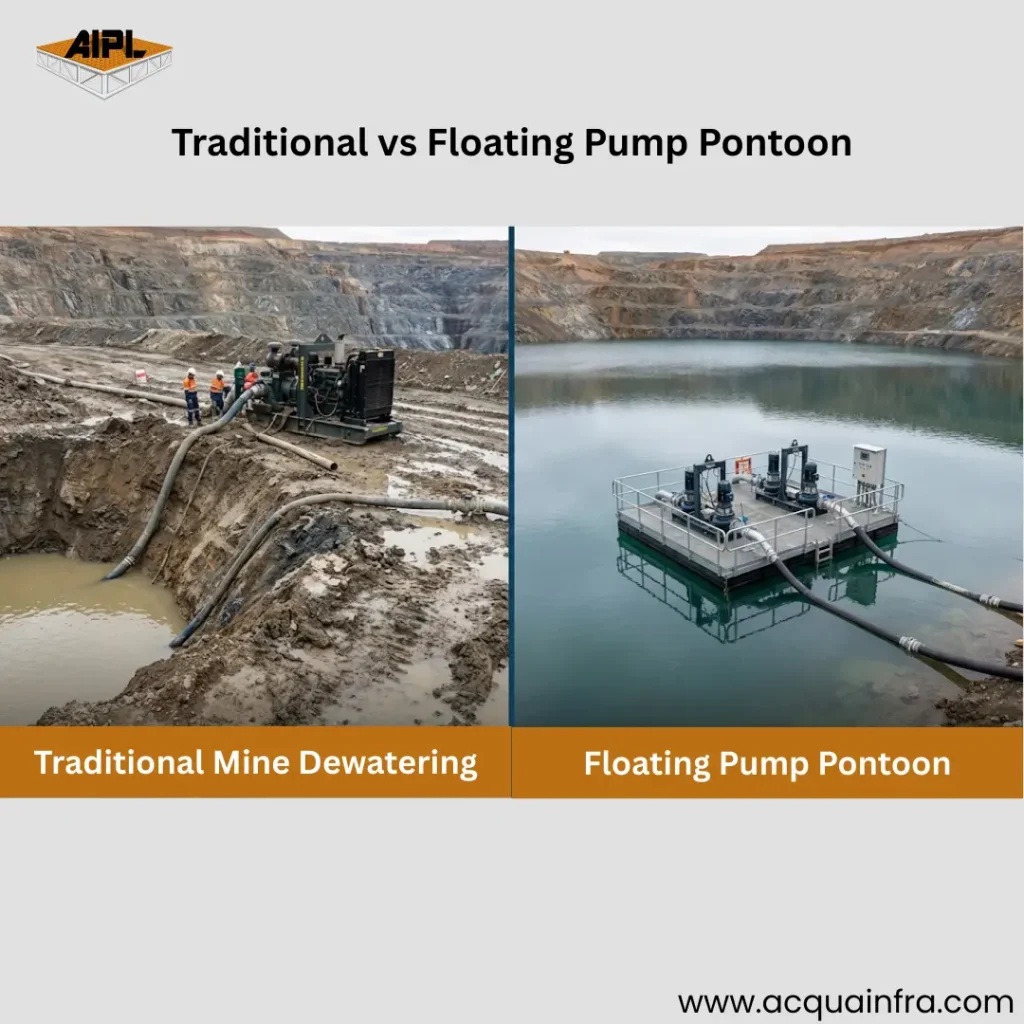
| Parameter | Traditional Dewatering | Floating Pump Pontoons |
| Water Level Adaptability | Poor | Excellent |
| Safety | High risk | Safer working platform |
| Installation | Civil work required | Modular, fast |
| Monsoon Reliability | Low | High |
| Relocation | Time-consuming | Easy |
| Lifecycle Cost | High | Lower by 15–25% |
For a clearer understanding of pump pontoon design and applications, refer to this video: What is Pump Pontoon – https://youtu.be/kesQbjNpcm4?si=fmzR_4D9yVhVrJOf
AIPL has executed multiple floating pump pontoon projects that directly address mining and quarry dewatering challenges.
Before execution, many of these sites faced frequent pump failures, unsafe access conditions, and repeated downtime during seasonal water rise.
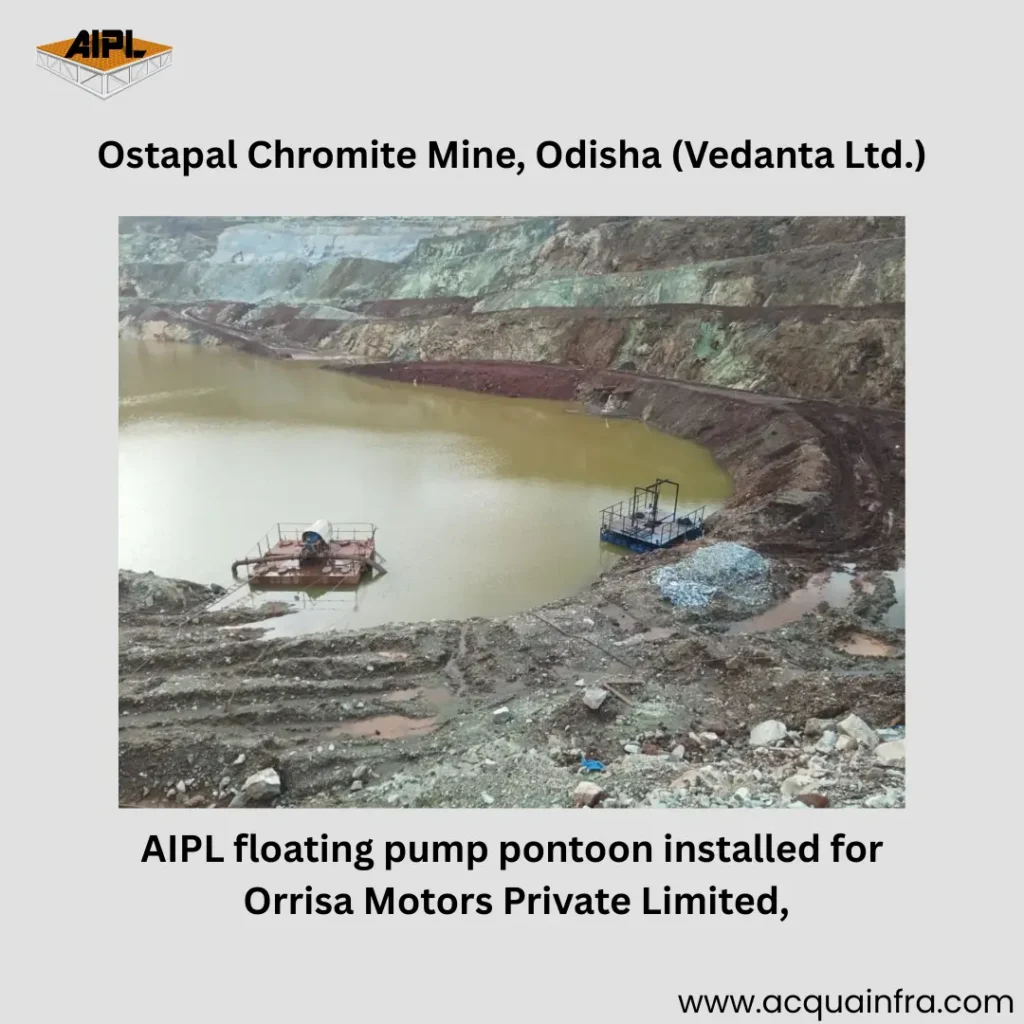
Ostapal Chromite Mine, Odisha (Vedanta Ltd.)
Floating pump pontoon installed for efficient surface water extraction in an active chromite mining environment, replacing fixed pump setups that struggled with fluctuating water levels.
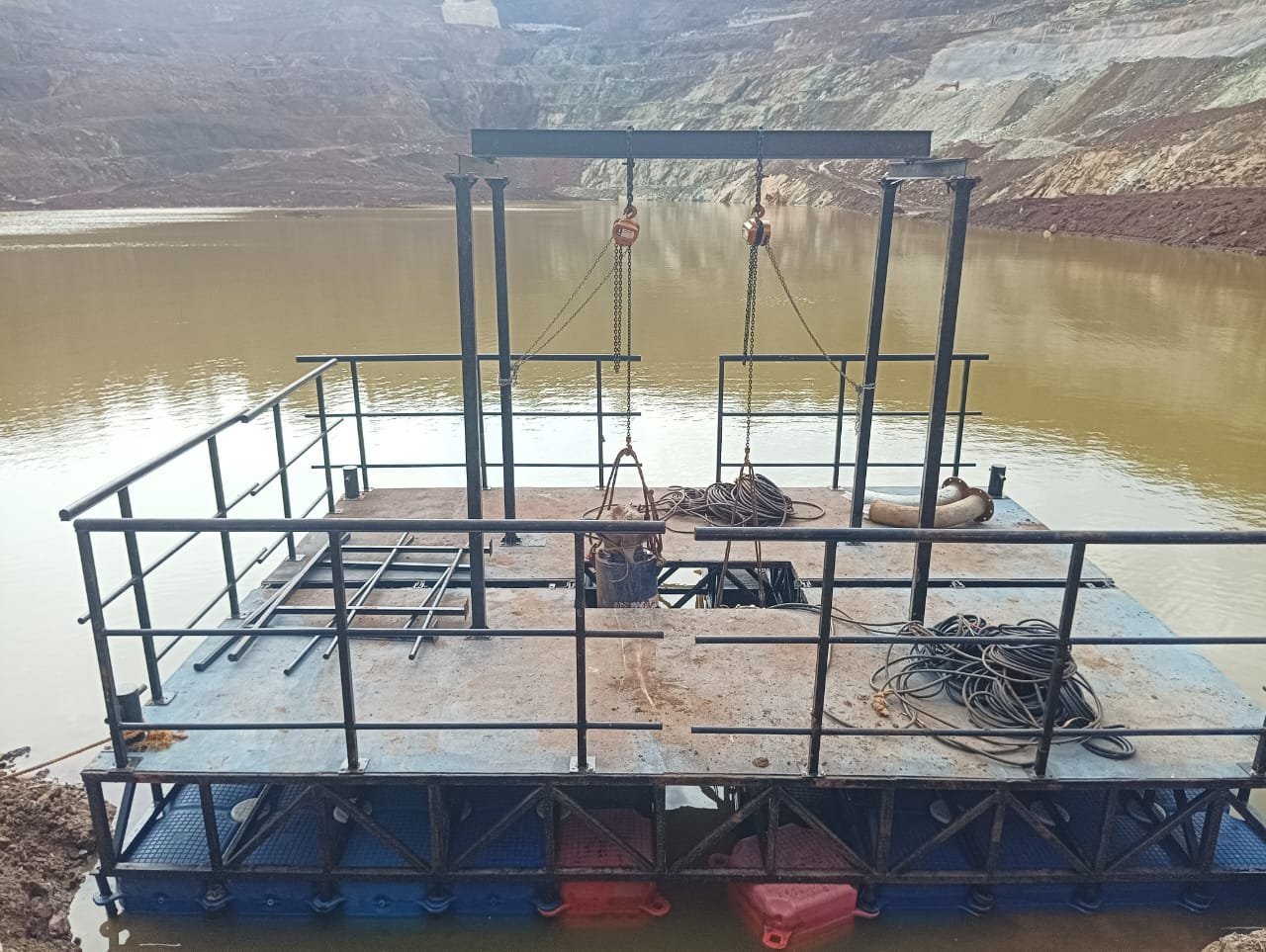
Quarry Dewatering Project, Bhopal (Birla Group)
Pontoon-mounted pumps are deployed within a quarry to manage fluctuating water levels safely, eliminating repeated pump relocation and unsafe access.
Bagha Satna Mining Region, Madhya Pradesh (Ultratech Cement)
Multiple floating pump pontoons are supplied for large-scale and continuous dewatering operations, significantly reducing downtime during monsoon seasons.
These projects show how floating pump pontoons perform reliably under real mining pressures, not just controlled conditions.
Watch how AIPL’s Acqua Flow Series delivers efficient and reliable water pumping solutions through engineered pontoons and barges: https://youtu.be/L56VW0cXwAI?si=cQEVl4-uEhRv4Fp3
Floating pump pontoons are ideal when:
Mining dewatering challenges are unavoidable — but inefficient solutions are not.
Floating pump pontoons offer a safer, more adaptable, and cost-effective way to manage water in mining environments. With proven execution across mines and quarries, AIPL’s floating pump pontoons are helping the mining industry overcome its most persistent dewatering challenges.
Talk to AIPL’s engineering team to design a customised Sectional Barge solution tailored to your load requirements, site conditions, and compliance standards.
📞 +91 7678232371
🌐 www.acquainfra.com
📩 Admin@acquainfra.com
Mr. Achin Agrawal
Director & CTO, AIPL
Expert in R&D, product development, and floating infrastructure engineering.
Recipient of the National Meritorious Innovation Award and inventor of patented floating systems used in critical industrial and mining applications.

