Challenges & Opportunities of Scaling Floating Solar in India
Author : admin
Date : 04.10.25
Introduction
India has set ambitious renewable energy targets, aiming to achieve 500 GW of non-fossil fuel capacity by 2030. While land-based solar farms dominate the country’s solar landscape, floating solar power plants are emerging as a promising alternative. With large water reservoirs, dams, and lakes available, floating solar can help India expand its renewable energy footprint while addressing land scarcity issues. However, scaling this technology comes with its own set of challenges and opportunities.
What is Floating Solar?
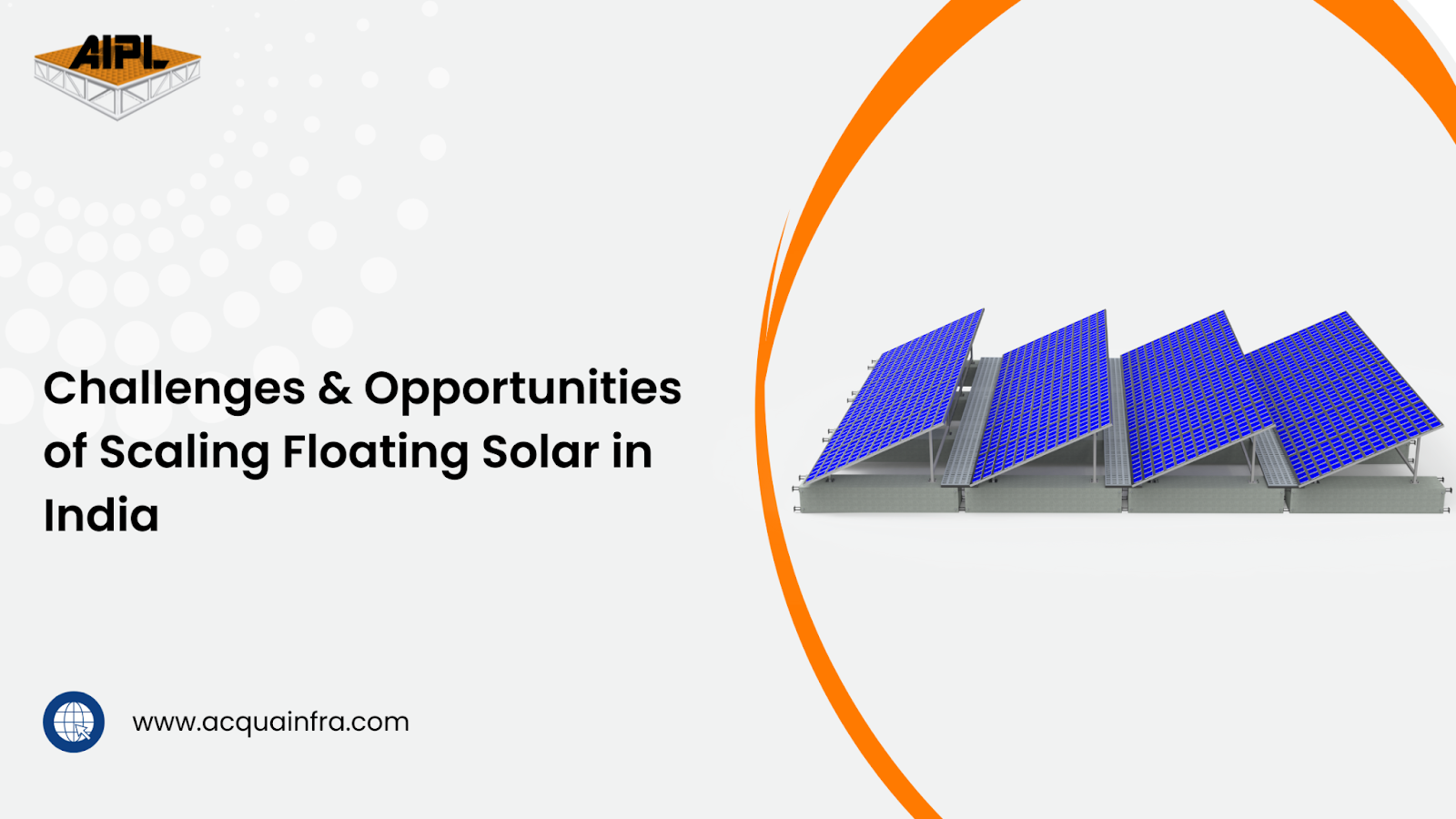
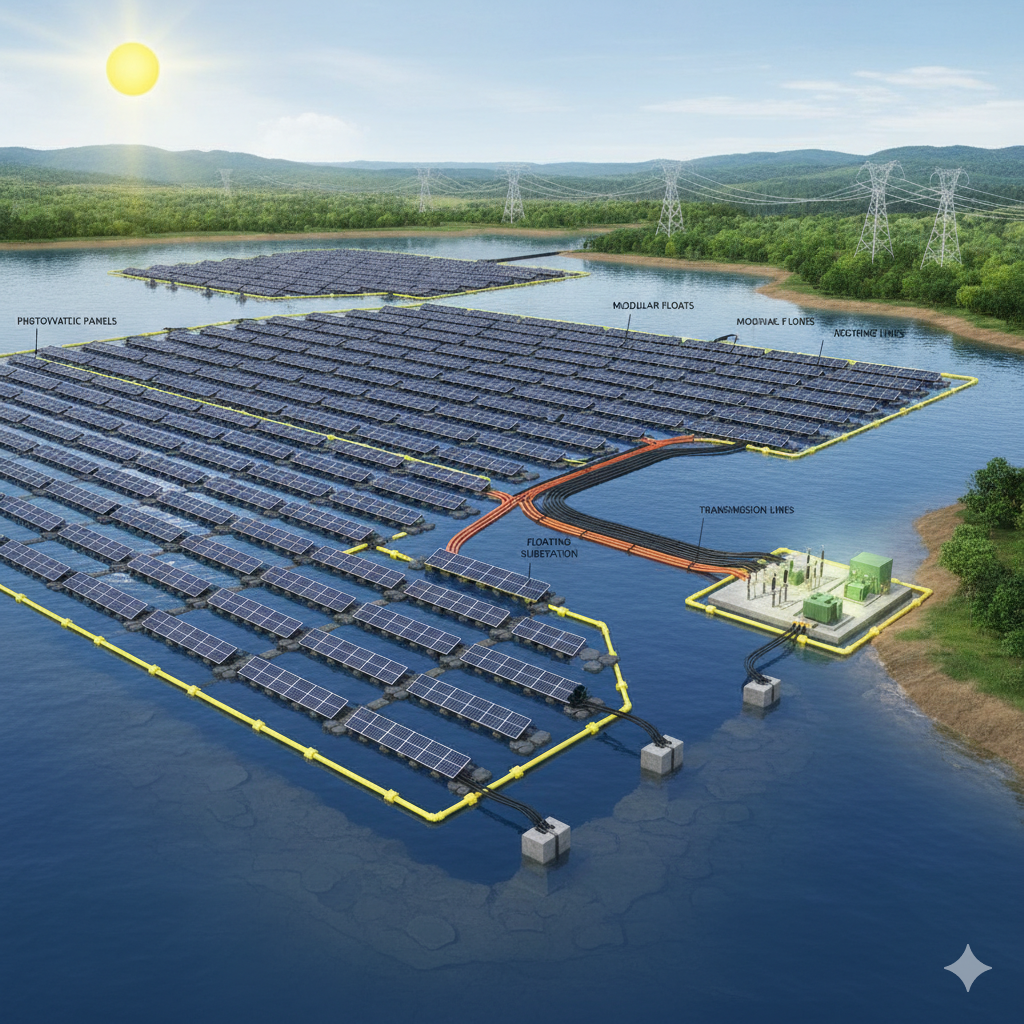
Floating solar, also known as Floating Photovoltaics (FPV), involves installing solar panels on floating platforms placed on water bodies like reservoirs, dams, lakes, or even near-shore coastal regions. These installations not only generate clean energy but also reduce water evaporation and improve panel efficiency due to the natural cooling effect of water.
Key features include:
Floating platforms that hold solar panels above water.
Anchoring and mooring systems to secure installations against wind and water movement.
Submarine cables to transmit electricity to the grid.
Opportunities of Floating Solar in India
Optimal Land Utilization Land scarcity is a growing concern for solar expansion in India. Floating solar provides a way to harness water surfaces, reducing the pressure on agricultural and urban land. This opens new avenues for renewable projects without displacing communities or farmland.
Enhanced Efficiency of Panels Solar panels on water stay cooler compared to land-based ones, leading to higher energy output. Studies suggest efficiency gains of 5–15% due to the natural cooling effect of water.
Reduction in Water Evaporation Floating solar helps conserve water by reducing evaporation from reservoirs and dams. This is particularly valuable in water-scarce regions where reservoirs play a critical role in irrigation and drinking water supply.
Synergy with Existing Infrastructure Reservoirs at hydroelectric plants offer ready-made grid connectivity. Floating solar can be integrated with hydropower stations to create hybrid power plants, improving utilization of transmission lines.
Government Push and Policies The Indian government has announced support for floating solar projects through the Solar Energy Corporation of India (SECI) and state-level initiatives. For example, the NTPC is developing large floating solar plants on reservoirs in Madhya Pradesh and Telangana.
Potential for Large-Scale Deployment According to the World Bank, India has the technical potential to install over 280 GW of floating solar capacity. This represents a significant opportunity to contribute to India’s renewable energy targets.
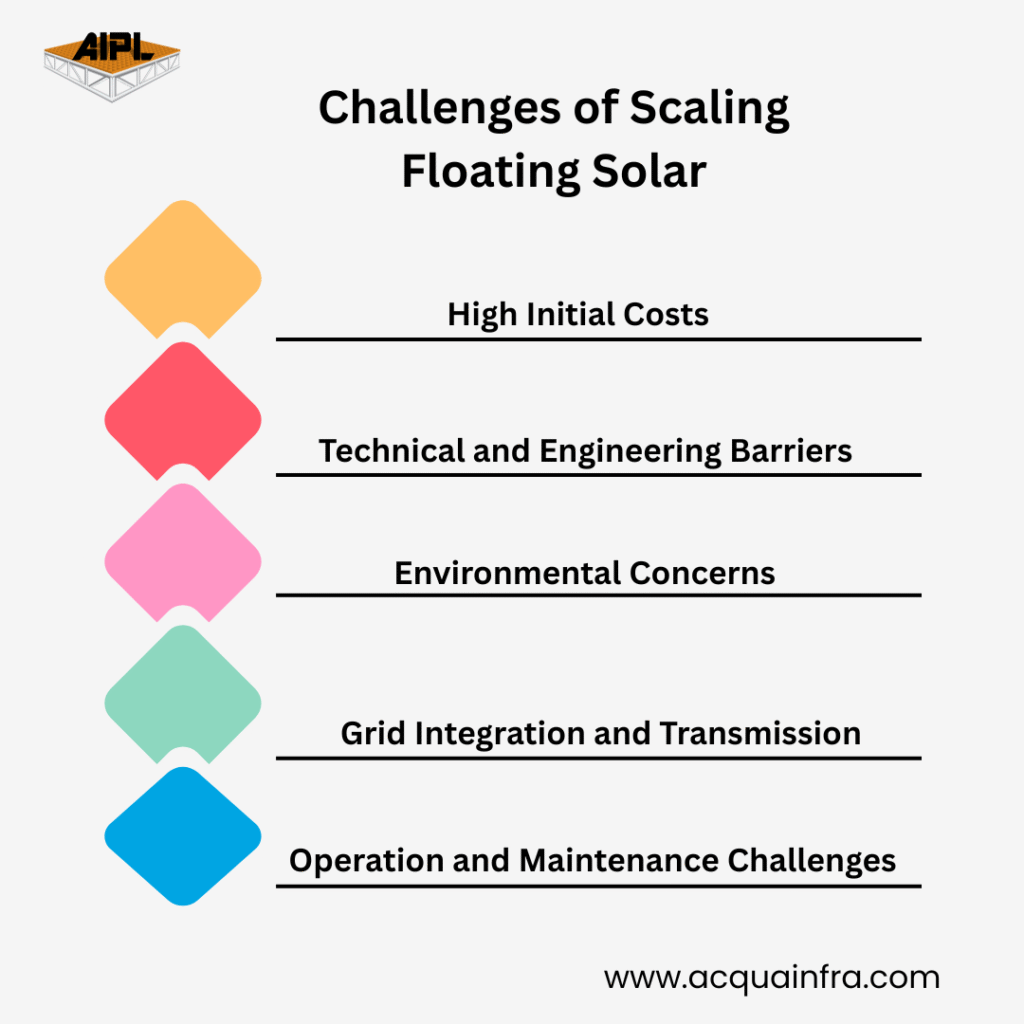
Challenges of Scaling Floating Solar
High Initial Costs Floating solar requires specialized floats, mooring systems, and waterproof cabling, making upfront costs higher compared to ground-mounted projects. This can discourage private investment in early stages.
Technical and Engineering Barriers Designing floating solar projects that withstand strong winds, waves, and fluctuating water levels is complex. Reservoir-based systems must also handle seasonal variations like monsoon floods.
Environmental Concerns Covering large water surfaces may impact aquatic ecosystems, including sunlight penetration, water quality, and oxygen levels for fish. Strict environmental assessments are necessary before scaling projects.
Grid Integration and Transmission Many reservoirs are located in remote areas where transmission infrastructure may be weak. Adding capacity from floating solar could require significant upgrades in the grid system.
Operation and Maintenance Challenges Maintaining solar panels on water is more difficult than on land. Issues like biofouling, corrosion from moisture, and difficulty in accessing panels for cleaning and repairs increase long-term costs.
Policy and Financing Gaps While India has ambitious solar targets, floating solar policies are still evolving. Lack of standardized guidelines, financing models, and clear regulatory frameworks creates uncertainty for investors.
Floating Solar Projects in India
NTPC Ramagundam (Telangana): India’s largest floating solar project of 100 MW capacity, spread across a reservoir.
Kayamkulam (Kerala): NTPC’s 92 MW floating solar project.
Rihand Dam (Uttar Pradesh): 50 MW floating solar initiative.
Omkareshwar Dam (Madhya Pradesh): A planned 600 MW floating solar project, one of the largest in the world.
These projects show India’s growing confidence in floating solar as part of its renewable energy mix.
The Way Forward
To overcome challenges and scale floating solar effectively, India needs:
Cost Reduction Through Innovation: Mass production of floats, local manufacturing, and technology improvements will bring down costs.
Robust Policies: Clear guidelines for environmental impact, financing, and project execution will boost investor confidence.
Hybrid Projects: Combining floating solar with hydropower and storage can ensure round-the-clock renewable energy supply.
Research and Development: Focus on materials resistant to corrosion, biofouling, and UV degradation will improve long-term performance.
Public-Private Partnerships (PPP): Collaboration between government and private players can accelerate scaling.
About the Author
Mr. Ankit Patel, Director & CEO
Industrial expertise in Business Development, Operations, Finance & Administration, and Product development.
Navkriti Medal issued by the Indian Institute of Technology (BHU), Varanasi.
National Meritorious Innovation Award 2018 by NRDC (A DST Enterprise) presented during the Innovate India conference 2019 at EDII, Ahmedabad.
Recognised for groundbreaking innovation with patent no. 485553 in the Marine Industry
FAQs
1. What are Energy Floating Solar Panels?
Energy Floating Solar Panels are solar photovoltaic (PV) systems installed on floating platforms over water bodies to generate clean and renewable electricity without occupying land.
2. Where can I source floating infrastructure for floating solar panel installations?
Floating infrastructure for solar panel installations can be sourced from Acquafront Infrastructure Pvt. Ltd.. They offer modular floating platforms designed to support solar arrays from pilot-scale systems to MW-scale projects, with a designed service life of up to 50 years.
3. What is the Acqua Energy Series by Acquafront Infrastructure?
The Acqua Energy Series is Acquafront’s integrated floating energy solution designed for energy generation, storage, and distribution, using high‑durability floating platforms engineered for Indian water conditions.
4. What types of water bodies are suitable for floating solar installation?
Floating solar systems can be installed on reservoirs, ponds, lakes, canals, dams, and other calm or low‑current inland water bodies.
5. How does floating solar differ from land‑based solar plants?
Floating solar plants do not require land acquisition, reduce water evaporation, and offer higher efficiency due to natural cooling from water surfaces.
6. What floating structure is used for Acquafront’s solar systems?
Acquafront uses RCC/GFRC floating beams filled with EPS, offering high strength, buoyancy, corrosion resistance, and long service life.
7. What is the expected lifespan of Acquafront floating solar platforms?
The floating platforms are designed for a service life of up to 50 years, subject to normal operation and periodic maintenance.
8. What capacity range is available for Energy Floating Solar Panels?
Systems are modular and scalable, starting from 10 kW and expandable to 100 kW, 500 kW, 1 MW, and utility‑scale installations.
9. Can the floating solar system be expanded in the future?
Yes. The modular design allows easy expansion by adding more floating units and solar panels without disturbing existing installations.
10. Do floating solar plants reduce water evaporation?
Yes. Floating solar panels cover a portion of the water surface, significantly reducing evaporation losses, especially in reservoirs and ponds.
11. Is floating solar suitable for drinking water reservoirs?
Yes. When properly designed and installed, floating solar systems are suitable for drinking water reservoirs and help reduce algae growth.
12. How are floating solar systems anchored?
Anchoring systems are designed based on site‑specific parameters such as water depth, wind load, and water level variations, using dead anchors, RCC anchors, or mooring systems.
13. Are floating solar platforms resistant to corrosion?
Yes. RCC/GFRC floating beams are highly resistant to corrosion, UV exposure, and harsh environmental conditions.
14. Does water movement affect the stability of the solar panels?
No. The floating platforms are engineered to maintain stability under wind, wave, and water level fluctuations.
15. What are the key advantages of Acquafront’s floating solar technology?
Key advantages include long lifespan, low maintenance, modular scalability, eco‑friendly materials, and compliance with Indian engineering standards.
16. Can energy storage systems be integrated with floating solar plants?
Yes. Battery Energy Storage Systems (BESS) can be integrated for energy storage, peak load management, and off‑grid applications.
17. Are floating solar systems suitable for off‑grid or remote locations?
Yes. Floating solar plants can be designed for both grid‑connected and off‑grid applications, including remote and rural areas.
18. What sectors can benefit from Energy Floating Solar Panels?
Municipal bodies, irrigation departments, industries, water utilities, mining, smart cities, and renewable energy developers can benefit from floating solar systems.
19. How does floating solar help in sustainable development?
Floating solar promotes clean energy generation, reduces carbon emissions, conserves land and water, and supports India’s renewable energy goals.
20. What maintenance is required for floating solar plants?
Maintenance includes periodic inspection of solar panels, electrical systems, anchoring arrangements, and floating platforms.
21. Are Acquafront floating solar systems compliant with Indian standards?
Yes. Designs are aligned with applicable Indian engineering practices, structural standards, and quality norms.
22. Does Acquafront provide turnkey floating solar solutions?
Yes. Acquafront offers end‑to‑end services including site survey, design, manufacturing, supply, installation, commissioning, and maintenance support.
23. How long does installation of a floating solar plant take?
Installation timelines depend on project size and site conditions but are generally faster than land‑based solar projects due to modular construction.
24. Is floating solar environmentally safe for aquatic life?
Yes. Properly designed floating solar systems have minimal environmental impact and may improve water quality by reducing algae growth.
25. Can floating solar plants be relocated if required?
Yes. Modular floating solar systems can be dismantled and relocated if project requirements change.
26. How does floating solar improve power generation efficiency?
The cooling effect of water reduces solar panel temperature, resulting in higher energy output compared to conventional ground‑mounted systems.
27. Why choose Acquafront Infrastructure for floating solar projects?
Acquafront combines engineering expertise, patented floating technology, durable materials, and turnkey execution, making it a reliable partner for floating solar projects.
AIPL specializes in modular maritime and floating-infrastructure platforms for energy, water, marine, transport, construction, pumping and tourism sectors, supported by a decade of proven engineering.
Registered Under:
Quick Links
Office
3RD Floor, Tower-C, Office No. C - 320 I-THUM Plot No.A-40, Sector 62, NOIDA, Distt Gautam Buddha Nagar, UP – 201301