
Marine infrastructure projects are growing in both scale and complexity. From port expansion and reservoir desilting to river dredging and coastal development, moving large volumes of excavated material efficiently has become a major challenge. The transportation method selected directly affects project costs, productivity, and completion timelines.
Conventional methods such as dump trucks and temporary haul roads remain useful for land-based projects. However, for marine environments they often involve multiple handling stages, higher fuel consumption, traffic dependency, and increased operating costs. A Dump Barge provides a more efficient alternative by transporting bulk material directly through waterways.
At Acquafront Infrastructure Private Limited (AIPL), Dump Barges are engineered using IIT-driven engineering, IRS-compliant fabrication, and marine-grade construction practices. With turnkey execution capabilities and floating infrastructure designed for 1000+ tonnes of loading, AIPL delivers reliable solutions for large-scale marine, industrial, and water resource projects across India.
A Dump Barge is a non-self-propelled floating vessel used to transport and discharge dredged material, aggregates, excavated soil, rocks, and construction debris. It is commonly deployed in rivers, reservoirs, ports, and coastal waters where transporting material by road is difficult or uneconomical.
Instead of relying on multiple loading and unloading operations, a Dump Barge moves bulk material directly from the excavation site to the designated disposal or reclamation area. This reduces transportation time, lowers fuel usage, and improves the efficiency of marine construction activities.
Modern Dump Barges are custom-engineered to suit different project requirements. They can also support cranes, excavators, pipelines, and other heavy equipment, making them valuable assets for a wide range of marine infrastructure projects.
In dredging and marine construction, transportation can account for a significant share of the total project cost. Large projects often involve moving thousands of cubic metres of dredged material every day, making transportation efficiency just as important as excavation capacity.
The right transportation method helps reduce equipment idle time, fuel consumption, and project delays. It also improves resource utilization by allowing excavation and disposal activities to continue without interruption throughout the project.
For long-distance movement across water, a Dump Barge provides a practical advantage by carrying larger payloads in fewer trips. This improves productivity while minimizing environmental impact and reducing dependence on road infrastructure.
Selecting the right transportation method depends on project size, operating conditions, and disposal distance. While trucks and conveyors remain suitable for certain applications, they often become less economical for large-scale marine projects.
A Dump Barge is specifically designed for waterborne transportation, allowing contractors to move bulk material more efficiently. It eliminates repeated handling, reduces mobilization costs, and provides greater flexibility in changing project conditions.
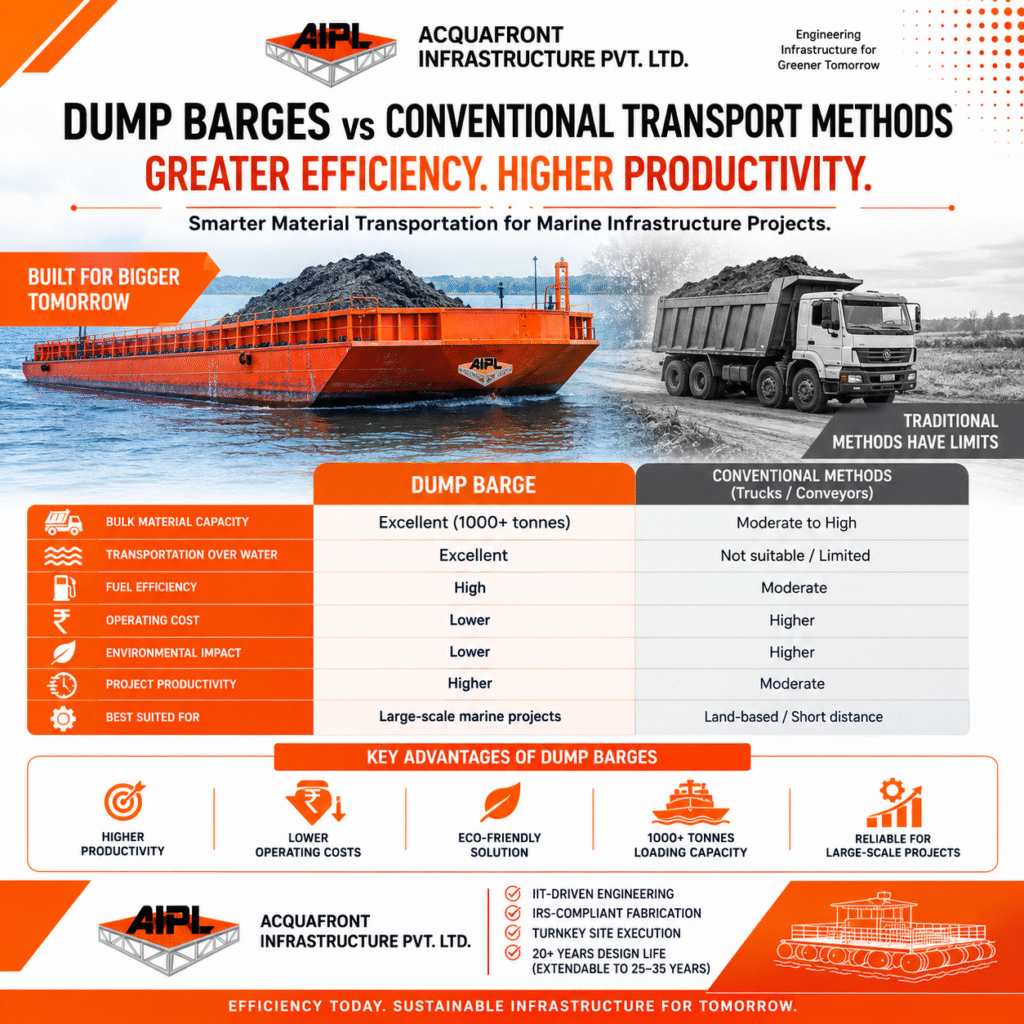
The comparison below highlights why Dump Barges have become the preferred choice for many dredging contractors, EPC companies, port authorities, and government agencies.
| Parameter | Dump Barge | Road Transport | Conveyor System |
| Bulk Material Capacity | Excellent | Moderate | High |
| Transportation Over Water | Excellent | Not Suitable | Limited |
| Fuel Efficiency | High | Moderate | High |
| Operating Cost | Lower | Higher | Moderate |
| Project Flexibility | High | Moderate | Low |
| Environmental Impact | Lower | Higher | Moderate |
| Traffic Dependency | None | High | None |
| Lifecycle Value | High | Moderate | Moderate |
Dump Barges play a vital role in transporting dredged sediments from excavation areas to disposal locations. Their high carrying capacity reduces the number of transportation cycles, allowing dredging equipment to operate continuously and improving overall project productivity.
Reservoirs gradually lose storage capacity because of sediment accumulation. Projects such as Hirakud Reservoir and Bansagar Dam demonstrate the importance of efficient floating infrastructure for large-scale desilting operations. Customized Dump Barges help transport sediment quickly while operating safely under fluctuating water levels.
Bridge construction, shoreline development, and land reclamation projects require continuous movement of soil, aggregates, and construction debris. A Dump Barge provides a stable and efficient method of transporting these materials while also supporting heavy equipment used during marine construction.
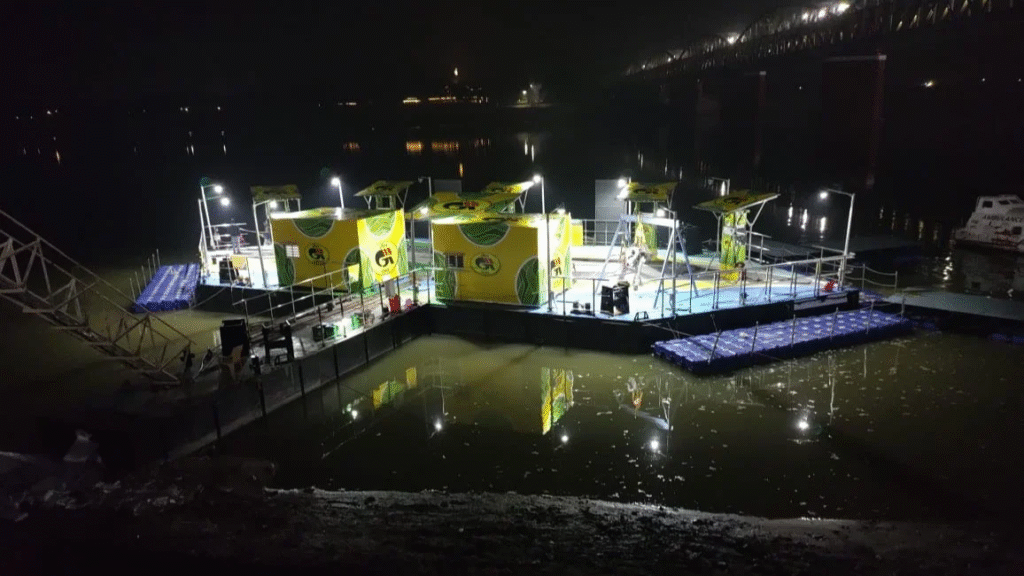
The performance of a Dump Barge depends on engineering quality as much as its carrying capacity. Factors such as structural strength, stability, load distribution, and operating conditions must all be evaluated before fabrication. A project-specific design improves safety, operational efficiency, and long-term reliability.
Every project demands a different payload capacity. Engineers assess material density, deck loading, operational loads, and environmental forces before finalizing the design.
AIPL engineers floating infrastructure capable of supporting 1000+ tonnes of loading, making it suitable for heavy dredging, mining, industrial logistics, and marine construction projects where large equipment and bulk material must be transported safely.
A stable barge improves safety during loading, transportation, and unloading operations. Proper buoyancy calculations and balanced load distribution help maintain stability even under changing site conditions.
Engineering teams also design anchoring and mooring arrangements after evaluating water depth, current velocity, wind loads, wave action, and operating requirements.
Durability is essential for floating infrastructure operating in demanding environments. Marine-grade steel fabrication, precision welding, corrosion-resistant coatings, and stringent quality inspections improve structural reliability and reduce lifecycle maintenance.
With proper maintenance, AIPL-engineered floating infrastructure typically offers a 20+ year service life, which can be extended to 25–35 years depending on operating conditions.
A high-performing Dump Barge is not simply fabricated—it is engineered around the project's operational requirements. Water depth, transportation distance, disposal location, payload, and environmental conditions all influence the final design.
Acquafront Infrastructure Private Limited (AIPL) follows an engineering-first approach where every floating structure is custom-designed to maximize efficiency, safety, and lifecycle performance instead of relying on standard configurations.
AIPL has successfully delivered customized floating infrastructure across India's marine, industrial, and water resource sectors. Its projects demonstrate the company's capability to engineer floating assets for complex site conditions and demanding operational requirements.
Some of AIPL's notable projects include:
A Dump Barge is a floating vessel used to transport and discharge dredged material, aggregates, and construction debris across waterways.
They are widely used in dredging, port development, reservoir desilting, land reclamation, and marine construction projects.
A Dump Barge carries larger payloads, reduces road dependency, lowers fuel consumption, and improves project efficiency.
Depending on project requirements, AIPL engineers floating infrastructure capable of supporting 1000+ tonnes of loading.
Ports, mining, EPC contractors, irrigation departments, dredging companies, and industrial infrastructure developers.
Typically over 20 years, with service life extendable to 25–35 years through planned maintenance.
Yes. Deck size, payload capacity, and structural configuration are customized for each project.
Yes. They are extensively used for reservoir desilting, dam maintenance, and water resource management.
Marine-grade steel with corrosion-resistant protective coatings is commonly used for long-term durability.
AIPL designs and fabricates custom-engineered Dump Barges for marine and industrial infrastructure projects across India.
Yes. AIPL executes floating infrastructure projects across Gujarat and other coastal and inland states.
Yes. AIPL has successfully delivered projects across Uttar Pradesh, Madhya Pradesh, Odisha, and several other states.
Evaluate engineering expertise, fabrication quality, project references, customization capability, and turnkey execution experience.
Yes. AIPL offers engineering, fabrication, SITC, installation support, and commissioning services.
They improve bulk material transportation, reduce project costs, minimize handling, and accelerate dredging and marine construction operations.
As marine infrastructure projects continue to increase in scale, efficient material transportation has become a critical factor in successful project execution. Compared with conventional transport methods, a Dump Barge provides higher carrying capacity, reduced logistics costs, lower environmental impact, and greater operational efficiency for dredging, reservoir maintenance, and marine construction activities.
Backed by IIT-driven engineering, IRS-compliant fabrication, and floating infrastructure engineered for 1000+ tonnes of loading, AIPL delivers customized barges for demanding applications across ports, reservoirs, industrial facilities, and mining operations. Successful execution of projects such as the Hirakud Reservoir Project, Bansagar Dam Project, Sabarmati Wet & Dry Dock Project, Vedanta Projects, Ultratech Cement Projects, and Floating CNG Station Projects reflects AIPL's expertise in delivering reliable, engineering-led floating infrastructure across India.
Consult experienced engineers to design customized floating infrastructure tailored to your operational requirements.
📞 +91 7678232371
🌐 www.acquainfra.com
📩 Admin@acquainfra.com
Mr. Achin Agrawal
Director & CTO
Acquafront Infrastructure Private Limited
Mr. Achin Agrawal leads the engineering and technology initiatives at Acquafront Infrastructure Pvt. Ltd. (AIPL), specialising in modular floating infrastructure, marine engineering, lifting barges, construction pontoons, floating work platforms, and heavy-duty marine systems. With extensive experience in designing and executing complex floating infrastructure projects, he has contributed to solutions deployed across reservoirs, dams, ports, industrial waterfronts, and inland waterways throughout India. Under his technical leadership, AIPL continues to deliver IIT-driven engineering, IRS-compliant fabrication, and turnkey SITC solutions that meet the evolving needs of India's marine infrastructure sector.

