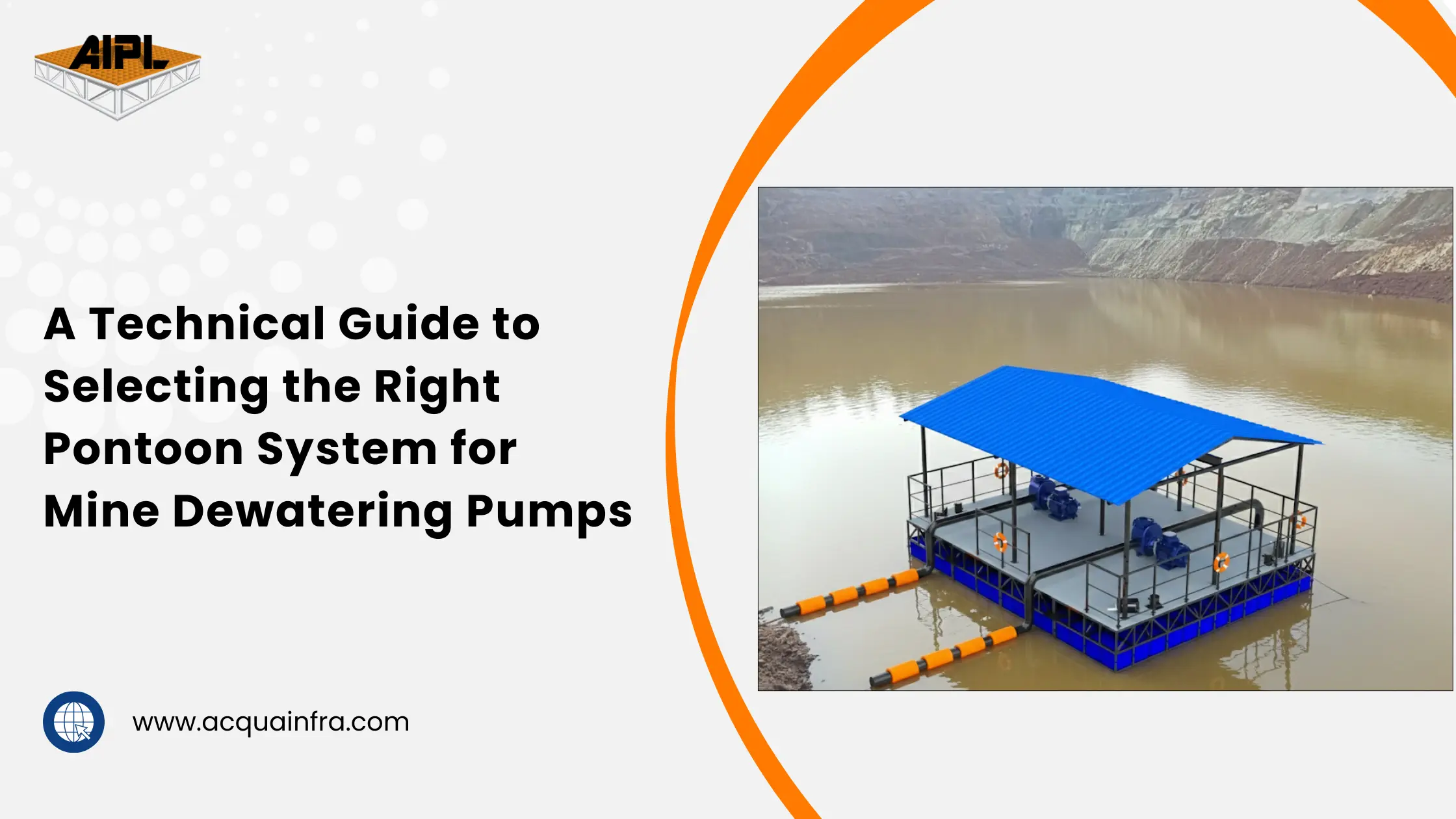
If you are a mining engineer, EPC contractor, project consultant, or site operations head, selecting the right pontoon system for mine dewatering pumps is not a minor equipment decision — it directly impacts safety, pump efficiency, uptime, and long-term cost.
Many mining sites install pumps first and think about the supporting platform later. The result?
In several quarry and open-cast mining projects, improper platform design has led to pump misalignment, reduced suction efficiency, and even emergency shutdowns during monsoon conditions.
This technical guide explains how to select the right pontoon system for mine dewatering pumps, using engineering parameters and real mining site considerations.
Mine dewatering pumps often range from 10 kW to 1000 kW, with pump weights between 0.5 to 50 tonnes, depending on application.
Supporting such equipment on water requires careful evaluation of:
Incorrect pontoon selection can reduce pump efficiency by 10–20% and increase maintenance frequency by 15–25%.
To understand the design, features, and applications of AIPL’s pumping pontoons, refer to this video: Acqua Flow Series | Pontoons & Barges for Water Pumping –
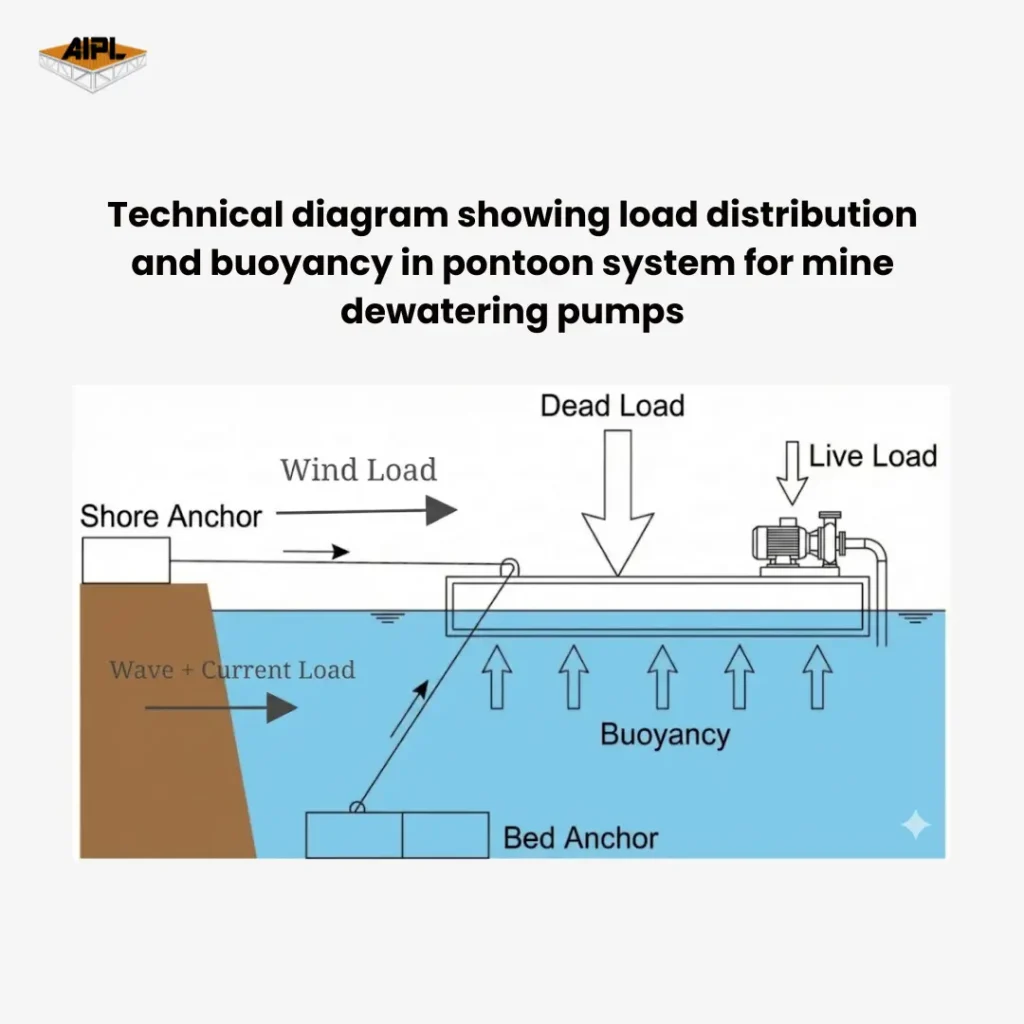
The first and most critical factor is load-bearing capacity.
A properly designed pontoon must account for:
As a general engineering principle, pontoons should be designed with a minimum 30% buoyancy safety margin above calculated total load.
At one mining site in Madhya Pradesh, undersized floating platforms caused uneven tilting when pump loads increased. Replacing them with correctly sized modular pontoons eliminated instability.
Mine dewatering pumps create vibration and torque.
If the pontoon’s center of gravity is poorly distributed:
A wide-beam modular pontoon design improves lateral stability and reduces oscillation by up to 30% compared to narrow floating platforms.
There are generally two suitable types for mining applications:
For large cement mining operations, modular barge-type pontoons have proven more adaptable due to scalability.
Even a well-designed pontoon can fail without proper anchoring.
Key anchoring considerations include:
Improper anchoring has caused drift displacement of min. 1–2 meters in some mining sumps, affecting pipeline alignment.
A properly engineered anchoring system ensures:
✔ Controlled lateral movement
✔ Operational safety during high inflow
✔ Structural reliability during floods
Different pump types require different mounting considerations:
Mounting frames must isolate vibration and prevent load transfer directly into the floating body.
In several installations, vibration isolation systems reduced structural stress and extended equipment life.
Pontoon selection must consider:
In mining regions with high silt load, corrosion-resistant coatings and maintenance-friendly design significantly reduce repair frequency.
| Parameter | Basic Floating Platform | Engineered Pontoon System |
| Load Calculation | Often estimated | Structurally calculated |
| Stability | Moderate | High |
| Anchoring | Minimal | Engineered multi-point |
| Monsoon Reliability | Low | High |
| Lifecycle Cost | Higher | Optimized |
Engineered pontoon systems provide measurable performance improvement in demanding mine dewatering conditions.
If you're new to pump pontoons, this video clearly explains the fundamentals and working: What is Pump Pontoon – https://youtu.be/kesQbjNpcm4?si=fmzR_4D9yVhVrJOf
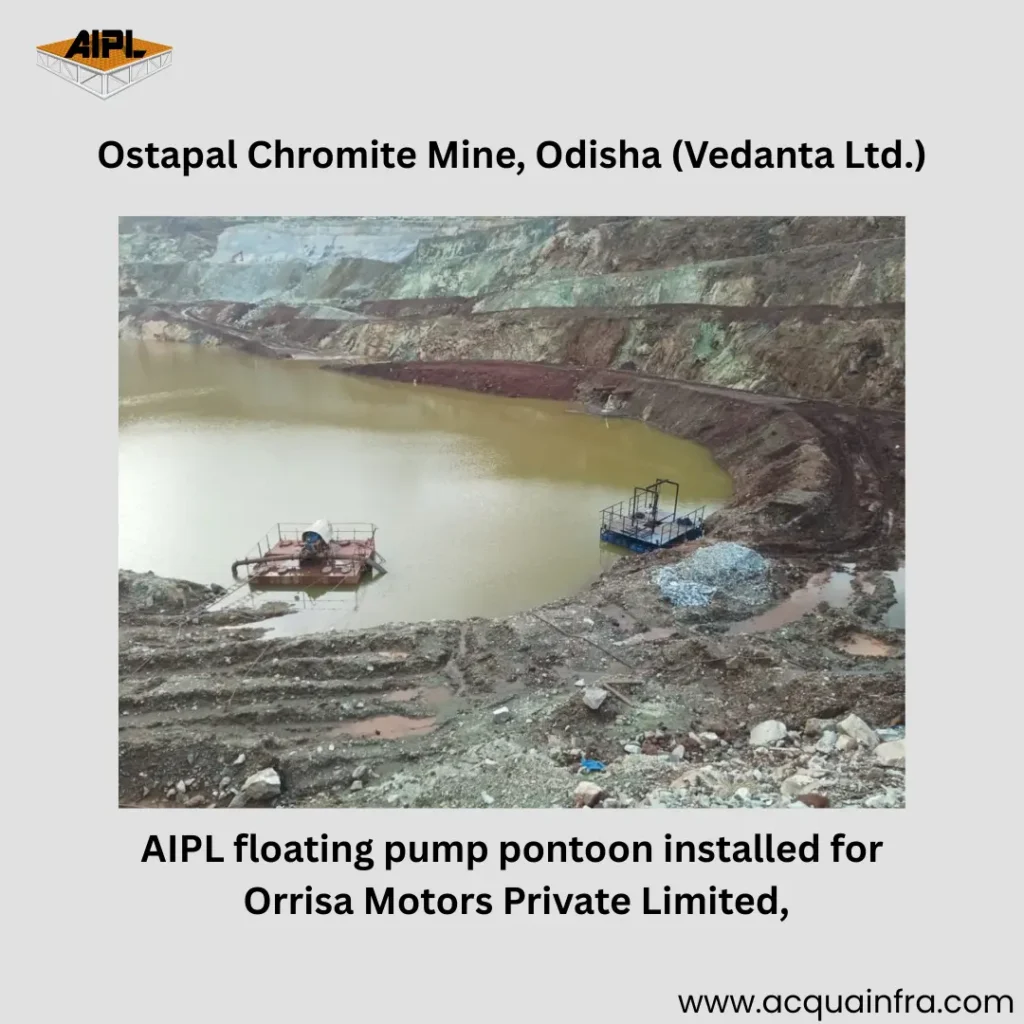
AIPL has executed multiple floating pump pontoon installations across mining and quarry environments.
Ostapal Chromite Mine, Odisha (Vedanta Ltd.)
Custom-designed floating pump pontoon engineered to handle fluctuating water levels and heavy-duty pumping.
Quarry Dewatering Project, Bhopal (Birla Group)
Modular pontoon system deployed for safe pump access and stable performance.
Bagha Satna Mining Region, Madhya Pradesh (Ultratech Cement)
Multiple modular floating pump pontoons installed for large-scale and continuous mine dewatering operations.
In these projects, site-specific load calculations, anchoring systems, and modular scaling ensured long-term performance and reduced downtime.
You should consider upgrading if:
1. How do I calculate the load capacity required for a pontoon system?
Add pump, motor, pipeline, operator, and future expansion loads, then include at least 30% safety margin.
2. What type of pontoon is best for heavy mining pumps?
Modular barge-type pontoons are typically preferred for heavy-duty applications.
3. Can a pontoon system handle 10-tonne pumps?
Yes, if properly engineered and designed for the required buoyancy and stability.
4. How important is anchoring in mine dewatering pontoons?
Critical. Poor anchoring can cause drift and misalignment.
5. Do floating pump pontoons require frequent maintenance?
With proper design and corrosion protection, maintenance requirements are minimal.
6. Are pontoon systems suitable for deep open-cast mines?
Yes, especially where water levels fluctuate significantly.
7. How long does a well-designed pontoon system last?
With maintenance more than 20 years.
8. Can pontoon systems be relocated easily?
Yes, modular systems allow easier relocation compared to fixed platforms.
Selecting the right pontoon system for mine dewatering pumps is not just about floating equipment — it is about engineering stability, safety, and long-term reliability.
A technically designed pontoon system improves pump efficiency, reduces downtime, enhances safety, and lowers lifecycle costs.
Planning a Water, Mining, Energy, or Floating Infrastructure Project?
Talk to AIPL’s engineering team to design a customised Sectional Barge solution tailored to your load requirements, site conditions, and compliance standards.
📞 +91 7678232371
🌐 www.acquainfra.com
📩 Admin@acquainfra.com
Mr. Achin Agrawal
Director & CTO, AIPLExpert in R&D, product development, and floating infrastructure engineering.
Recipient of the National Meritorious Innovation Award and innovator in floating infrastructure systems used in critical industrial projects.

