Floating Infrastructure in the Energy Industry: Innovations and Opportunities
Author : admin
Date : 25.07.24
As the global demand for energy continues to rise, the energy industry is seeking innovative solutions to harness and distribute power sustainably and efficiently. Floating infrastructure, such as Self-Inflating Floating Jetties (SIFJ), Floating HDPE (High-Density Polyethylene) platforms, and other floating technologies, is emerging as a key player in the renewable energy sector. These floating structures provide unique advantages for offshore energy projects, including wind, solar, and wave energy, making them crucial for the industry's future.
What is Floating Infrastructure?
Floating infrastructure refers to engineered structures designed to float on water bodies, providing various functionalities needed for energy generation, storage, and distribution. These infrastructures are constructed to withstand harsh marine environments while ensuring stability and safety.
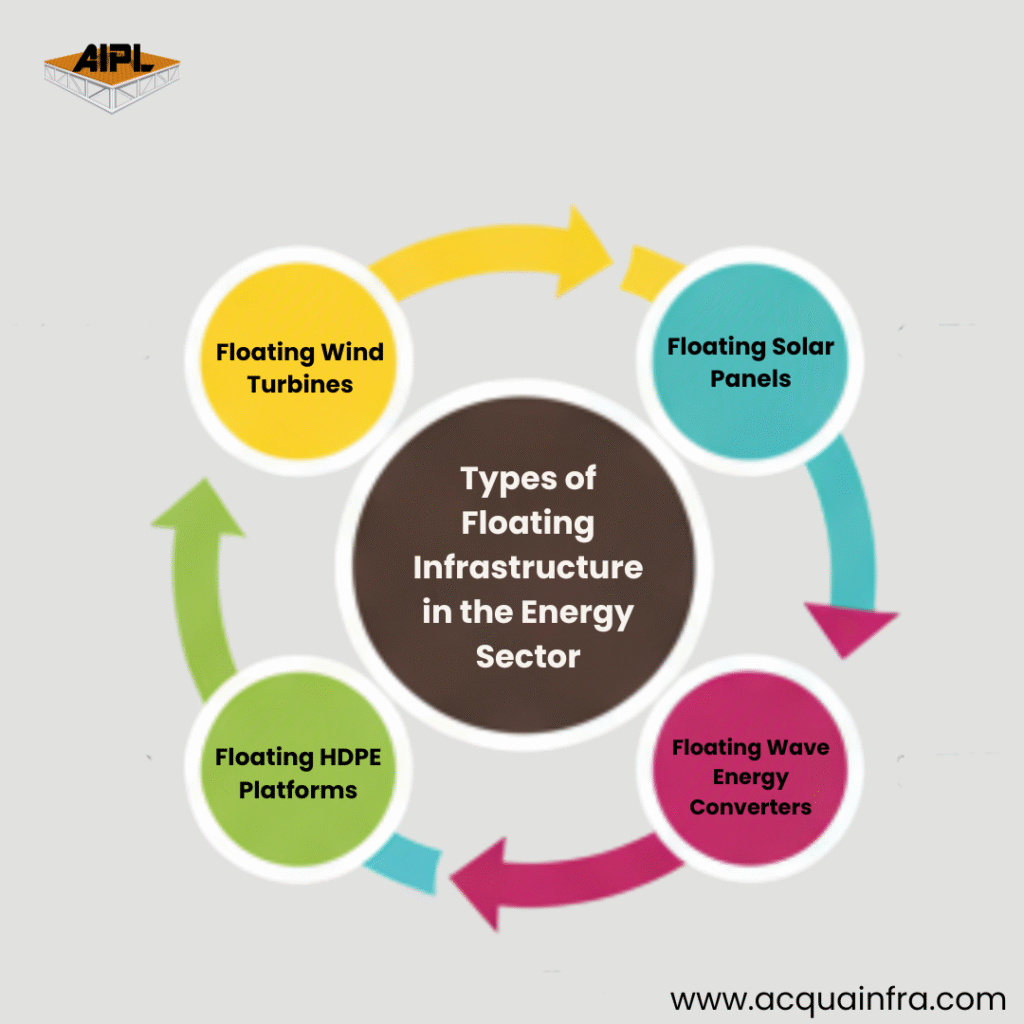
Types of Floating Infrastructure in the Energy Sector
Floating Wind Turbines:
Description: Wind turbines mounted on floating platforms that are anchored to the seabed.
Applications: Offshore wind farms located in deep waters where traditional fixed-foundation turbines are not feasible.
Advantages: Access to stronger and more consistent winds, reduced visual and noise impact, and the ability to deploy in deeper waters away from shipping lanes and coastal activities.
Floating Solar Panels:
Description: Solar photovoltaic panels installed on floating platforms on water surfaces like reservoirs, lakes, and seas.
Applications: Energy generation for local grids, especially in areas with limited land availability.
Advantages: Efficient use of water bodies, reduced land use, lower temperatures enhancing solar panel efficiency, and reduced water evaporation from reservoirs.
Floating HDPE Platforms:
Description: High-Density Polyethylene platforms that can support various energy infrastructure components.
Applications: Supporting structures for solar panels, wind turbines, and other equipment in offshore environments.
Advantages: Durability, resistance to harsh marine conditions, low maintenance, and recyclability.
Floating Wave Energy Converters:
Description: Devices that convert the kinetic energy of ocean waves into electrical power.
Applications: Coastal and offshore installations to generate renewable energy.
Advantages: High energy density, continuous and predictable power generation, and minimal environmental footprint.
Benefits of Floating Infrastructure in the Energy Industry
Expanded Renewable Energy Potential:
Floating infrastructure allows for the utilization of vast ocean and water surfaces, significantly increasing the potential for renewable energy generation. Offshore wind and solar farms can harness stronger and more consistent resources compared to land-based installations.
Environmental Sustainability:
These floating systems typically have a lower environmental impact than traditional land-based energy projects. They avoid land use conflicts and minimize habitat disruption. Floating solar installations also help reduce water evaporation and improve water quality in reservoirs.
Scalability and Flexibility:
Floating platforms offer scalability and flexibility, allowing for incremental expansion of energy projects. This modularity makes it easier to adapt to changing energy demands and technological advancements.
Economic Opportunities:
The development of floating energy infrastructure creates new economic opportunities, including job creation in construction, maintenance, and operation. Coastal communities can benefit from increased economic activity and energy independence.
Mitigation of Land Constraints:
In densely populated or geographically constrained areas, floating energy solutions provide a viable alternative to land-based installations. This is particularly important for island nations and regions with limited available land.
Challenges and Considerations
Technical and Engineering Challenges:
Designing and maintaining floating energy infrastructure capable of withstanding harsh marine conditions, such as strong waves, currents, and storms, requires advanced engineering solutions.
Cost:
The initial investment for floating energy projects can be high. However, the long-term benefits, including reduced land acquisition costs and access to more consistent energy resources, can offset these initial expenditures.
Regulatory and Permitting Hurdles:
Navigating the regulatory landscape for offshore installations can be complex. Compliance with environmental regulations, maritime laws, and energy policies is essential for project success.
Environmental and Social Impact:
While generally more sustainable, floating energy projects must still consider potential impacts on marine ecosystems and local communities. Engaging stakeholders and conducting thorough environmental assessments are critical.
Case Studies and Examples
Hywind Scotland:
The world's first floating wind farm, Hywind Scotland, has demonstrated the feasibility and efficiency of floating wind turbines. It consists of five floating turbines with a total capacity of 30 MW, providing power to approximately 20,000 homes.
Kagoshima Floating Solar Plant:
Located in Japan, this floating solar plant features over 50,000 solar panels on a reservoir, generating 13.7 MW of power. It showcases the potential for large-scale floating solar projects.
Wave Energy Projects:
Various experimental wave energy projects, such as the Pelamis Wave Energy Converter, are exploring the potential of harnessing wave energy. These projects aim to provide reliable and continuous renewable energy from ocean waves.
Conclusion
Floating infrastructure represents a promising and innovative frontier in the energy industry. By leveraging the vast potential of ocean and water surfaces, these technologies offer sustainable and scalable solutions for renewable energy generation. As advancements continue and the demand for clean energy grows, floating infrastructure will play an increasingly vital role in meeting global energy needs while preserving the environment and creating new economic opportunities.
Power the Future with Floating Energy Solutions
Looking to deploy a renewable energy project in deep water or on a reservoir? Acquafront Infrastructure designs and supplies durable, advanced floating platforms, including SIFJs and HDPE solutions.
Innovate your energy project now—contact our experts to discuss your custom floating infrastructure needs.
Industrial expertise in Business Development, Operations, Finance & Administration, and Product development.
Navkriti Medal issued by the Indian Institute of Technology (BHU), Varanasi.
National Meritorious Innovation Award 2018 by NRDC (A DST Enterprise) presented during the Innovate India conference 2019 at EDII, Ahmedabad.
Recognised for groundbreaking innovation with patent no. 485553 in the Marine Industry
FAQs
1. What are Energy Floating Solar Panels?
Energy Floating Solar Panels are solar photovoltaic (PV) systems installed on floating platforms over water bodies to generate clean and renewable electricity without occupying land.
2. What is the Acqua Energy Series by Acquafront Infrastructure?
The Acqua Energy Series is Acquafront’s integrated floating energy solution designed for energy generation, storage, and distribution, using high‑durability floating platforms engineered for Indian water conditions.
3. What types of water bodies are suitable for floating solar installation?
Floating solar systems can be installed on reservoirs, ponds, lakes, canals, dams, and other calm or low‑current inland water bodies.
4. How does floating solar differ from land‑based solar plants?
Floating solar plants do not require land acquisition, reduce water evaporation, and offer higher efficiency due to natural cooling from water surfaces.
5. What floating structure is used for Acquafront’s solar systems?
Acquafront uses RCC/GFRC floating beams filled with EPS, offering high strength, buoyancy, corrosion resistance, and long service life.
6. What is the expected lifespan of Acquafront floating solar platforms?
The floating platforms are designed for a service life of up to 50 years, subject to normal operation and periodic maintenance.
7. What capacity range is available for Energy Floating Solar Panels?
Systems are modular and scalable, starting from 10 kW and expandable to 100 kW, 500 kW, 1 MW, and utility‑scale installations.
8. Can the floating solar system be expanded in the future?
Yes. The modular design allows easy expansion by adding more floating units and solar panels without disturbing existing installations.
9. Do floating solar plants reduce water evaporation?
Yes. Floating solar panels cover a portion of the water surface, significantly reducing evaporation losses, especially in reservoirs and ponds.
10. Is floating solar suitable for drinking water reservoirs?
Yes. When properly designed and installed, floating solar systems are suitable for drinking water reservoirs and help reduce algae growth.
11. How are floating solar systems anchored?
Anchoring systems are designed based on site‑specific parameters such as water depth, wind load, and water level variations, using dead anchors, RCC anchors, or mooring systems.
12. Are floating solar platforms resistant to corrosion?
Yes. RCC/GFRC floating beams are highly resistant to corrosion, UV exposure, and harsh environmental conditions.
13. Does water movement affect the stability of the solar panels?
No. The floating platforms are engineered to maintain stability under wind, wave, and water level fluctuations.
14. What are the key advantages of Acquafront’s floating solar technology?
Key advantages include long lifespan, low maintenance, modular scalability, eco‑friendly materials, and compliance with Indian engineering standards.
15. Can energy storage systems be integrated with floating solar plants?
Yes. Battery Energy Storage Systems (BESS) can be integrated for energy storage, peak load management, and off‑grid applications.
16. Are floating solar systems suitable for off‑grid or remote locations?
Yes. Floating solar plants can be designed for both grid‑connected and off‑grid applications, including remote and rural areas.
17. What sectors can benefit from Energy Floating Solar Panels?
Municipal bodies, irrigation departments, industries, water utilities, mining, smart cities, and renewable energy developers can benefit from floating solar systems.
18. How does floating solar help in sustainable development?
Floating solar promotes clean energy generation, reduces carbon emissions, conserves land and water, and supports India’s renewable energy goals.
19. What maintenance is required for floating solar plants?
Maintenance includes periodic inspection of solar panels, electrical systems, anchoring arrangements, and floating platforms.
20. Are Acquafront floating solar systems compliant with Indian standards?
Yes. Designs are aligned with applicable Indian engineering practices, structural standards, and quality norms.
21. Does Acquafront provide turnkey floating solar solutions?
Yes. Acquafront offers end‑to‑end services including site survey, design, manufacturing, supply, installation, commissioning, and maintenance support.
22. How long does installation of a floating solar plant take?
Installation timelines depend on project size and site conditions but are generally faster than land‑based solar projects due to modular construction.
23. Is floating solar environmentally safe for aquatic life?
Yes. Properly designed floating solar systems have minimal environmental impact and may improve water quality by reducing algae growth.
24. Can floating solar plants be relocated if required?
Yes. Modular floating solar systems can be dismantled and relocated if project requirements change.
25. How does floating solar improve power generation efficiency?
The cooling effect of water reduces solar panel temperature, resulting in higher energy output compared to conventional ground‑mounted systems.
26. Why choose Acquafront Infrastructure for floating solar projects?
Acquafront combines engineering expertise, patented floating technology, durable materials, and turnkey execution, making it a reliable partner for floating solar projects.
AIPL specializes in modular maritime and floating-infrastructure platforms for energy, water, marine, transport, construction, pumping and tourism sectors, supported by a decade of proven engineering.
Registered Under:
Quick Links
Office
3RD Floor, Tower-C, Office No. C - 320 I-THUM Plot No.A-40, Sector 62, NOIDA, Distt Gautam Buddha Nagar, UP – 201301