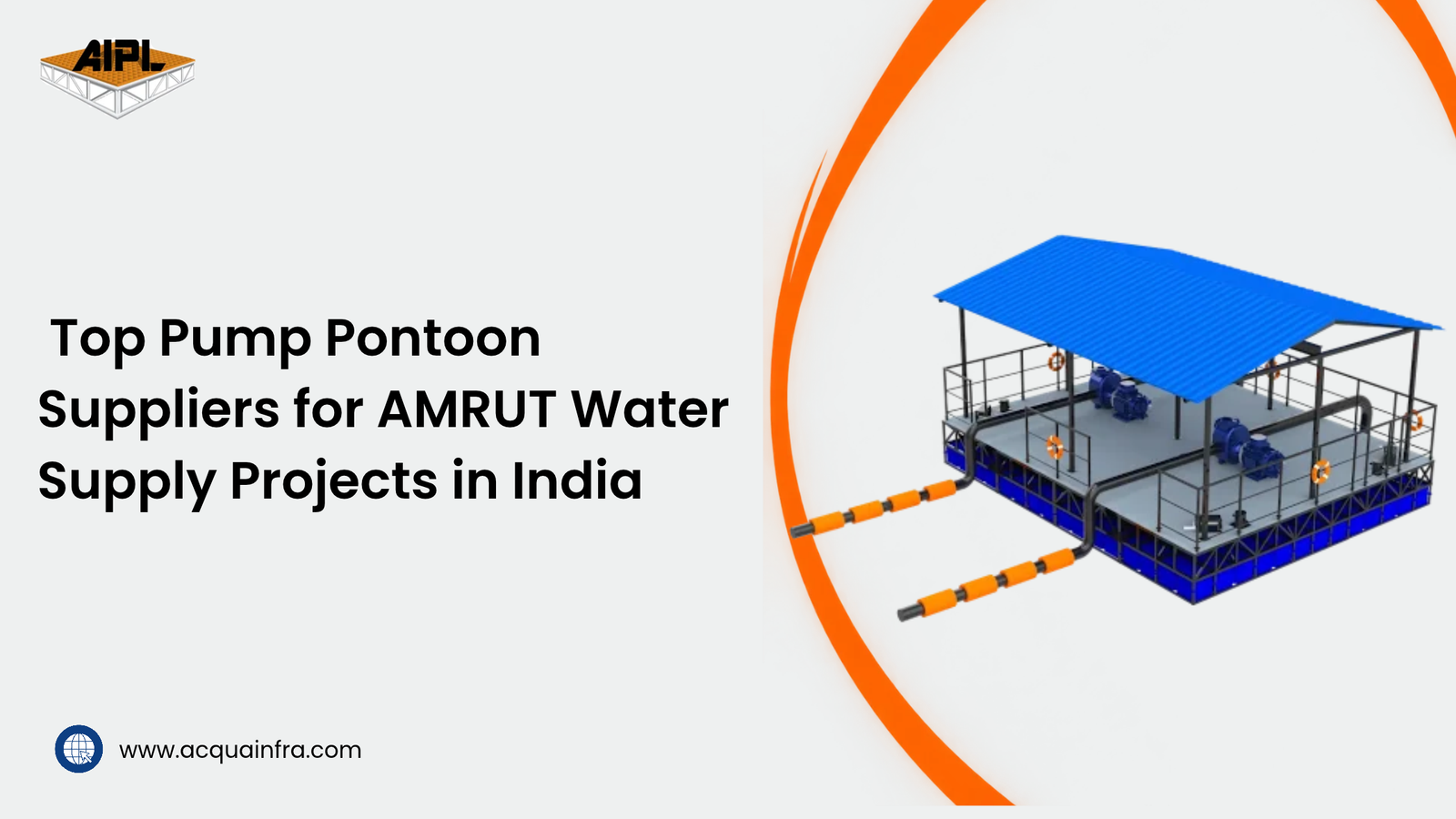
India's urban water supply infrastructure depends on reliable systems for collecting and transferring raw water from reservoirs, dams, and other suitable sources. As cities expand and water demand increases, selecting the right intake infrastructure becomes an important consideration for government agencies, engineering consultants, and EPC contractors.
Among the available solutions, floating pump pontoons can provide a practical platform for installing pumping equipment at suitable surface-water intake locations. These structures are designed to support pumps, motors, pipelines, and associated equipment while accommodating changes in water levels.
Choosing among pump pontoon suppliers requires more than comparing prices. Engineering capability, structural stability, fabrication quality, equipment integration, corrosion protection, installation support, and long-term maintenance all influence the suitability of a proposed system.
Acquafront Infrastructure Private Limited (AIPL) provides engineered floating infrastructure, including pump pontoons and modular floating structures. This guide explains the key factors to evaluate when comparing suppliers for AMRUT water supply projects in India.
The Atal Mission for Rejuvenation and Urban Transformation (AMRUT) and AMRUT 2.0 support improvements in urban water supply, water security, and related infrastructure. Depending on the approved water source and engineering design, suitable projects may require infrastructure for drawing raw water from reservoirs or other surface-water bodies.
A pump pontoon is a floating platform engineered to support pumping equipment at an intake location. Depending on the design and contracted scope, it may accommodate pumps, motors, mounting frames, valves, pipelines, electrical equipment, and maintenance access.
Because the platform floats on the water surface, it can move vertically as the water level changes. This can help maintain the intended intake arrangement across varying reservoir levels, provided that the structure, mooring system, piping, and pump configuration are designed for the site's operating conditions.
Floating pump pontoons are not required for every AMRUT project. Their suitability depends on the water source, intake depth, pumping requirements, environmental conditions, site access, and approved project specifications.
Floating pump pontoons may be considered for several water and industrial infrastructure applications:
The final arrangement should be selected through appropriate site assessment, hydraulic evaluation, and structural engineering.
A supplier's website can help buyers understand its products and experience, but photographs alone do not establish whether a structure is suitable for a particular project. Buyers should evaluate documented engineering capabilities, manufacturing processes, relevant project experience, and the services included in the quotation.
Engineering is a fundamental part of pump pontoon selection. The structure must accommodate its own weight, pumping equipment, operational loads, and relevant environmental forces.
A supplier should be able to address:
Ask for project-specific drawings and engineering calculations that reflect the proposed equipment, site conditions, and applicable design requirements.
Fabrication quality affects structural integrity, watertightness, maintenance requirements, and the expected service life of a floating structure.
When comparing pump pontoon suppliers, consider their approach to:
The technical offer should identify the inspections, tests, and documentation included in the supplier's scope.
A pump pontoon must be designed around the equipment it will carry. The arrangement may include pumps, motors, mounting frames, valves, pipelines, cables, control equipment, and access provisions.
The supplier's scope should clearly explain how these components will be accommodated and coordinated.
For example, the pontoon fabricator, pump manufacturer, electrical contractor, and pipeline contractor may have different responsibilities. Clear interface arrangements help reduce coordination problems during installation and operation.
Manufacturing the floating structure is only one part of project execution. Transportation, launching, positioning, anchoring, equipment installation, and commissioning can also influence project schedules and costs.
Before placing an order, establish whether the supplier provides:
For projects requiring a coordinated delivery package, Supply, Installation, Testing, and Commissioning (SITC) can be included in the agreed scope.
Floating infrastructure requires periodic inspection and maintenance. Corrosion protection, weld condition, watertight compartments, mooring components, piping connections, and equipment mounts should be assessed according to the operating environment and maintenance plan.
Buyers should compare warranty conditions, maintenance documentation, spare-part availability, and technical support arrangements.
The expected service life of a pump pontoon depends on its design, materials, fabrication quality, environmental exposure, operating loads, maintenance practices, and repair history. A suitable maintenance plan should form part of the overall procurement decision.
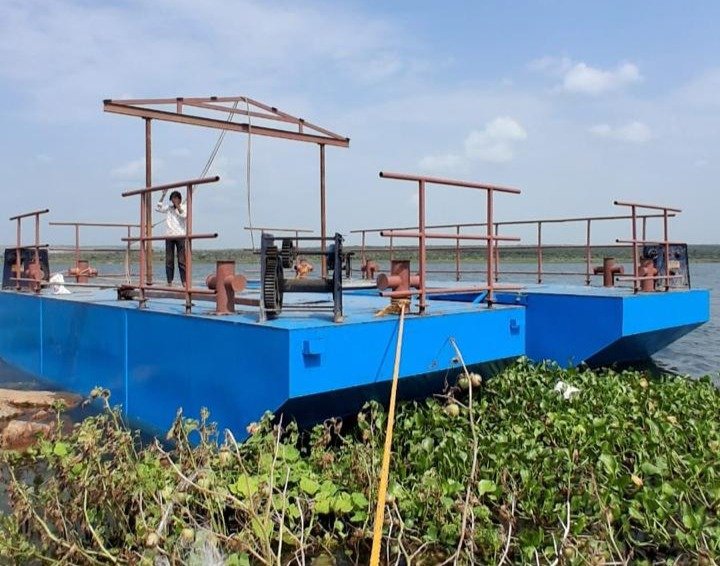
A technical evaluation should establish whether the proposed structure can safely support its equipment, remain stable during operation, and withstand the expected site conditions.
The structural design must account for the pontoon's own weight, pumps, motors, piping, electrical equipment, personnel, and other specified loads.
Particular attention should be given to concentrated loads from pump mounting frames, motors, lifting equipment, and maintenance activities.
A project-specific structural assessment should consider:
The design should follow the applicable standards and approved project criteria.
Buoyancy determines the displacement required to support the loaded structure, while stability assessment evaluates how the pontoon behaves under different loading and operating conditions.
The design should consider equipment positioning, centre of gravity, freeboard, uneven loading, reserve buoyancy, and the integrity of watertight compartments.
Changes in reservoir levels, maintenance activities, and equipment replacement should also be considered where they affect the pontoon's loading or operating arrangement.
The mooring system keeps the pontoon near its designated intake location while allowing the movement required as water levels change.
Depending on the site's conditions, a system may use shore-connected mooring lines, guide piles, anchors, or a combination of suitable arrangements.
The design should account for water depth, seabed conditions, wind exposure, currents, and expected water-level variation. Piping connections and electrical cable routes must also accommodate the intended movement without creating excessive forces on the equipment or connections.
Floating structures are exposed to water and changing environmental conditions. Material selection, welding quality, and corrosion protection are therefore important considerations.
A suitable fabrication and protection plan may address:
The appropriate measures depend on the structure's design, the water chemistry, and the expected operating environment.
AIPL's stated floating infrastructure capabilities cover pump applications ranging from 10 kW to 2,000+ kW, subject to project-specific engineering. The appropriate configuration depends on the requirements of the individual application.
Pump selection should be based on the required discharge, total dynamic head, suction conditions, efficiency, operating hours, and source-water characteristics.
The pontoon must then be designed to accommodate the selected equipment's actual weight, mounting requirements, operating loads, and associated piping and electrical arrangements.
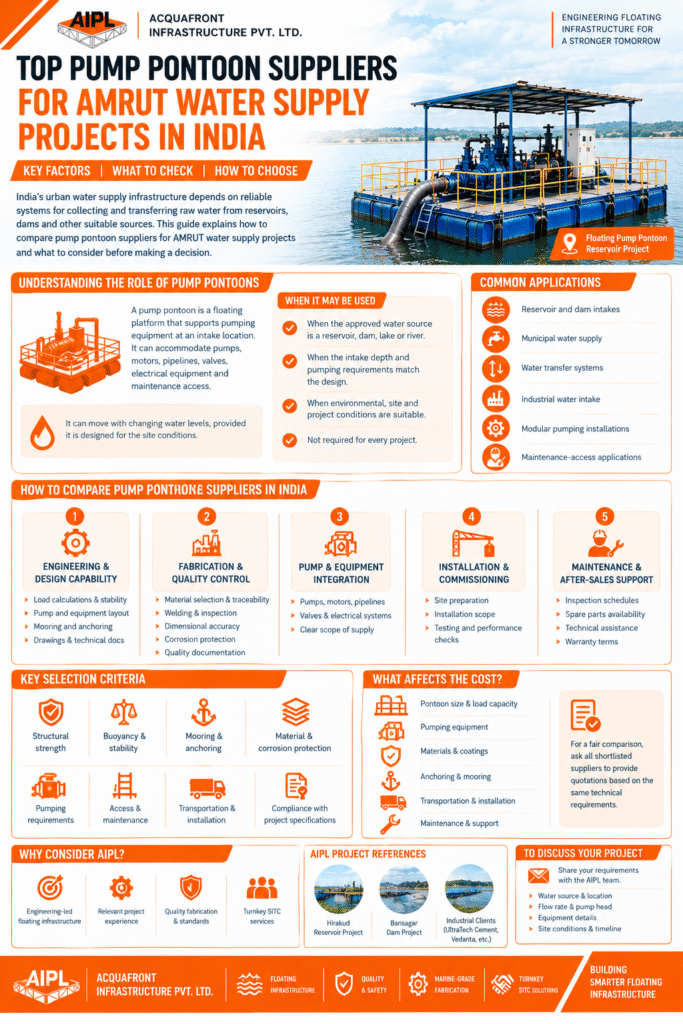
For public water supply projects, buyers should shortlist manufacturers according to their documented technical capabilities, relevant experience, fabrication quality, and ability to meet the project requirements.
Acquafront Infrastructure Private Limited (AIPL) is one manufacturer to consider when evaluating engineered floating infrastructure for reservoir, industrial, and marine applications. Its capabilities can be assessed alongside other bidders using the same technical and commercial evaluation criteria.
| Evaluation criterion | What to evaluate |
| Relevant experience | Comparable projects and verifiable references |
| Engineering | Structural drawings, load calculations, buoyancy, and stability assessments |
| Fabrication | Material specifications, welding procedures, and inspection records |
| Equipment integration | Pump duty, mounting details, piping, and electrical scope |
| Installation | Transportation, launching, anchoring, and commissioning arrangements |
| Compliance | Tender requirements and applicable standards |
| Maintenance | Warranty terms, inspection schedules, and service responsibilities |
| Commercial scope | Itemised quotation, exclusions, delivery schedule, and payment terms |
Using a consistent checklist helps government agencies, consultants, and EPC contractors compare supplier proposals on a common basis.
Before issuing a purchase order, discuss the following questions with each shortlisted manufacturer:
The agreed answers should be reflected in the technical offer and final contract.
There is no single standard price for every pump pontoon used in water supply infrastructure. The cost depends on the design, equipment requirements, fabrication scope, transportation, installation, and site conditions.
| Cost factor | Effect on the quotation |
| Pontoon size and displacement | Influences material quantities and structural design |
| Pump and motor requirements | Affects equipment, mounting, and electrical provisions |
| Fabrication complexity | Depends on structural requirements, geometry, and material specifications |
| Corrosion protection | Varies with water chemistry and environmental exposure |
| Mooring arrangement | Depends on water depth, seabed conditions, and environmental loads |
| Transportation and deployment | Depends on site access, module dimensions, and lifting requirements |
| SITC scope | Depends on the equipment and services included in the contract |
Buyers should compare the total delivered cost rather than the fabrication price alone. A quotation that appears less expensive may exclude installation, electrical integration, testing, or engineering documentation.
An itemised commercial proposal makes it easier to compare the actual scope offered by different manufacturers.
To obtain a meaningful technical and commercial quotation, buyers should share the available project information with shortlisted suppliers.
Useful inputs include:
If some information is not yet available, the enquiry can identify the surveys, site data, and engineering inputs needed before a firm technical proposal is prepared.
Acquafront Infrastructure Private Limited (AIPL) specialises in engineered floating infrastructure for reservoir, industrial, and marine applications. Its capabilities include pump pontoons, modular barges, floating work platforms, and heavy-duty fabricated structures.
AIPL's engineering approach incorporates project-specific design, IIT-driven engineering, marine-grade manufacturing, and IRS-compliant floating infrastructure where applicable to the project. Its turnkey SITC capabilities support coordinated delivery covering supply, fabrication, installation, testing, and commissioning according to the agreed scope.
AIPL's project references include the Hirakud Reservoir Project and Bansagar Dam Project, along with work associated with UltraTech Cement, Vedanta, floating CNG stations, passenger jetties, floating stages, and the Sabarmati Wet & Dry Dock Project.
Every floating structure should be designed for its intended application rather than selected solely by dimensions or nominal load ratings.
AIPL's project-specific engineering approach considers:
AIPL's broader floating infrastructure capabilities also include heavy-load applications exceeding 1,000 tonnes, depending on the engineered configuration.
For AMRUT-related water supply projects, the proposed pontoon configuration should be developed around the individual project's technical specifications, approval requirements, and operating conditions.
Pump pontoon suppliers provide floating structures designed to support pumping equipment at suitable water intake locations. Depending on the contract, their scope may include engineering, fabrication, equipment integration, and installation.
Acquafront Infrastructure Private Limited (AIPL) provides engineered floating infrastructure and pump pontoon capabilities. Buyers can contact AIPL to discuss project-specific technical requirements and quotations.
Compare suppliers based on relevant project experience, engineering documentation, fabrication quality, equipment integration, installation capability, warranty conditions, and commercial scope.
Evaluate structural engineering, buoyancy and stability assessments, corrosion protection, fabrication quality, pump integration, mooring design, installation services, and maintenance support.
A properly engineered pontoon can move with the water surface. The design must also account for minimum intake submergence, mooring movement, freeboard, piping connections, and electrical cable routing.
Yes. A pontoon can be designed around the project's water depth, equipment loads, hydraulic requirements, environmental conditions, site access, and maintenance needs.
The appropriate pump capacity depends on the required discharge, total dynamic head, equipment configuration, and structural design. AIPL's stated floating infrastructure capabilities cover pump applications from 10 kW to 2,000+ kW, subject to project-specific engineering.
The cost depends on pontoon dimensions, equipment loads, materials, corrosion protection, mooring, transportation, installation, and commissioning requirements. Buyers should request an itemised quotation based on their project specifications.
No. A floating intake is considered where it suits the approved water source and engineering design. The project authority and its engineering consultants determine the appropriate intake arrangement.
The scope varies by supplier and contract. Buyers should establish whether transportation, launching, anchoring, equipment integration, testing, and commissioning are included in the quotation.
Request relevant structural drawings, load calculations, buoyancy and stability assessments, material specifications, welding inspection records, corrosion protection details, and applicable testing documentation.
Contact Acquafront Infrastructure Private Limited to discuss your project location, hydraulic requirements, equipment specifications, site conditions, and delivery scope.
Selecting among pump pontoon suppliers requires a balanced assessment of engineering capability, fabrication quality, equipment integration, installation support, and lifecycle maintenance.
For AMRUT water supply projects, the proposed floating intake should be evaluated against the approved technical specifications, hydraulic requirements, and site conditions. A structured procurement process helps buyers compare quotations fairly, identify differences in scope, and establish clear responsibilities before fabrication begins.
Acquafront Infrastructure Private Limited (AIPL) provides engineered floating infrastructure and pump pontoon capabilities for organisations evaluating reservoir, industrial, and marine applications across India.
Discuss your project requirements with AIPL to explore floating pump pontoon solutions tailored to your operational needs.
Phone: +91 7678232371
Website: https://acquainfra.com/
Email: Admin@acquainfra.com
Mr. Achin Agrawal
Director & CTO
Acquafront Infrastructure Private Limited
Mr. Achin Agrawal leads engineering and technology initiatives at Acquafront Infrastructure Private Limited (AIPL), with a focus on modular floating infrastructure, marine engineering, lifting barges, construction pontoons, floating work platforms, and heavy-duty marine systems.
AIPL works on floating infrastructure applications for reservoirs, dams, ports, industrial waterfronts, and inland waterways across India, with engineering and execution approaches tailored to project requirements.

