India's urban water infrastructure is undergoing significant development as cities and towns work to improve household water access, strengthen existing supply systems, and develop reliable drinking-water sources. For government departments, engineering consultants, and EPC contractors, this requires careful planning of the entire water supply chain, from raw-water intake to treatment, storage, pumping, and distribution.
The Atal Mission for Rejuvenation and Urban Transformation (AMRUT) 2.0 provides a national framework for improving urban water security. Launched on 1 October 2021, the mission targets universal household water-supply coverage in approximately 4,700 statutory towns, including 2.68 crore household tap connections. It also targets 2.64 crore sewerage and septage connections, with universal sewerage and septage coverage planned for 500 AMRUT cities.
Reliable water supply depends on suitable water sources, efficient pumping arrangements, and infrastructure designed for site-specific conditions. Where a project draws water from a reservoir, dam, lake, or river, a floating intake system may be considered as part of the overall water-supply design.
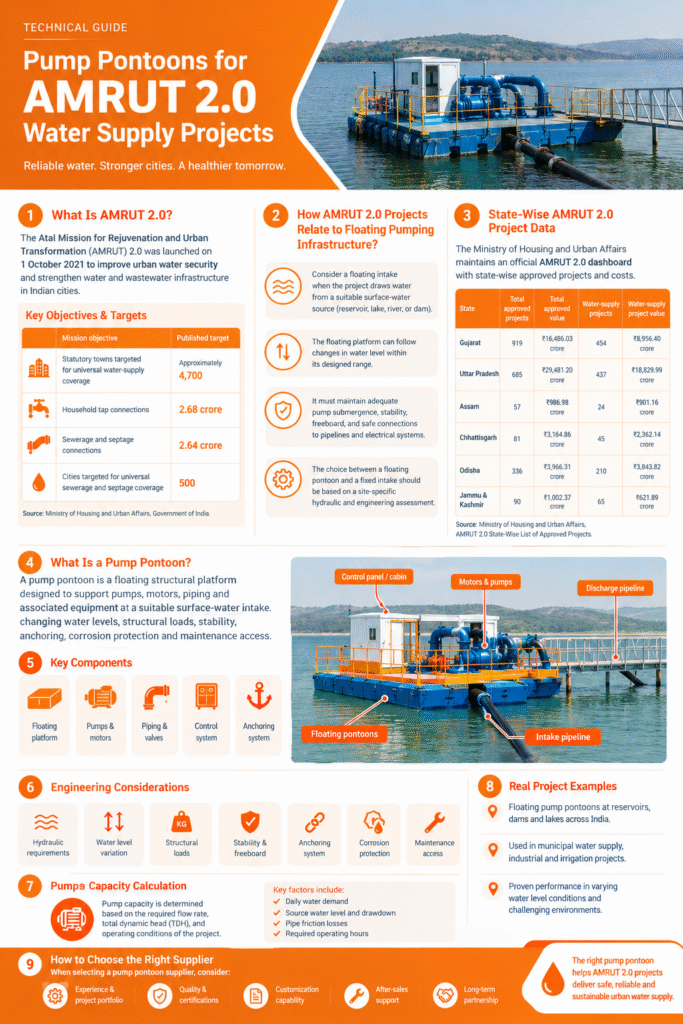
A pump pontoon is a floating structural platform designed to support pumps, motors, piping, and associated equipment at a suitable surface-water intake. Its design must account for hydraulic requirements, changing water levels, structural loads, stability, anchoring, corrosion protection, and maintenance access.
This guide explains the role of pump pontoons in AMRUT 2.0 water-supply projects, their main components, essential engineering considerations, pump capacity calculations, relevant project examples, and the factors to consider when selecting a supplier.
The Atal Mission for Rejuvenation and Urban Transformation (AMRUT) 2.0 was launched on 1 October 2021 to improve urban water security and strengthen water and wastewater infrastructure in Indian cities.
The mission's published objectives include the following targets:
| Mission objective | Published target |
| Statutory towns targeted for universal water-supply coverage | Approximately 4,700 |
| Household tap connections | 2.68 crore |
| Sewerage and septage connections | 2.64 crore |
| Cities targeted for universal sewerage and septage coverage | 500 |
Source: Ministry of Housing and Urban Affairs, Government of India.
Achieving reliable urban water supply requires several connected systems. These may include water-source development, raw-water intake, pumping, treatment, storage, transmission pipelines, and distribution networks.
The exact infrastructure depends on local conditions. Some projects use groundwater, while others draw water from rivers, reservoirs, lakes, dams, or other surface-water sources.
A pump pontoon is a potential engineering solution for projects where the water source, hydraulic requirements, and site conditions support a floating intake arrangement.
Floating pumping systems may be considered when a water-supply project requires equipment to draw raw water from a suitable surface-water source.
A floating platform can follow changes in the water surface within its designed operating range. This can help maintain the position of the pumping equipment as reservoir levels rise or fall.
The system must maintain adequate pump submergence, stability, freeboard, and safe connections to pipelines and electrical systems. The choice between a floating pontoon and a fixed intake should be based on a site-specific hydraulic and engineering assessment.
The Ministry of Housing and Urban Affairs maintains an official AMRUT 2.0 dashboard containing state-wise approved projects and their associated costs. The following figures illustrate the scale of approved projects across selected states.
| State | Total approved projects | Total approved value | Water-supply projects | Water-supply project value |
| Gujarat | 919 | ₹16,486.03 crore | 454 | ₹8,956.40 crore |
| Uttar Pradesh | 685 | ₹29,481.20 crore | 437 | ₹18,829.99 crore |
| Assam | 57 | ₹986.98 crore | 24 | ₹901.16 crore |
| Chhattisgarh | 81 | ₹3,164.86 crore | 45 | ₹2,362.14 crore |
| Odisha | 336 | ₹3,966.31 crore | 210 | ₹3,843.82 crore |
| Jammu and Kashmir | 90 | ₹1,002.37 crore | 65 | ₹621.89 crore |
Source: Ministry of Housing and Urban Affairs, AMRUT 2.0 State-Wise List of Approved Projects.
These figures highlight the scale of water infrastructure development across different states. For projects involving surface-water sources, the intake arrangement must be selected according to the approved design, water availability, hydraulic requirements, and local conditions.
A water-supply scheme must withdraw raw water from its source and deliver it to the treatment system at the required flow rate and operating conditions.
A pump pontoon provides a floating base for pumping equipment where the approved design calls for a floating intake. Its hull or flotation arrangement provides buoyancy, while the structural deck supports pumps, motors, piping, and associated equipment.
Potential benefits include:
These benefits depend on the design and operating conditions. A floating pontoon cannot compensate for insufficient source-water availability, inadequate intake depth, or an incorrectly selected pump.
| Consideration | Floating pump pontoon | Fixed intake structure |
| Water-level changes | Can follow the water surface within its designed operating range | Depends on the intake's fixed elevation and configuration |
| Structural arrangement | Floating hull or modules, deck, mooring, and connections | Fixed civil or structural construction |
| Equipment access | Can provide access from the floating deck | Depends on the structure's layout and elevation |
| Installation | Requires launching, mooring, and floating-system integration | May require substantial site-based civil construction |
| Main design requirements | Buoyancy, stability, mooring, piping movement, and structural loads | Foundation conditions, structural design, and hydraulic performance |
Neither arrangement is universally better. Engineers should compare both options against site conditions, hydraulic requirements, construction constraints, operating needs, and lifecycle maintenance.
A pump pontoon is an engineered floating platform that supports pumping equipment used to draw or transfer water. Depending on the application, it may accommodate submersible pumps, horizontal or vertical pumping arrangements, motors, valves, electrical equipment, and associated piping.
The floating structure provides buoyancy. Its deck and supporting frame distribute equipment loads, while the mooring system helps keep the platform within its designated operating area.
A typical floating pumping arrangement may include:
The final configuration depends on the pump duty, water depth, environmental conditions, equipment layout, and project requirements.
A pump pontoon should therefore be treated as an integrated engineering system rather than simply a floating deck.
Floating pumping platforms may be evaluated for several applications where the source-water conditions and engineering requirements support their use.
Reservoirs may experience seasonal or operational water-level changes. A floating intake can be considered where sufficient water depth, suitable water quality, and an appropriate mooring arrangement are available.
A floating pumping platform may support equipment used to transfer raw water from an impounded source to a treatment or pumping facility.
Where the source-water arrangement requires floating pumping equipment, a pontoon can form part of the intake system feeding a water treatment plant.
Industries may require water from reservoirs, canals, or other surface-water sources. A pontoon can be assessed according to the required flow, operating schedule, equipment loads, and site conditions.
A floating intake may be useful where water-level fluctuations affect the practicality of fixed-level access. The design must still maintain adequate pump submergence and safe operating conditions.
In all these applications, the final selection should follow an approved hydraulic design and site assessment. A pontoon does not replace the need to evaluate source-water availability, water quality, pump performance, or applicable environmental requirements.
The hull provides buoyancy, while the structural frame supports the deck and distributes loads from pumps, motors, piping, and personnel.
Depending on the application, the structure may use modular mild-steel pontoons or another engineered floating configuration.
Important considerations include structural strength, watertight integrity, compartmentation where applicable, lifting points, inspection access, and transportation requirements.
Pump selection must match the required discharge and total dynamic head. The pontoon's mounting arrangement must support the installed equipment and account for vibration, concentrated loads, maintenance activities, and lifting requirements.
The equipment schedule should identify:
The intake arrangement must provide sufficient submergence and be designed to limit air entrainment, vortex formation, and unwanted sediment intake.
Connections between the floating platform and fixed shore-based systems must accommodate the expected movement. Flexible or articulated connections may be required, depending on the layout.
Piping should not impose excessive forces on pump nozzles, joints, or the pontoon structure.
The mooring system keeps the pontoon within its intended operating area while allowing the permitted movement caused by changing water levels and environmental forces.
Depending on site conditions, the system may use anchors, mooring lines, guide piles, shore connections, or a combination of these methods.
The design should account for water depth, currents, wind, wave action, reservoir-level variation, seabed conditions, and loads transferred through connected pipelines.
Electrical panels, cables, lighting, earthing, and protective equipment must be suitable for the operating environment and applicable electrical requirements.
Guardrails, non-slip walkways, safe access, suitable lifting arrangements, and emergency procedures should also be considered during design.
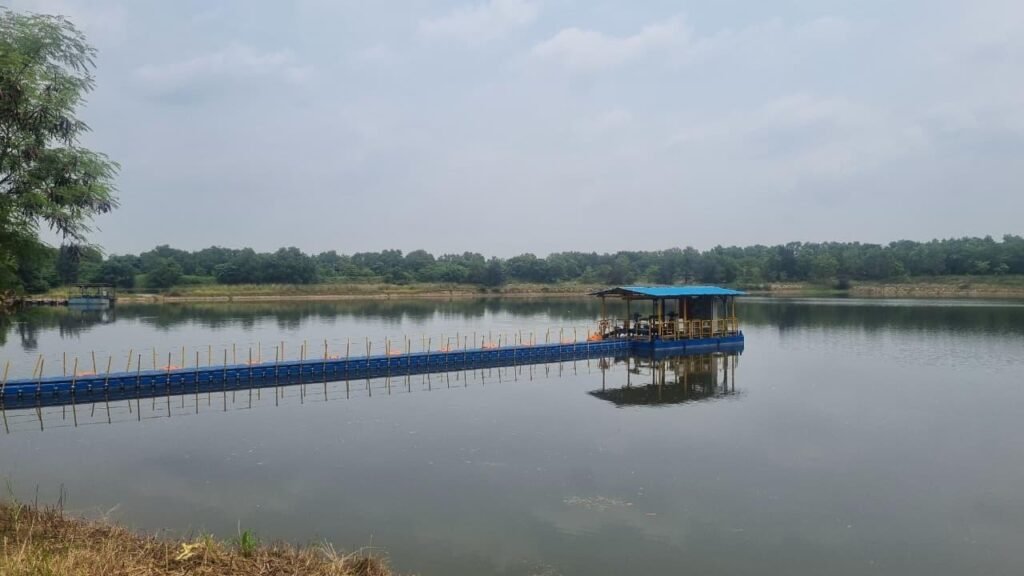
A pump pontoon must support its equipment safely while maintaining sufficient buoyancy and stability throughout its operating range. A platform that floats under static conditions may still be unsuitable if it lacks adequate structural strength, freeboard, stability, or mooring capacity during operation.
Structural calculations should account for the loads acting on the platform during normal operation, maintenance, transportation, and other relevant conditions.
These may include:
Equipment placement matters. Heavy components should be positioned according to approved structural and stability calculations rather than simply arranged to maximise deck space.
Structural calculations should assess load combinations, member stresses, local deck strength, connections, welds, and the effects of equipment movement. The responsible engineer should identify the applicable design standards and project specifications.
Buoyancy determines whether a pontoon can support its total displacement. Stability determines how the structure behaves when loads are unevenly distributed or external forces act on it.
The engineering review should include:
Illustrative Buoyancy Calculation
Freshwater has a density of approximately 1,000 kg/m³ under ordinary engineering assumptions.
Consider a floating platform with a total operating mass of 50,000 kg, including the structure, equipment, and other loads.
The approximate displaced water volume required to support this mass at static equilibrium is:
Displaced volume = Mass ÷ Water density
50,000 ÷ 1,000 = 50 m³
This example illustrates the relationship between mass and displaced water volume. The actual pontoon design must also account for reserve buoyancy, freeboard, stability, hull dimensions, and safe operating loads.
Designers should identify the minimum, normal, and maximum operating water levels. The intake must remain at a suitable position and submergence throughout the intended operating range.
The assessment should consider:
The design must ensure that the intake remains suitable throughout the expected operating range.
The mooring arrangement should prevent unwanted drift while allowing the movement required by the floating system.
The design must account for expected environmental loads and ensure that connected pipelines, cables, and walkways do not experience excessive tension or movement.
Mooring components should remain accessible for inspection and maintenance. Their design life and replacement requirements should also be considered.
Steel structures operating in water or continuously humid environments require suitable material selection, fabrication quality, surface preparation, and protective coatings.
Depending on the exposure conditions, the design may include:
Procurement documents should specify the required materials, fabrication procedures, inspection arrangements, coating system, and applicable testing.
Corrosion protection should be selected for the actual water and exposure conditions.
Pump capacity should be selected according to the project's hydraulic requirements, not simply the motor's kilowatt rating.
Three important parameters are:
Engineers must also review the pump's operating curve, suction conditions, expected operating hours, and duty/standby requirements.
For water, approximate hydraulic power can be calculated using:
Hydraulic power = Water density × Gravity × Flow rate × Total dynamic head
Consider an illustrative duty point of 100 litres per second at a total dynamic head of 30 metres.
| Parameter | Illustrative value |
| Required flow | 100 L/s |
| Equivalent flow | 360 m³/hour |
| Total dynamic head | 30 m |
| Assumed overall pump efficiency | 75% |
First, convert the flow rate:
100 L/s = 0.1 m³/s = 360 m³/hour
The approximate hydraulic power is:
1,000 × 9.81 × 0.1 × 30 = 29,430 watts
Therefore, the hydraulic power is approximately 29.4 kW.
If the assumed overall pump efficiency is 75%, the approximate input power required is:
29.4 ÷ 0.75 = 39.2 kW
This example illustrates how flow rate, head, and efficiency influence power requirements. Actual motor selection requires the system curve, pump performance data, operating conditions, starting requirements, and applicable design margins.
The engineer must also assess suction conditions, intake submergence, potential vortex formation, sediment ingress, and the consequences of pump failure.
A project with multiple pumps may use them in different ways:
The actual system output depends on the approved operating philosophy, pump curves, hydraulic losses, and commissioning results.
| Parameter | What must be established |
| Required flow | Design discharge and demand profile |
| Total dynamic head | Static head and system losses |
| Pump arrangement | Number of duty and standby pumps |
| Motor requirements | Power, electrical supply, and protection |
| Intake conditions | Minimum water depth and required submergence |
| Structural loads | Equipment, piping, personnel, and maintenance loads |
| Stability | Displacement, freeboard, load distribution, and operating limits |
| Mooring | Environmental forces and permitted movement |
| Maintenance | Safe access, lifting provisions, and replacement strategy |
Floating pumping installations are designed according to the hydraulic requirements, site conditions, equipment arrangement, and operational needs of each water-supply scheme. The Kondagaon Water Supply Scheme in Chhattisgarh and the Lakhimpur Water Treatment Plant in Assam illustrate different floating-platform configurations and pump arrangements.
| Project detail | Information |
| Location | Kondagaon, Chhattisgarh |
| Project | Kondagaon Water Supply Scheme |
| Pontoon area | 180 m² |
| Pump arrangement | Three HSCF pumps, each rated at 198 m³/hour |
| Water-supply design capacity | 9 MLD |
| Floating structure | Mild-steel modular barges |
| Scope | Design, engineering, supply, installation, and commissioning |
| Status | Ongoing |
The floating platform is designed around the project's pumping equipment and water-supply requirements. The three pumps have a combined nominal rating of 594 m³/hour when operating simultaneously at their stated ratings.
The 9 MLD water-supply design capacity represents the scheme's stated design capacity, while the pump ratings describe the listed capacities of the individual pumps.
The platform's structural design must account for equipment weights, load distribution, piping loads, access requirements, buoyancy, and stability.
| Project detail | Information |
| Location | Lakhimpur, Assam |
| Application | Water supply and treatment |
| Pontoon area | 35 m² |
| Pump arrangement | Two HSCF pumps, each rated at 435.6 m³/hour |
| Floating structure | Mild-steel modular barges |
| Scope | Design, engineering, supply, installation, and commissioning |
| Status | Ongoing |
The two pumps have a combined nominal rating of 871.2 m³/hour when operating simultaneously at their stated ratings.
The floating platform supports the pumping arrangement for the water-supply application. Its design must account for the equipment layout, structural loads, hydraulic requirements, and access needed for operation and maintenance.
Water-supply installations can differ significantly in platform area, pump configuration, equipment weight, and site conditions.
The main engineering considerations include:
These considerations help project teams develop floating pumping systems suited to their specific operating requirements.
A pump pontoon's service life depends on its engineering, materials, fabrication quality, protective systems, operating environment, and maintenance.
A suitable specification should explain how the structure will be protected and inspected throughout its intended operating life.
Material selection: Steel grade, plate thickness, and structural details must suit the design loads and exposure conditions.
Welding and fabrication: Approved drawings, suitable welding procedures, and inspection help reduce the risk of fabrication defects.
Protective coatings: The coating system should suit the expected immersion, splash, and atmospheric exposure.
Inspection and maintenance: Periodic inspection should cover corrosion, coating damage, welds, watertight compartments, mooring components, and connected systems.
Operating conditions: Water chemistry, debris, impacts, environmental loads, and operating practices can affect deterioration and maintenance requirements.
Service-life expectations should be based on the project specification, materials, exposure conditions, and maintenance plan.
Selecting a pump pontoon involves technical evaluation and a clear definition of responsibilities. The purchaser should establish whether the contract covers only the floating structure or also includes pumps, motors, piping, electrical systems, mooring, launching, testing, and commissioning.
Prepare the project information before requesting quotations. This should include the water-source location, water-level range, required discharge and total dynamic head, pump and motor schedule, structural loads, shore connections, environmental conditions, and maintenance requirements.
Review the structural calculations, buoyancy, stability, freeboard, anchoring, piping flexibility, corrosion protection, electrical safety, and access provisions.
Confirm that the proposed arrangement meets the tender requirements and approved drawings before fabrication begins.
Fabrication should follow approved drawings, material specifications, welding procedures, and inspection requirements.
Depending on the project specification, checks may include dimensional inspection, weld inspection, coating-thickness measurements, and watertightness testing.
Transportation and launching arrangements depend on module dimensions, lifting points, road access, water depth, and site conditions.
The installation method should define the lifting equipment, launching procedures, temporary restraints, personnel responsibilities, and safety controls.
Commissioning should verify that the pontoon, pumps, piping, electrical systems, and mooring arrangement work as intended.
Checks may include pump alignment, electrical protection, pipeline connections, leakage, mooring performance, vibration, and hydraulic performance against the approved duty requirements.
The handover package should include relevant drawings, equipment details, inspection records, operating instructions, and maintenance recommendations.
SITC stands for Supply, Installation, Testing, and Commissioning.
For a floating pumping system, the contract should clearly state which party is responsible for the pontoon, pumps, motors, electrical systems, pipelines, mooring, deployment, and final performance checks.
A clearly defined scope helps prevent coordination gaps between the floating-structure supplier, pump supplier, civil contractor, electrical contractor, and project owner.
A suitable supplier should demonstrate engineering capability, fabrication quality, and an understanding of the complete floating pumping arrangement.
When evaluating pump pontoon suppliers for AMRUT 2.0 projects, buyers should assess the following criteria.
| Evaluation criterion | Evidence to request |
| Relevant experience | Comparable projects and verifiable references |
| Engineering documentation | Structural drawings, load calculations, buoyancy and stability assessments |
| Fabrication quality | Material specifications, welding procedures, and inspection records |
| Corrosion protection | Coating specifications and inspection requirements |
| Equipment integration | Pump duty, mounting details, piping, and electrical scope |
| Installation capability | Transportation, launching, anchoring, and commissioning methodology |
| Compliance | Tender-specific documentation and applicable standards |
| Maintenance support | Warranty terms, inspection schedules, and service responsibilities |
| Commercial scope | Itemised quotation, exclusions, delivery schedule, and payment terms |
The tender should specify the required deliverables and acceptance criteria. Descriptions such as “heavy-duty,” “high capacity,” or “long service life” should be supported by engineering documentation and measurable requirements.
Before issuing a purchase order, ask each shortlisted supplier:
The answers should be documented in the technical offer and final contract.
Acquafront Infrastructure Private Limited (AIPL) provides engineered floating infrastructure for water intake, industrial applications, and other marine and inland-waterway requirements.
Its floating-infrastructure capabilities include pump pontoons, modular barges, floating work platforms, and other fabricated floating structures.
AIPL's water-supply-related project experience includes floating-pontoon assignments in Kondagaon, Chhattisgarh, and Lakhimpur, Assam. The company's wider portfolio also includes floating infrastructure for reservoir and water-supply applications.
AIPL's floating infrastructure project at Hirakud Reservoir, Odisha, includes a Steel Integrated Floating Jetty (SIFJ) used for a water-supply application.
| Project detail | Information |
| Location | Hirakud Reservoir, Odisha |
| Platform area | 204 m² |
| Structure | Steel Integrated Floating Jetty (SIFJ) |
| Platform weight | 50 tonnes |
| Pump arrangement | Three submersible pumps, each rated at 500 m³/hour |
| Water-supply design capacity | 9.5 MLD |
| Client | Public Health and Engineering Department (PHED), Odisha |
| Completion year | 2021 |
The three pumps have a combined nominal rating of 1,500 m³/hour when operating simultaneously at their stated ratings. The water-supply design capacity is listed separately at 9.5 MLD.
The project demonstrates the use of floating infrastructure for reservoir-based water extraction, combining a floating structural platform with pumping equipment for a water-supply application.
AIPL's project portfolio also includes a Steel Integrated Floating Jetty (SIFJ) floating pump pontoon associated with the Beohari Water Supply Scheme.
| Project detail | Information |
| Location | Beohari, Madhya Pradesh |
| Platform area | 45 m² |
| Structure | Steel Integrated Floating Jetty (SIFJ) |
| Pump arrangement | Two submersible pumps, each rated at 200 m³/hour |
| Combined nominal pump rating | 400 m³/hour |
| Completion year | 2019 |
| Client/contractor reference | Tejas Construction & Infrastructure Private Limited |
The floating platform supports the pumping arrangement for the water-supply application. Its design and equipment layout address the requirements of the installation.
Every floating structure should be designed around its intended application rather than selected solely by dimensions or nominal load rating.
The engineering process should consider:
For AMRUT 2.0 applications, the proposed configuration must meet the project's technical specifications, approval requirements, and operating conditions.
A pump pontoon for AMRUT 2.0 is an engineered floating platform that supports pumping equipment where a floating intake is suitable for a water-supply project. Its design depends on the water source, hydraulic requirements, water-level variation, structural loads, and project specifications.
The published mission targets include household tap connections for 2.68 crore households and universal water-supply coverage in approximately 4,700 statutory towns. The mission also targets 2.64 crore sewerage and septage connections and universal sewerage and septage coverage in 500 AMRUT cities.
No. AMRUT 2.0 covers different types of water and wastewater infrastructure. A pump pontoon is considered where the project's water source and engineering requirements support a floating intake arrangement.
They may be suitable where a project uses an appropriate surface-water source and the engineering assessment supports a floating intake. AIPL has floating-pontoon project experience associated with Lakhimpur, Assam.
AIPL's project portfolio includes the Kondagaon Water Supply Scheme in Chhattisgarh. The project information lists a 180 m² platform, three HSCF pumps rated at 198 m³/hour each, and a water-supply design capacity of 9 MLD.
Pump capacity is selected according to the required flow rate and total dynamic head. Engineers also review pump curves, efficiency, suction conditions, operating hours, and whether the installation requires duty and standby pumps.
A properly designed floating platform can rise and fall with the water surface within its intended operating range. The design must maintain adequate pump submergence, stability, freeboard, mooring performance, and safe piping connections.
Useful information includes the site location, water-level range, required flow and total dynamic head, pump and motor details, equipment loads, pipeline arrangement, environmental conditions, access constraints, and expected supply and installation scope.
Buyers should assess relevant project experience, structural and stability calculations, fabrication quality, corrosion protection, equipment integration, installation capability, commissioning procedures, warranty conditions, and after-sales support.
SITC means Supply, Installation, Testing, and Commissioning. The scope varies by contract and may cover the floating structure and associated equipment. Buyers should confirm whether pumps, motors, piping, electrical works, mooring, launching, and performance verification are included.
Service life depends on the design, material selection, fabrication quality, corrosion protection, environmental exposure, operating conditions, and maintenance. Buyers should review the project-specific design-life requirements and maintenance schedule.
Yes. A floating platform can be designed around the required pump duty, equipment arrangement, water-level variation, structural loads, mooring, access, and maintenance needs. The final design must be verified for the actual site and operating conditions.
A floating pontoon follows the water surface within the permitted movement of its mooring and connections. A fixed intake remains at a defined structural elevation. The choice depends on hydraulic requirements, water-level variation, construction constraints, operating conditions, and lifecycle considerations.
Request structural drawings, load calculations, buoyancy and stability assessments, material specifications, welding inspection records, corrosion-protection details, mooring information, and relevant testing documentation.
Start with the approved project requirements and source-water assessment. Confirm the hydraulic duty, compare suitable intake options, obtain project-specific engineering documentation, define the supply and installation scope, and verify that the proposed system meets the tender and commissioning requirements.
AMRUT 2.0 establishes a significant national programme for improving urban water security, with targets covering household water connections, sewerage, and septage management. Delivering reliable water services requires suitable water sources, effective intake systems, treatment infrastructure, and well-engineered distribution networks.
For projects that rely on suitable surface-water sources, a pump pontoon can provide a floating platform for pumping equipment. Its performance depends on hydraulic duty, buoyancy, stability, structural integrity, mooring, corrosion protection, and maintainability.
AIPL's project portfolio includes floating-pontoon assignments associated with water-supply applications in Kondagaon and Lakhimpur, as well as floating infrastructure installations at Hirakud Reservoir and the Beohari Water Supply Scheme. These projects illustrate different floating-platform configurations and pumping arrangements for water-supply applications.
For government agencies, consultants, and EPC contractors, the priority should be to assess site conditions, establish hydraulic requirements, review engineering calculations, and define the complete supply and installation scope before selecting a solution.
Contact Acquafront Infrastructure Private Limited to discuss your site conditions, pump duty, structural requirements, equipment integration, and project scope.
Phone: +91 7678232371
Website: https://acquainfra.com
Email: Admin@acquainfra.com
Mr. Achin Agrawal
Director & CTO
Acquafront Infrastructure Private Limited
Mr. Achin Agrawal leads engineering and technology initiatives at Acquafront Infrastructure Private Limited (AIPL), focusing on modular floating infrastructure, marine engineering, lifting barges, construction pontoons, floating work platforms, and heavy-duty marine systems. His work includes floating infrastructure solutions for reservoirs, dams, ports, industrial waterfronts, and inland waterways across India.
AIPL develops floating infrastructure solutions for marine and industrial applications, with engineering, fabrication, installation, testing, and commissioning responsibilities defined according to project requirements.

