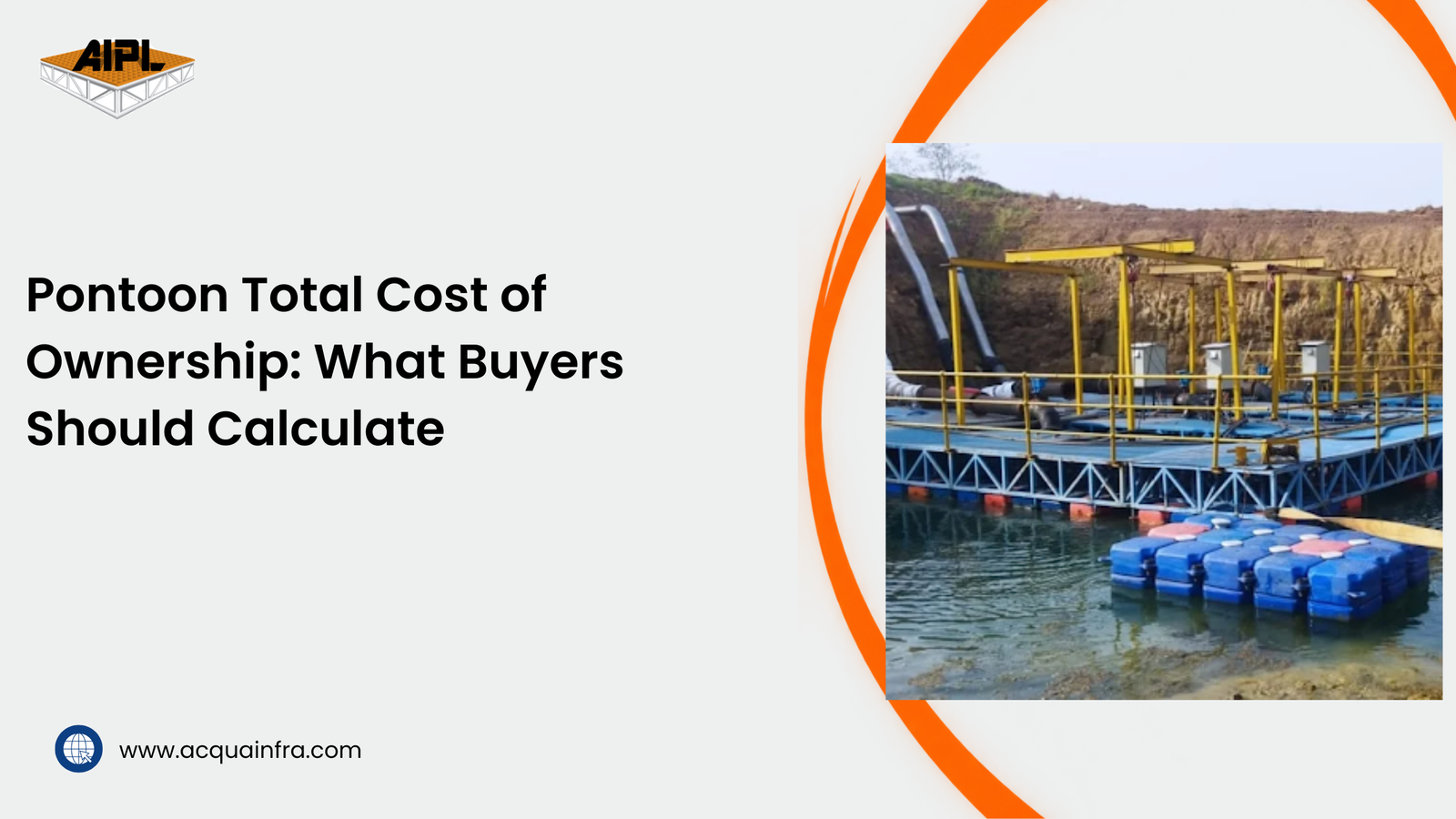
Across industrial, water-supply and marine infrastructure projects, the purchase price of a pontoon is only one part of the investment. Fabrication quality, transportation, installation, maintenance and operating conditions can significantly influence the actual project cost.
Pontoon Total Cost of Ownership provides a broader way to evaluate that investment. Instead of comparing only the initial quotation, buyers can assess the costs associated with operating and maintaining a floating structure throughout its service life.
For EPC contractors, government agencies, consultants and industrial buyers, this approach helps connect engineering decisions with long-term operational reliability.
Pontoon Total Cost of Ownership is the combined cost of owning, operating, maintaining and eventually modifying or replacing a pontoon over its useful service period.
The calculation can include:
Therefore, two pontoons with similar dimensions can have very different lifecycle economics.
A low initial quotation may appear attractive during procurement. However, a lower price can become less economical if it results in frequent repairs, difficult maintenance access, poor corrosion resistance or unexpected installation expenses.
Conversely, a properly engineered pontoon may require a higher initial investment while reducing recurring expenditure over its operating life.
| Cost Factor | Initial Purchase Price | Total Cost of Ownership |
| Engineering | Sometimes included | Considered |
| Fabrication | Included | Considered |
| Transportation | May be excluded | Included |
| Installation | May be excluded | Included |
| Maintenance | Usually excluded | Included |
| Repairs | Excluded | Included |
| Downtime | Excluded | Considered |
| Modifications | Usually excluded | Considered |
| End-of-life costs | Excluded | Considered |
A quotation may show the pontoon dimensions, material and basic fabrication price without clearly defining the complete project scope.
For example, a buyer may receive a quotation for a 12 m × 3 m modular barge and assume that two pontoons with the same dimensions are equivalent.
They may not be equivalent.
The engineering behind those dimensions can differ in:
AIPL's modular barges, for example, are described as rectangular mild-steel floating units intended for project-specific applications and heavy-load requirements. (Acquafront Infrastructure)
Engineering is one of the first areas buyers should examine.
A pontoon supporting pumps, cranes, construction equipment or cargo requires more than a basic floating box.
Engineering may need to address:
A floating pumping station, for example, may experience concentrated equipment loads that require specific buoyancy and stability calculations.
AIPL's project documentation describes pump pontoons designed around equipment loading, water-level fluctuation and environmental conditions. (Acquafront Infrastructure)
Material selection directly influences structural performance and maintenance requirements.
Buyers should check:
Marine-grade fabrication should also account for the actual water environment rather than relying only on generic material specifications.
A pontoon may be economical to fabricate but expensive to transport to a remote reservoir, river or industrial site.
Transportation cost depends on:
Modular construction can be valuable where large floating structures must reach locations with restricted transportation access.
AIPL describes its modular barges as transportable units suitable for rivers, reservoirs, lakes, inland waterways and coastal waters. (Acquafront Infrastructure)
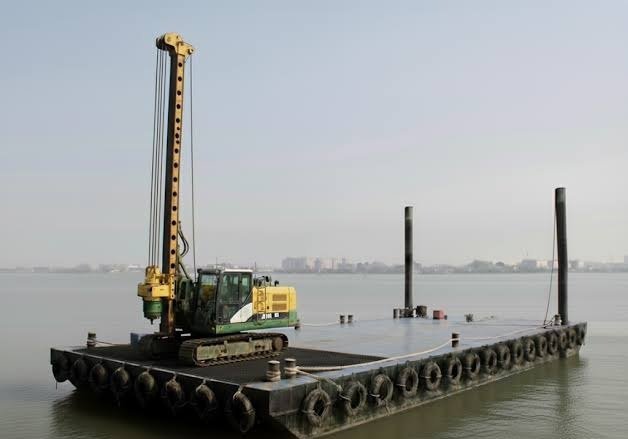
The pontoon should be designed around actual operating loads rather than only its physical dimensions.
Important loading information can include:
AIPL's project enquiry process itself requests information such as equipment weight, loading capacity, maximum loading, water depth, waterbody characteristics and wave conditions. (Acquafront Infrastructure)
This illustrates why site and equipment data should be established before final engineering.
A pontoon must provide sufficient buoyancy for its operating condition.
The engineering assessment should consider:
Insufficient reserve buoyancy can create operational and safety concerns, particularly when equipment is concentrated in one area.
Stability is not determined by dimensions alone.
Equipment location, centre of gravity, deck loading and water conditions can influence the pontoon's response.
For a pump pontoon, positioning heavy motors and pumps without evaluating the resulting centre of gravity can affect trim and stability.
Anchoring arrangements are another important part of lifecycle cost.
The design should consider:
A cheaper pontoon with an unsuitable anchoring arrangement may generate additional modification and maintenance costs later.
Corrosion is one of the recurring expenses associated with steel floating infrastructure.
The TCO calculation should therefore consider:
The objective is not simply to minimise the initial coating cost.
Instead, buyers should consider how the selected protection method influences inspection intervals, repair requirements and service life.
AIPL states that its floating infrastructure is intended for long-term operation, with a standard product life of 20+ years, extendable to 25–35 years with proper maintenance, depending on project conditions and maintenance practices.
One of the most overlooked components of Pontoon Total Cost of Ownership is downtime.
If a pontoon supports a critical pumping operation, construction activity or industrial process, an unexpected shutdown can have consequences beyond the repair invoice.
Potential impacts include:
For this reason, buyers should assess reliability and maintainability alongside purchase price.
Maintenance becomes easier when critical components can be inspected without major dismantling.
A well-planned floating infrastructure project should provide reasonable access to:
Good accessibility can reduce both maintenance time and labour requirements.
Consider two hypothetical quotations.
| Cost Category | Pontoon A | Pontoon B |
| Purchase Price | Lower | Higher |
| Engineering Documentation | Basic | Detailed |
| Structural Analysis | Limited | Project-specific |
| Corrosion Protection | Basic | Marine-grade specification |
| Installation Scope | Excluded | Included |
| Maintenance Access | Standard | Engineered |
| Expected Service Life | Project dependent | 20+ years* |
| Modification Flexibility | Limited | Modular |
| Lifecycle Assessment | Required | Required |
*Actual service life depends on design, operating environment, inspection and maintenance.
The comparison demonstrates why purchase price alone cannot establish lifecycle value.
A proper commercial evaluation should identify what each quotation actually includes.
A practical Pontoon Total Cost of Ownership model can be structured as follows:
TCO = Initial Cost + Installation + Operating Costs + Maintenance + Repairs + Downtime + Modifications − Residual Value
The exact calculation should be project-specific.
For example, a floating intake platform operating continuously for water supply may have very different cost drivers compared with a construction pontoon used periodically for dredging.
Before approving a pontoon purchase, evaluate:
A modular floating structure can provide advantages where transportation, relocation or future expansion is important.
Modular barges can be assembled according to project requirements rather than forcing every project into one fixed configuration.
This can be particularly relevant for:
Every floating infrastructure project should consider whether additional equipment may be required later.
Future expansion may involve:
Designing for foreseeable expansion during the initial engineering stage can avoid expensive structural modifications later.
Where practical, standardised components can simplify maintenance and spare-parts management.
However, standardisation should not replace project-specific engineering.
Every project still needs to account for water depth, environmental conditions, equipment loads and operational requirements.
| Application | Major TCO Drivers |
| Floating Pump Pontoon | Pump loading, corrosion, access, continuous operation |
| Floating Intake Platform | Water-level variation, intake depth, anchoring |
| Construction Pontoon | Heavy machinery, dynamic loading, relocation |
| Cargo Barge | Cargo capacity, deck loading, transportation |
| Floating Jetty | Passenger loading, access, stability, corrosion |
| Floating CNG Facility | Equipment loading, safety, inspection and maintenance |
| Marine Work Platform | Machinery loads, mobility, anchoring and durability |
The appropriate TCO model therefore depends on the intended application.
Acquafront Infrastructure Private Limited (AIPL) follows an engineering-driven approach to floating infrastructure, with project-specific design and fabrication rather than treating every pontoon as an identical product.
AIPL's capabilities include IIT-driven engineering, custom-engineered fabrication, marine-grade manufacturing and turnkey SITC execution. Its website states that the company works with IIT Kanpur and IIT (BHU) Varanasi and undertakes design, survey, manufacturing, supply, installation, commissioning and maintenance activities. (Acquafront Infrastructure)
Its project portfolio includes floating pump pontoons, modular barges, floating CNG facilities, passenger jetties and other marine infrastructure. (Acquafront Infrastructure)
Projects such as the Hirakud Reservoir pump pontoon, Bansagar Dam water-supply project, Floating CNG Station at Varanasi and Sabarmati Wet & Dry Dock demonstrate applications across different operating environments. (Acquafront Infrastructure)
The engineering approach is particularly relevant to TCO because design, fabrication, transportation, installation and long-term maintenance need to work together rather than being treated as isolated procurement activities.
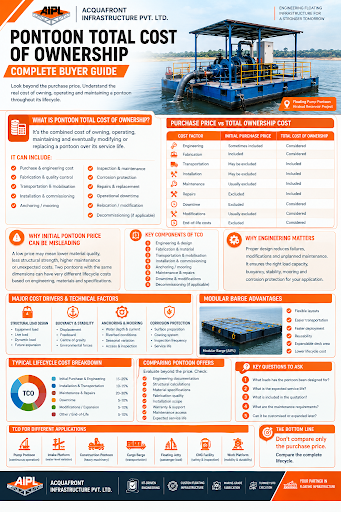
Before signing a purchase order, ask the vendor to clearly identify the following.
A detailed scope prevents the initial quotation from becoming an incomplete representation of the final project cost.
A buyer should ask:
These questions turn a basic price comparison into an engineering and commercial evaluation.
Pontoon Total Cost of Ownership is the combined lifecycle cost of purchasing, installing, operating, maintaining, repairing and eventually modifying or replacing a pontoon.
Purchase price does not normally represent transportation, installation, maintenance, corrosion protection, repairs or downtime.
Include engineering, fabrication, transportation, installation, maintenance, repairs, inspection, downtime and future modifications.
Not necessarily. TCO depends on engineering quality, operating conditions, maintenance requirements and the scope included in the quotation.
Corrosion can increase inspection, coating-repair and structural-maintenance costs, particularly in demanding marine environments.
Proper structural, buoyancy, stability and anchoring calculations can help reduce failures, modifications and unplanned maintenance.
AIPL specifies a standard product life of 20+ years, with potential extension to 25–35 years with proper maintenance, subject to project conditions.
Yes. AIPL custom-engineers floating infrastructure according to project requirements, water depth, equipment loads, environmental conditions and future expansion.
AIPL provides project-specific engineering, fabrication, supply, installation and commissioning for floating infrastructure across India. (Acquafront Infrastructure)
Yes. Pump load, operating hours, corrosion, maintenance access, anchoring and downtime can all be included in the TCO calculation.
Yes, modular floating infrastructure can be engineered for projects in Gujarat according to site conditions, water depth and loading requirements. AIPL undertakes project-specific floating infrastructure engineering across India.
Yes. AIPL has executed floating infrastructure projects in multiple Indian states, including water-related applications in Madhya Pradesh and Odisha. (Acquafront Infrastructure)
Important inputs include dimensions, equipment weight, operating load, water depth, waterbody type, wave conditions, location and intended operation. AIPL's enquiry process requests these project parameters. (Acquafront Infrastructure)
Yes. AIPL describes its capabilities as including design, survey, manufacturing, supply, installation, commissioning and maintenance. (Acquafront Infrastructure)
Yes. AIPL undertakes custom-engineered heavy-duty floating infrastructure, including modular barges and construction pontoons, with execution capability for loads exceeding 1,000 tonnes, subject to project-specific engineering.
Pontoon Total Cost of Ownership gives buyers a more complete picture than the initial purchase price. Engineering, material quality, transportation, installation, maintenance, corrosion protection and downtime can all influence the final lifecycle expenditure.
The most useful comparison is therefore not simply “Which pontoon costs less?” but “What is included, how is it engineered, and what will it cost to operate reliably over its intended life?”
For complex applications, project-specific engineering and lifecycle planning can help EPC contractors, government agencies and industrial buyers make procurement decisions based on measurable technical and commercial requirements.
Consult experienced engineers to design customized floating infrastructure tailored to your operational requirements.
📞 +91 7678232371
📩
Mr. Achin Agrawal
Director & CTO
Acquafront Infrastructure Private Limited
Mr. Achin Agrawal leads the engineering and technology initiatives at Acquafront Infrastructure Pvt. Ltd. (AIPL), specialising in modular floating infrastructure, marine engineering, lifting barges, construction pontoons, floating work platforms, and heavy-duty marine systems. With extensive experience in designing and executing complex floating infrastructure projects, he has contributed to solutions deployed across reservoirs, dams, ports, industrial waterfronts, and inland waterways throughout India. Under his technical leadership, AIPL continues to deliver IIT-driven engineering, IRS-compliant fabrication, and turnkey SITC solutions that meet the evolving needs of India's marine infrastructure sector.

