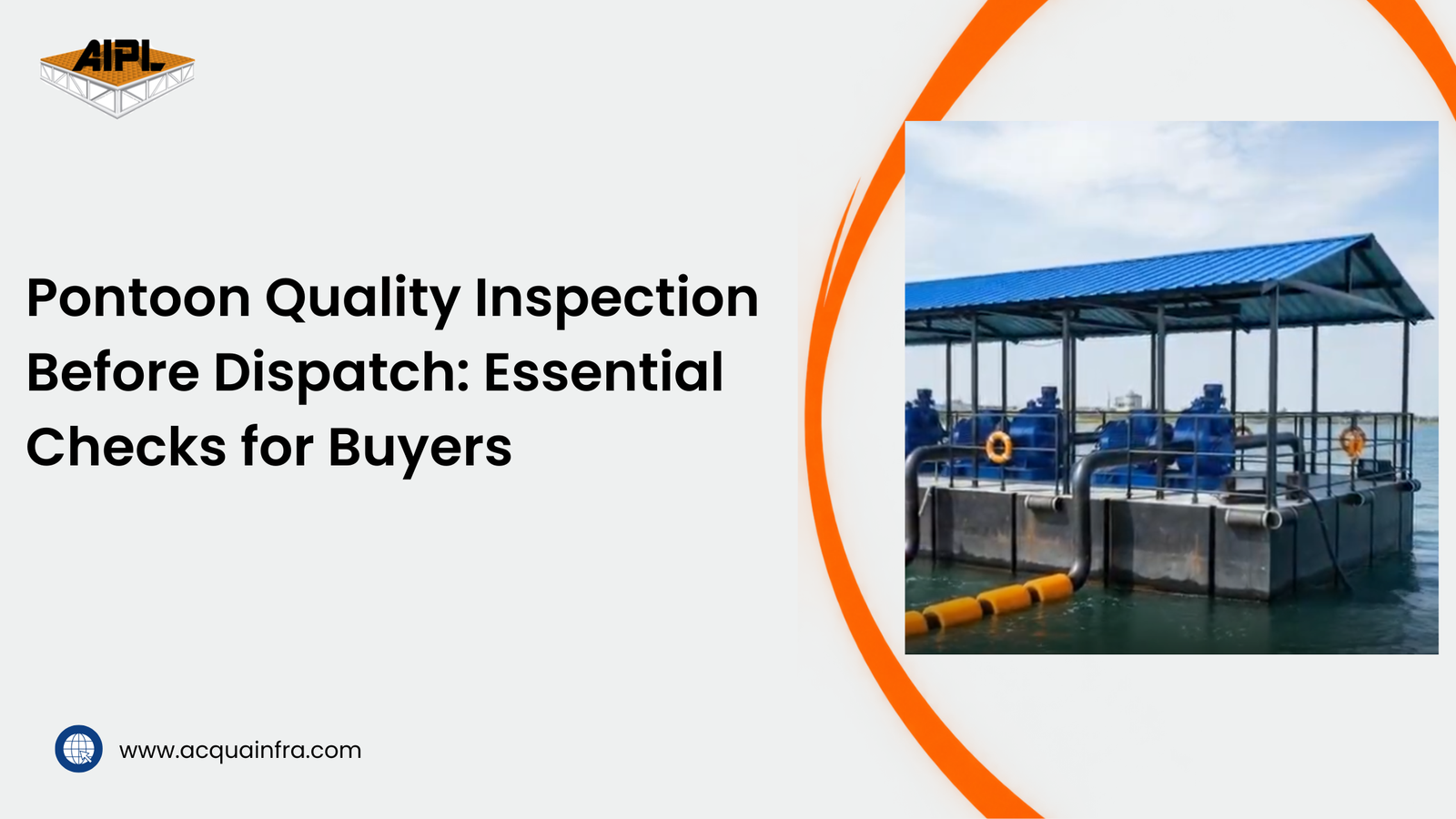
Across marine infrastructure projects, the quality of a pontoon cannot be judged only by its dimensions, steel weight, or appearance. A Floating Pump Pontoon, Construction Pontoon, Floating Jetty, or Modular Barge must perform safely after transportation, deployment, equipment installation, and continuous operation.
That is why Pontoon Quality Inspection should be completed before the pontoon leaves the fabrication facility. A structured pre-dispatch inspection allows buyers to verify construction quality, structural details, welding, coatings, modular connections, documentation, and readiness for deployment.
For EPC contractors, consultants, government agencies, and industrial buyers, this stage is also an opportunity to identify deficiencies before they become transportation, installation, commissioning, or operational problems.
A pontoon may look complete from the outside while important quality checks remain unresolved. Welding defects, incorrect dimensions, incomplete coating, poor modular connections, inadequate stiffeners, or missing documentation may not be obvious during a visual inspection alone.
Pre-dispatch inspection therefore needs to combine visual verification, dimensional checks, documentation review, fabrication inspection, and engineering validation.
For a project-specific pontoon, buyers should verify at least the following:
The objective is not simply to confirm that the pontoon has been fabricated. It is to confirm that it has been fabricated according to the approved engineering and project requirements.
A proper inspection should follow an approved inspection and test plan wherever applicable. The buyer, consultant, or appointed inspection agency should also compare the fabricated pontoon against approved drawings and technical specifications.
Dimensional inspection is one of the first checks because deviations can affect transportation, equipment installation, modular connections, and site deployment.
Check:
Measurements should be recorded rather than relying only on visual confirmation.
The inspection should confirm that primary and secondary structural members correspond with the approved design.
Particular attention should be given to:
This becomes particularly important where the pontoon is intended to support pumps, generators, cranes, piling equipment, or other heavy machinery.
For project-specific applications, load distribution should be checked against the intended equipment arrangement rather than only the empty pontoon configuration.
Welding is a critical part of marine-grade fabrication because structural continuity and watertight integrity depend heavily on fabrication quality.
During Pontoon Quality Inspection, buyers should review:
Depending on the approved inspection plan, visual inspection may be supplemented by appropriate non-destructive testing.
The important point is that inspection should verify both fabrication workmanship and documented quality control.
Material traceability is an important part of quality assurance.
The buyer should request applicable documentation for major structural materials, including:
Documentation should correspond with the materials actually incorporated into the pontoon.
For a Modular Barge or Sectional Barge, connections require particular attention because the modules must transfer loads properly after assembly.
Inspect:
A modular floating structure should be checked not only as individual sections but also for how those sections are intended to work together after assembly.
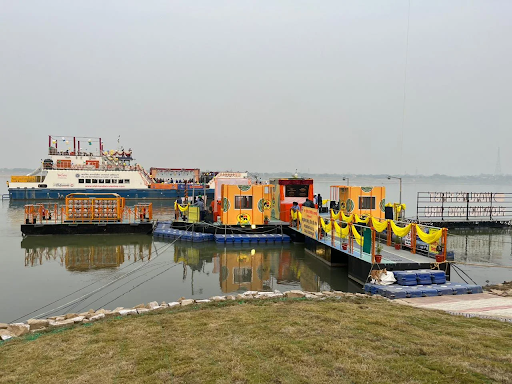
Marine and inland-water environments expose floating infrastructure to continuous moisture and, depending on the location, aggressive environmental conditions.
A Pontoon Quality Inspection should therefore include the complete coating system rather than simply checking whether the pontoon has been painted.
Verify:
Particular attention should be given to weld zones, corners, edges, connections, deck areas, and locations that may retain water.
A properly selected and applied corrosion-protection regime contributes directly to long-term operational reliability.
A pontoon's ability to float safely depends on its buoyancy arrangement and watertight construction.
Before dispatch, buyers should verify the condition and configuration of:
Where testing is specified in the project documentation, relevant watertightness or compartment inspection records should also be reviewed.
The inspection should confirm that the fabricated arrangement corresponds with the engineering design used for buoyancy calculations.
Stability is not determined by pontoon dimensions alone. It depends on the relationship between displacement, centre of gravity, centre of buoyancy, equipment position, freeboard, and loading conditions.
Before dispatch, buyers should verify that the pontoon has been fabricated for its intended loading configuration.
Important considerations include:
For floating pumping stations and Floating Pump Pontoons, pump, motor, piping, electrical equipment, and ancillary loads should be considered together.
A pontoon can be structurally complete but still require modifications if equipment interfaces were not properly considered during fabrication.
Inspect:
For pump applications ranging from 10–2000+ kW, equipment interface requirements can vary considerably. The inspection should therefore be based on the actual project equipment rather than a generic pontoon configuration.
A practical pre-dispatch checklist can help buyers and inspection teams record acceptance systematically.
| Inspection Area | What to Verify | Typical Evidence |
| Dimensions | Length, width, depth and key locations | Dimensional report |
| Structure | Girders, stiffeners, bulkheads and deck | Approved drawings |
| Welding | Weld quality and specified NDT | Inspection/NDT reports |
| Materials | Steel grade and traceability | Material certificates |
| Modular joints | Pins, bolts, locks and alignment | Inspection records |
| Buoyancy | Compartments and watertight construction | Test/inspection records |
| Coating | Surface preparation and coating quality | Coating report |
| Equipment supports | Foundations and mounting points | Approved GA/fabrication drawings |
| Safety | Railings, ladders, access and walkways | Visual inspection |
| Lifting | Lifting points and identification | Engineering documentation |
| Documentation | Drawings, certificates and reports | Handover dossier |
This checklist should be adapted to the specific pontoon, its intended application, and the approved project documentation.
The buyer should verify that the fabricated structure corresponds with the approved structural design.
This includes checking load-bearing members, equipment foundations, deck capacity, stiffeners, reinforcement, and critical connection areas.
For heavy-duty floating infrastructure, the inspection should also consider the intended operating loads rather than only fabrication dimensions.
Buoyancy calculations should correspond with the actual fabricated configuration.
Changes in deck equipment, machinery arrangement, structural weight, or compartment configuration can influence displacement and stability.
Therefore, significant fabrication changes should be reviewed by the responsible engineering team before acceptance.
Where the pontoon is designed for fixed or semi-fixed operation, inspect the provisions for:
The final arrangement should correspond with the approved mooring or anchoring design.
Pre-dispatch inspection should also consider how the pontoon will reach the project site.
Verify:
For modular floating infrastructure, clear identification of individual sections can significantly simplify site assembly.
Physical inspection is only one part of quality acceptance. The documentation package should also be reviewed before dispatch.
Depending on project scope, buyers should request:
A well-organised documentation package provides traceability and helps the project team during installation, commissioning, maintenance, and future inspections.
Several issues should trigger additional engineering review rather than immediate acceptance.
A low-value cosmetic defect and a structural deviation should not be treated in the same way. Buyers should classify findings according to their potential effect on structural integrity, buoyancy, stability, safety, and project functionality.
At Acquafront Infrastructure Private Limited, floating infrastructure is approached through project-specific engineering and marine-grade fabrication rather than treating every pontoon as a standard product.
AIPL's engineering process considers project requirements, water depth, equipment loads, environmental conditions, transportation requirements, and future expansion.
The company's IIT-driven engineering approach, IRS-compliant fabrication, custom-engineered manufacturing, and turnkey SITC execution capability support projects where structural performance and deployment reliability are critical.
AIPL's experience includes the Hirakud Reservoir Project, Bansagar Dam Project, Floating CNG Station Projects, Ultratech Cement Projects, Vedanta Projects, Passenger Jetty Projects, Floating Stage Projects, and Sabarmati Wet & Dry Dock Project.
For heavy-duty applications, AIPL has execution capability for floating infrastructure handling 1000+ tonnes, while pump-related applications can accommodate requirements from 10–2000+ kW, depending on project engineering.
The standard design life is 20+ years, with the potential to extend service life to 25–35 years with proper maintenance.
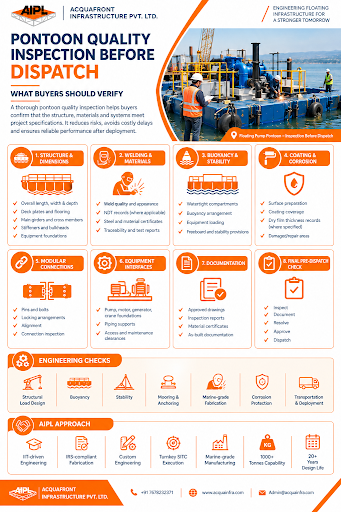
A professional Pontoon Quality Inspection should establish a clear connection between design intent, fabrication quality, documentation, and final project requirements.
For buyers, this means going beyond checking whether the pontoon looks finished. The inspection should establish whether the structure has been fabricated correctly, whether critical materials and workmanship are traceable, and whether the pontoon is ready for transportation and deployment.
This approach is especially important for Floating Pump Pontoons, water intake pontoons, construction pontoons, marine work platforms, and other floating infrastructure carrying valuable equipment or supporting critical operations.
Pontoon Quality Inspection is the pre-dispatch verification of a pontoon's structural fabrication, welding, materials, coating, connections, documentation, and project-specific requirements before delivery.
Inspection can involve the pontoon manufacturer, buyer's inspection team, consultant, or an appointed third-party inspection agency, depending on project requirements.
Buyers should verify dimensions, structural members, welding, material certificates, coating, modular connections, buoyancy provisions, equipment foundations, safety features, and quality documentation.
Inspection arrangements are generally project-specific. Buyers should select an inspection team with appropriate experience in floating infrastructure and marine-grade fabrication.
Yes, project-specific inspection arrangements can be made for floating infrastructure projects in India, subject to the project scope and inspection requirements.
Yes. Inspection and project support can be arranged according to project requirements and the location of the floating infrastructure.
Yes. The inspection checklist should be customised according to the pontoon type, equipment loads, water conditions, fabrication drawings, applicable specifications, and intended operation.
Welding inspection helps identify defects, discontinuities, distortion, and workmanship issues that could affect structural integrity or watertight construction.
Yes. Material certificates and traceability records help confirm that the structural materials used during fabrication meet the specified requirements.
Typical documents include approved drawings, material certificates, welding and NDT records where applicable, dimensional reports, coating records, inspection reports, and as-built documentation.
Yes. Where required by the project inspection plan, buyers should verify buoyancy-related construction, watertight compartments, bulkheads, and supporting inspection or test records.
Yes. Pump, motor, generator, crane, piping, and other equipment interfaces should be checked against approved drawings and actual equipment requirements.
AIPL's standard floating infrastructure design life is 20+ years, with service life potentially extending to 25–35 years with proper maintenance, depending on operating conditions and maintenance practices.
Yes. Depending on the project scope, a manufacturer can provide fabrication drawings, material certificates, inspection records, test documentation, coating records, and other quality documents.
An engineering-driven manufacturer can coordinate structural design, buoyancy, stability, fabrication, quality inspection, equipment interfaces, transportation, deployment, and project-specific requirements as part of an integrated execution approach.
Pre-dispatch inspection gives buyers an important opportunity to verify the pontoon before transportation and site deployment. Structural quality, welding, materials, coatings, connections, buoyancy provisions, equipment interfaces, and documentation should all be reviewed against the approved project requirements.
For critical floating infrastructure, the inspection should connect fabrication quality with engineering intent. A detailed inspection record also provides useful traceability for installation, commissioning, maintenance, and future operational assessments.
AIPL's engineering-driven approach combines custom engineering, marine-grade manufacturing, IIT-driven engineering, IRS-compliant fabrication, and turnkey SITC capability for project-specific floating infrastructure across India.
Consult experienced engineers to design customized floating infrastructure tailored to your operational requirements.
📞 +91 7678232371
📩 Admin@acquainfra.com
Mr. Achin Agrawal
Director & CTO
Acquafront Infrastructure Private Limited
Mr. Achin Agrawal leads the engineering and technology initiatives at Acquafront Infrastructure Pvt. Ltd. (AIPL), specialising in modular floating infrastructure, marine engineering, lifting barges, construction pontoons, floating work platforms, and heavy-duty marine systems. With extensive experience in designing and executing complex floating infrastructure projects, he has contributed to solutions deployed across reservoirs, dams, ports, industrial waterfronts, and inland waterways throughout India. Under his technical leadership, AIPL continues to deliver IIT-driven engineering, IRS-compliant fabrication, and turnkey SITC solutions that meet the evolving needs of India's marine infrastructure sector.

