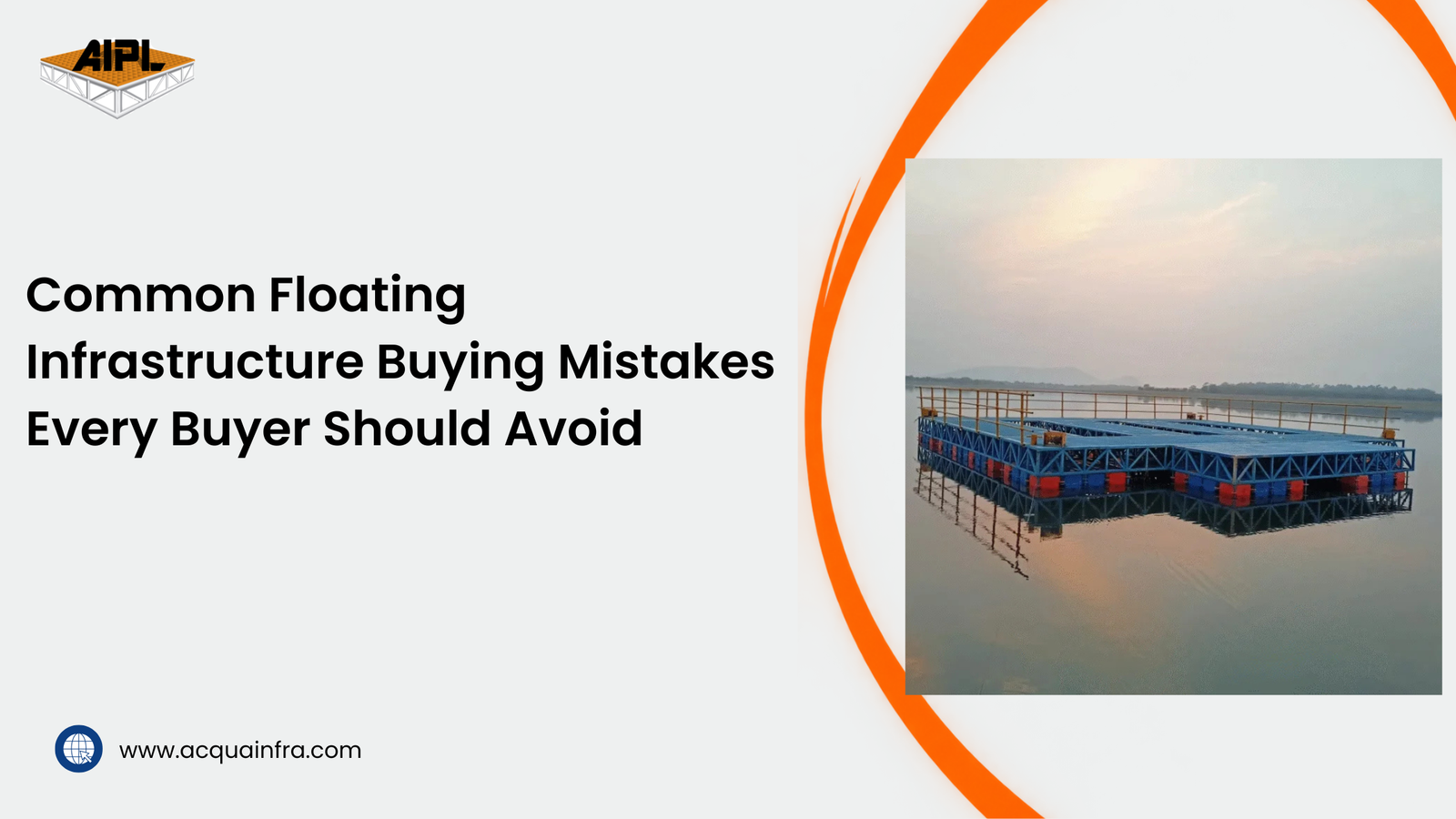
Across industrial, water-resource and marine infrastructure projects, purchasing a floating structure is rarely just a matter of selecting the right size and negotiating the lowest price. A pontoon, floating intake platform, marine work platform or modular barge must perform reliably under actual site conditions.
Yet many procurement decisions are still made primarily around dimensions, quoted price and delivery time. The real cost often appears later through redesign, additional fabrication, installation changes, anchoring modifications or unexpected maintenance.
This is why Floating Infrastructure should be evaluated as an engineered asset rather than a fabricated steel product. A technically complete assessment considers site conditions, structural loads, buoyancy, stability, corrosion, deployment and clearly defined responsibilities before purchase approval.
A floating structure may look straightforward from the outside. However, its performance depends on several engineering parameters that cannot be understood from dimensions alone.
For example, two pontoons with similar length and width can have significantly different payload capacities, freeboard, structural arrangements, stability characteristics and operating limitations.
Similarly, two quotations with different prices may not represent equivalent scopes. One vendor may include engineering, transportation, installation and commissioning, while another may quote only fabrication.
Before comparing vendors, buyers should therefore establish a technical and commercial basis of comparison.
These mistakes can affect both project schedules and long-term reliability.
One of the most common purchasing mistakes is treating pontoon dimensions as the main technical specification.
A buyer may compare two quotations based on length, width, depth and price. However, these parameters alone do not establish whether the floating structure can safely carry the required equipment.
A better comparison should include:
| Evaluation Parameter | What the Buyer Should Check |
| Overall dimensions | Length, width and depth |
| Payload | Rated operational and equipment load |
| Structural design | Framing, deck and load-bearing arrangement |
| Freeboard | Available reserve above water |
| Stability | Trim, heel and operating condition |
| Buoyancy | Displacement and reserve buoyancy |
| Material | Marine-grade steel and applicable specifications |
| Corrosion protection | Coating and protection methodology |
| Anchoring | Anchor type, loads and arrangement |
| Mobility | Towing, modularity or relocation requirements |
| Installation | Defined supply and site responsibilities |
| Design life | Standard 20+ years, subject to design and maintenance |
Price becomes meaningful only after the technical scope is normalized.
A lower initial quotation may exclude engineering calculations, transportation, anchoring hardware, installation assistance or commissioning.
Those items can later appear as variations or additional site costs.
For EPC contractors and industrial buyers, the correct approach is to compare equivalent scope against equivalent technical performance.
Floating infrastructure is highly dependent on its operating environment.
A vendor cannot properly engineer a floating pump pontoon or water intake pontoon if important site information is missing.
Buyers should provide as much project data as possible during the enquiry stage.
Incomplete information often leads to assumptions.
Those assumptions may work during preliminary quotation but become problematic during detailed engineering or installation.
A strong procurement process establishes a clear technical data sheet before design approval.
Where site information is uncertain, the quotation should clearly identify the assumptions being used.
This prevents later disputes over whether additional engineering or fabrication is within the original scope.
A floating structure should not be selected only from drawings or photographs.
Engineering calculations are important because the pontoon must remain structurally adequate and stable under its intended operating conditions.
For a heavy-duty construction pontoon or floating pumping station, buyers should ask for relevant design documentation.
For equipment-intensive applications, the position of heavy components is particularly important.
A pump, motor, generator, crane or storage tank placed away from the pontoon's centerline can create significant heeling moments.
A common error is using only the equipment's dry weight.
Engineering may also need to consider operational loads, piping, fluids, maintenance personnel, lifting activities and other project-specific loads.
For heavy-duty applications, AIPL's execution capability extends to floating infrastructure handling 1000+ tonnes, subject to project-specific engineering and design conditions.
A pontoon floats because its displacement creates sufficient buoyancy.
However, floating does not automatically mean stable.
A properly engineered floating structure must maintain adequate reserve buoyancy and acceptable stability across its intended loading conditions.
Can the pontoon support the required displacement?
Will it remain acceptably stable while carrying that displacement?
This distinction is particularly important for floating pumping stations, marine work platforms and modular barges carrying concentrated equipment.
Changes in loading condition can alter draft, trim and heel.
Therefore, buyers should request engineering documentation demonstrating that the proposed configuration has been evaluated for relevant operating conditions.
A floating structure does not operate independently of the waterbody.
Its position may need to be controlled using anchors, piles, guide arrangements, chains, wires, ropes or other project-specific mooring arrangements.
The correct arrangement depends on water depth, current, wind, waves, water-level variation and operational requirements.
Anchoring is not simply an accessory.
For a floating intake platform, incorrect positioning can affect pipeline alignment, pump suction conditions, access and operational safety.
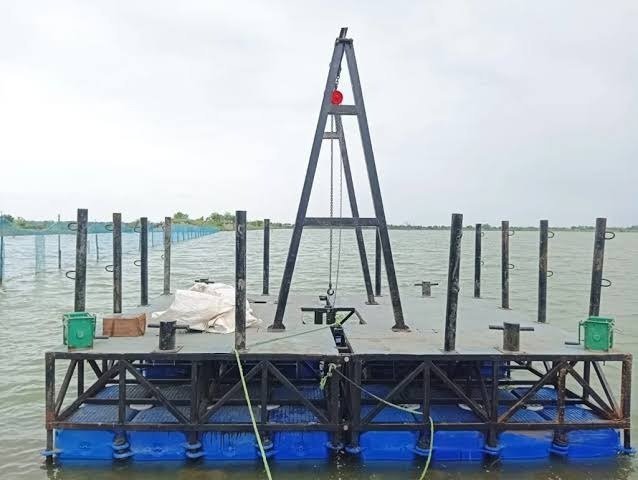
A quotation can appear commercially attractive until the buyer discovers that major site activities are excluded.
This is particularly common when procurement documents use broad terms such as “supply,” “fabrication” or “delivery.”
For a complete floating infrastructure project, responsibilities should be clearly divided.
The buyer should never assume these activities are automatically included.
A simple responsibility matrix can eliminate significant commercial ambiguity.
| Activity | Buyer | Vendor | Joint / Clarify |
| Engineering | ✓ | ||
| Fabrication | ✓ | ||
| Factory inspection | ✓ | ||
| Site preparation | ✓ | ✓ | |
| Transportation | ✓ | ✓ | |
| Launching | ✓ | ✓ | |
| Anchoring | ✓ | ✓ | |
| Equipment installation | ✓ | ✓ | ✓ |
| Electrical connections | ✓ | ✓ | ✓ |
| Testing | ✓ | ✓ | |
| Commissioning | ✓ | ✓ |
The exact division should always be finalized contractually for the specific project.
Every floating infrastructure project has different engineering conditions.
A reservoir floating intake may have completely different requirements from a coastal cargo barge, passenger jetty or construction pontoon.
The design should therefore consider:
A modular floating platform can provide flexibility, but modularity still needs to be engineered around the actual operating configuration.
AIPL follows a project-specific engineering approach rather than treating every application as an identical fabrication package.
Floating infrastructure operates in an environment where steel is exposed to moisture, immersion, splash zones and atmospheric corrosion.
Therefore, material selection and corrosion protection should be part of the procurement evaluation.
Buyers should review:
Marine-grade fabrication is not simply about using thicker steel.
It involves controlling material quality, fabrication practices, welding quality and corrosion protection as an integrated engineering process.
A pontoon can be correctly designed but still create difficulties if its transportation and deployment method is not considered early.
Large monolithic structures may require specialized transportation and lifting arrangements.
Sectional barges and modular barges can offer different logistics advantages where site access or transportation restrictions exist.
The buyer should therefore ask:
These questions should be answered before purchase approval rather than after fabrication.
A technically mature procurement process should include an engineering review before the purchase order is finalized.
The deck, primary framing and supporting members should be checked against the intended equipment and operational loads.
Concentrated loads require particular attention because they can create localized stresses.
The design should establish draft, reserve buoyancy, trim and stability for relevant load cases.
This is especially important when heavy machinery is mounted on one side of the pontoon.
Environmental forces should be considered when determining the anchoring or mooring arrangement.
The design should account for the actual waterbody rather than relying on a generic arrangement.
Fabrication should follow documented engineering drawings, material specifications, welding requirements and inspection procedures.
For critical applications, buyers should also establish inspection and documentation requirements before fabrication begins.
The coating specification should reflect the operating environment and expected service life.
With proper maintenance, floating infrastructure can have a standard service life of 20+ years, with potential to extend to 25–35 years depending on design, operating conditions and maintenance practices.
Lifting points, access arrangements, handrails, walkways, emergency access and deployment procedures should be considered as part of the engineering scope.
The purchase price is only one component of the cost of ownership.
A better evaluation considers the complete lifecycle.
| Cost Area | Questions to Ask |
| Initial fabrication | What exactly is included? |
| Engineering | Are calculations and drawings included? |
| Transportation | Who bears logistics costs? |
| Installation | Is site assembly included? |
| Anchoring | Are all components included? |
| Commissioning | Who performs testing? |
| Maintenance | What inspections are required? |
| Corrosion protection | What maintenance cycle is expected? |
| Modification | Can future equipment be accommodated? |
| Service life | What design life is targeted? |
A slightly higher initial price can be commercially sensible when it includes stronger engineering, clearer documentation and better lifecycle reliability.
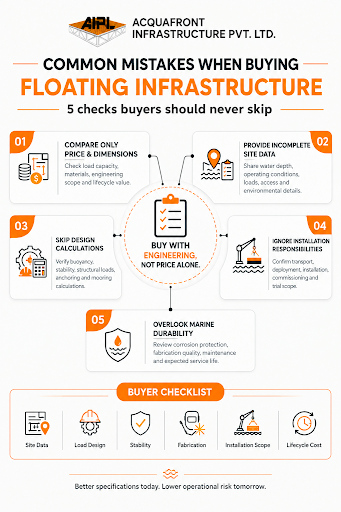
A structured evaluation can significantly reduce procurement risk.
Identify whether the requirement is for a:
Prepare a technical data sheet covering water depth, operating levels, loads and environmental conditions.
Ask every vendor to quote against the same technical scope.
Check calculations, drawings, material specifications and inspection requirements.
Ask specifically what is excluded from fabrication, transportation, installation, anchoring and commissioning.
Consider maintenance requirements, corrosion protection, service life and future modifications.
Past experience matters, particularly for complex floating infrastructure.
The buyer should look for evidence of relevant engineering, fabrication and site execution rather than relying only on catalogue photographs.
Acquafront Infrastructure Private Limited approaches floating infrastructure through project-specific engineering rather than a one-size-fits-all fabrication model.
Its IIT-driven engineering approach considers the relationship between structure, equipment loading, buoyancy, stability, anchoring, fabrication and deployment.
AIPL's capabilities include custom-engineered fabrication, marine-grade manufacturing, heavy-duty fabrication and turnkey SITC execution.
The company can engineer floating infrastructure around equipment capacities ranging from 10–2000+ kW for applicable pumping applications, while its execution capability includes heavy-load applications of 1000+ tonnes, subject to project-specific engineering.
AIPL's project experience includes applications associated with:
This type of experience is valuable because procurement decisions should consider not only fabrication capability but also engineering coordination, transportation, installation and commissioning requirements.
For an EPC contractor or government procurement team, the quality of engineering documentation can be as important as the physical fabrication.
A well-defined documentation package helps establish what has been designed, what has been tested and what responsibilities remain with the buyer.
Where applicable, IRS-compliant floating infrastructure and documented quality procedures can provide an additional engineering reference point during technical evaluation.
Floating infrastructure includes engineered floating structures such as pontoons, barges, floating intake structures, jetties and marine work platforms designed for specific operational applications.
Comparing only dimensions and price is a major mistake. Buyers should also compare structural design, load capacity, stability, anchoring, installation scope and lifecycle requirements.
Water depth, water-level variation, currents, wind, loads and access conditions directly influence engineering, anchoring and deployment requirements.
Yes. Buyers should request relevant structural, buoyancy, stability and load calculations appropriate to the intended application.
Specialized marine engineering and fabrication companies such as AIPL provide project-specific floating infrastructure for industrial, reservoir, dam and waterfront applications.
No. Price should be compared only after technical scope, engineering deliverables, installation responsibilities and exclusions have been standardized.
A quotation should clearly identify engineering, fabrication, materials, corrosion protection, transportation, anchoring, installation, testing, commissioning and exclusions.
Yes. Floating infrastructure can be custom engineered for Gujarat projects based on site conditions, water depth, equipment loads and environmental requirements.
Yes. Project-specific floating infrastructure can be engineered for reservoirs, dams and industrial applications across Uttar Pradesh, Madhya Pradesh and Odisha.
Yes. AIPL custom engineers floating infrastructure according to project requirements, water depth, equipment loads, environmental conditions and future expansion.
A properly engineered structure can have a standard life of 20+ years, with potential for 25–35 years with appropriate maintenance and operating conditions.
AIPL has execution capability for floating infrastructure handling 1000+ tonnes, subject to project-specific engineering, structural design and operating conditions.
Applicable AIPL floating pumping applications can be engineered for pump capacities from approximately 10–2000+ kW, depending on project requirements.
Responsibility varies by contract. Buyers should explicitly define transportation, launching, assembly, anchoring, equipment installation, testing and commissioning responsibilities.
Evaluate engineering capability, relevant project experience, fabrication quality, technical documentation, installation scope, compliance requirements, lifecycle considerations and total project cost.
Buying floating infrastructure should be treated as an engineering procurement decision, not simply a comparison of steel dimensions and quoted prices.
Complete site information, verified design calculations, clear anchoring requirements and defined installation responsibilities can prevent expensive changes during fabrication and deployment.
For demanding marine and inland-water applications, an engineering-driven approach provides a stronger foundation for long-term operational reliability, maintenance planning and project performance.
Planning a floating infrastructure project?
Consult experienced engineers to design customized floating infrastructure tailored to your operational requirements.
📞 +91 7678232371
📩
Mr. Achin Agrawal
Director & CTO
Acquafront Infrastructure Private Limited
Mr. Achin Agrawal leads the engineering and technology initiatives at Acquafront Infrastructure Pvt. Ltd. (AIPL), specialising in modular floating infrastructure, marine engineering, lifting barges, construction pontoons, floating work platforms, and heavy-duty marine systems.
With extensive experience in designing and executing complex floating infrastructure projects, he has contributed to solutions deployed across reservoirs, dams, ports, industrial waterfronts, and inland waterways throughout India.
Under his technical leadership, AIPL continues to deliver IIT-driven engineering, IRS-compliant fabrication, and turnkey SITC solutions that meet the evolving needs of India's marine infrastructure sector.

