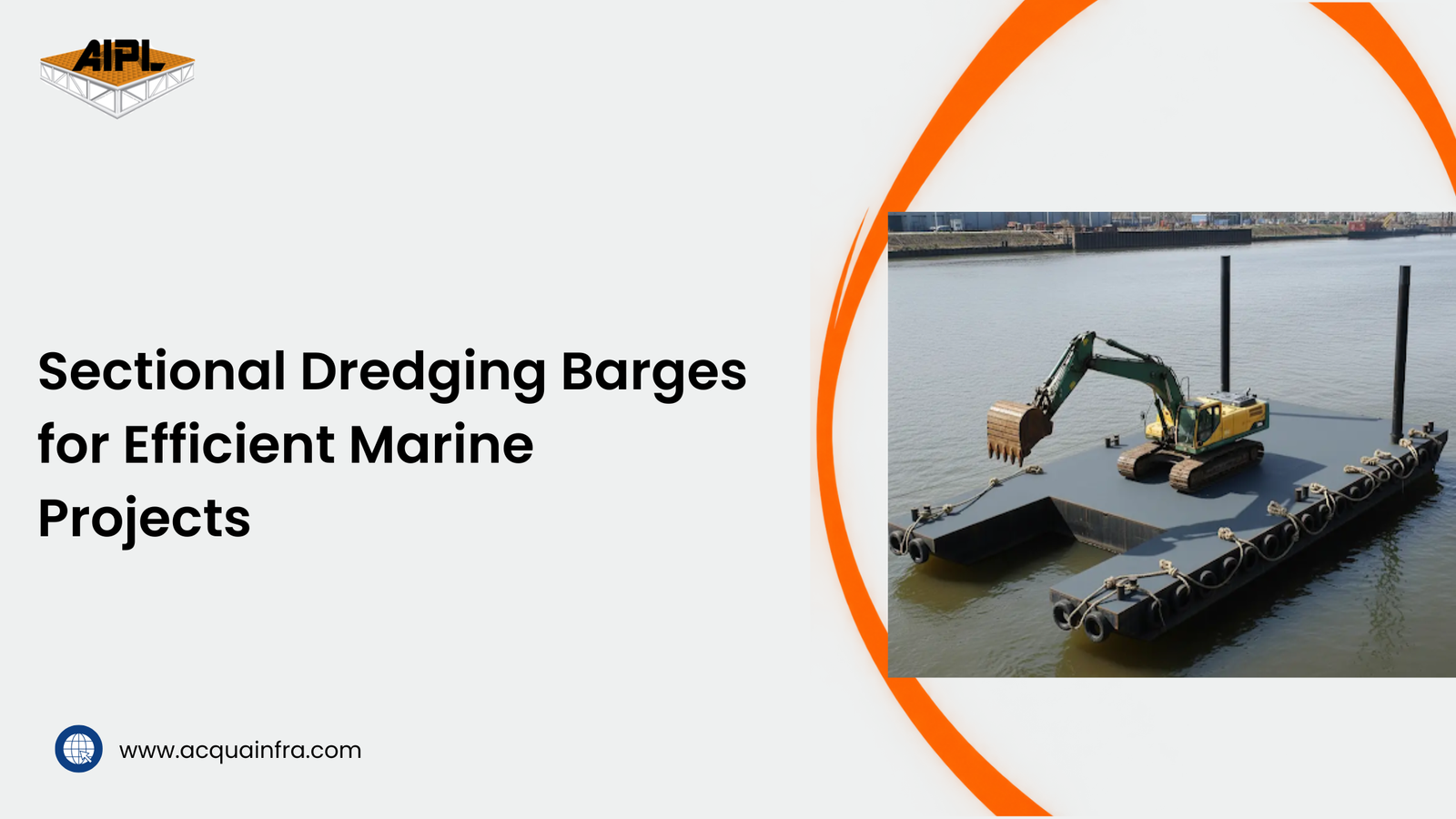
Modern infrastructure projects increasingly rely on efficient marine equipment to execute dredging operations in rivers, reservoirs, ports, canals, mining pits, and coastal zones. Among the most versatile floating assets used in these environments are sectional barges, engineered to provide stable, modular, and heavy-duty floating workspaces for dredging equipment.
Unlike conventional welded barges that require specialized transportation and extensive fabrication at the installation site, Sectional Dredging involves assembling modular steel barge sections into a customized floating structure capable of supporting dredgers, excavators, cranes, booster pumps, pipelines, and ancillary equipment. The modular design significantly reduces logistics challenges while improving scalability and operational flexibility.
As India's inland waterways, smart ports, river rejuvenation projects, mining operations, and irrigation infrastructure continue to expand, the demand for modular dredging barges has grown rapidly. Engineering consultants, EPC contractors, government agencies, and industrial operators increasingly prefer sectional barges because they can be transported by road, assembled on-site, expanded as project requirements evolve, and relocated for future assignments.
With extensive experience in engineering and manufacturing modular floating infrastructure, Acquafront Infrastructure Private Limited (AIPL) has executed numerous marine infrastructure projects across India. From the 204 sq. m Floating Pump Pontoon at Hirakud Reservoir to modular floating structures for Ultratech Cement, Vedanta Ltd., Bansagar Dam, Floating CNG Stations, passenger jetties, floating stages, and the Sabarmati Wet & Dry Dock, AIPL applies an engineering-driven approach to deliver customized floating infrastructure for demanding environments.
Sectional Dredging is a dredging methodology in which modular steel barges are interconnected to create a customized floating work platform for dredging equipment. Instead of fabricating one large monolithic vessel, individual barge modules are transported separately and assembled at the project site.
Each module functions as a structural building block. Depending on project requirements, multiple modules are mechanically connected to achieve the required deck area, buoyancy, and load-bearing capacity.
This modular approach offers exceptional flexibility for projects where transportation limitations, varying operational loads, and changing site conditions make conventional barges impractical.
A typical sectional dredging setup includes interconnected marine-grade steel modules engineered to operate as a single floating structure. Each module is fabricated with precision-engineered connection mechanisms that distribute structural loads evenly across the assembled barge.
Once assembled, the sectional barge can accommodate:
The modular configuration allows engineers to modify deck layouts according to equipment weight, project duration, and environmental conditions.
India's marine and inland infrastructure sector presents several logistical challenges. Many dredging sites are located in remote areas where transporting a fully fabricated barge is neither practical nor economical.
Sectional barges address these challenges by enabling:
As a result, sectional dredging has become the preferred choice for government departments, mining companies, EPC contractors, and infrastructure developers working on reservoirs, rivers, canals, and coastal development projects.
Why Sectional Barges are Ideal for Dredging Projects
Dredging operations demand floating infrastructure capable of withstanding continuous dynamic loading, equipment vibration, fluctuating water levels, and challenging environmental conditions.
A sectional barge offers several engineering advantages over traditional fixed barges.
| Parameter | Conventional Barge | Sectional Barge |
| Transportation | Difficult | Easy by road |
| On-site Assembly | Not possible | Modular assembly |
| Expansion | Limited | Highly scalable |
| Maintenance | Entire vessel | Individual modules |
| Relocation | Expensive | Cost-effective |
| Deck Size | Fixed | Customizable |
| Load Distribution | Fixed | Engineered as required |
| Future Reuse | Limited | Excellent |
Each module acts as an independent structural component, allowing engineers to create floating work platforms ranging from compact dredging units to large multi-module installations.
Modern sectional barges can be engineered to support 50+ tonnes of operational load, depending on module configuration, deck reinforcement, and buoyancy calculations. This makes them suitable for large excavators, cranes, cutter suction dredgers, booster pumps, and associated marine equipment.
Every dredging project presents unique operational requirements. Factors such as dredger size, excavation depth, pipeline routing, wave conditions, and soil characteristics influence the final barge configuration.
AIPL adopts a project-specific engineering approach, customizing:
Marine infrastructure is a long-term investment. High-quality sectional barges fabricated using marine-grade steel, protective coating systems, and precision welding techniques can achieve a standard operational lifespan exceeding 20 years, with proper maintenance extending service life to 25–35 years.
This durability reduces lifecycle costs while maximizing return on investment across multiple dredging projects.
Sectional barges have become indispensable across numerous infrastructure sectors due to their versatility and scalability.
Common applications include:
As India's maritime and inland infrastructure investments continue to expand, modular dredging barges are expected to play an even more significant role in enhancing project efficiency and reducing construction timelines.
Selecting the right sectional barge is one of the most important engineering decisions in a dredging project. The barge configuration directly affects operational safety, equipment stability, project productivity, and lifecycle costs.
Unlike conventional barges built to fixed dimensions, Sectional Dredging allows engineers to configure modular floating infrastructure according to project-specific requirements. Factors such as dredger size, water depth, current velocity, soil characteristics, working area, and equipment weight determine the final barge layout.
At Acquafront Infrastructure Private Limited (AIPL), every modular barge is custom-engineered rather than manufactured to a one-size-fits-all specification. This engineering-first approach ensures that each floating structure delivers optimum buoyancy, structural integrity, and operational efficiency.
Excavator-mounted sectional barges are widely used for shallow-water dredging, river restoration, canal desilting, and embankment strengthening projects.
These barges provide a stable marine work platform for crawler excavators equipped with standard or long-reach booms. The modular deck distributes machine loads evenly, minimizing structural stress during excavation.
| Equipment | Typical Capacity |
| Hydraulic Excavator | 20–50 tonnes |
| Long Reach Excavator | 18–40 tonnes |
| Hydraulic Grab | Up to 12 tonnes |
| Auxiliary Generator | 50–500 kVA |
Cutter suction dredgers require stable floating infrastructure capable of supporting continuous vibration, rotational forces, slurry pipelines, and booster pumps.
Sectional barges offer a highly adaptable deck arrangement that accommodates dredger equipment while allowing future expansion if production capacity needs to increase.
Typical installations include:
Because dredging productivity often depends on uninterrupted operation, modular barges simplify maintenance by allowing individual components or deck sections to be serviced without replacing the complete floating structure.
Large dredging projects frequently require booster pumps to transport dredged slurry over long distances.
Rather than installing pumps on temporary civil foundations, booster pumps can be mounted on sectional barges that move with changing project requirements.
Benefits include:
Heavy lifting operations in marine construction demand barges with high structural rigidity and optimized load distribution.
Typical crane applications include:
Depending on operational requirements, sectional barges can be engineered to safely support lifting operations exceeding 50 tonnes, with reinforcement designed around crane loading patterns and overturning moments.
Successful Sectional Dredging projects rely on detailed engineering rather than simply assembling floating modules.
Every design begins with a comprehensive assessment of project requirements, including:
At AIPL, engineering teams use project-specific calculations to determine the optimum module arrangement before fabrication begins.
One of the biggest engineering advantages of sectional barges is their ability to distribute concentrated loads across multiple interconnected modules.
Instead of transferring all stresses to a single hull, modular construction spreads loads throughout the floating structure.
Typical loads considered include:
Proper structural analysis minimizes localized stress concentrations and enhances the overall durability of the floating infrastructure.
Buoyancy calculations determine whether the assembled barge can safely support equipment while maintaining adequate freeboard.
Engineers evaluate:
Maintaining sufficient reserve buoyancy is particularly important during dredging, where changing equipment positions continuously alter load distribution.
Unlike recreational floating structures, dredging barges experience continuous movement of heavy machinery.
A stable sectional barge must safely resist:
Design engineers optimize module arrangement and equipment placement to maintain a low centre of gravity and improve operational stability.
Although each project is customized, most modular dredging barges include the following engineered components:
| Component | Function |
| Modular Steel Sections | Primary buoyant structure |
| Connection Pins & Bolts | Join individual modules |
| Deck Plates | Equipment operating surface |
| Structural Frames | Load distribution |
| Mooring Bollards | Secure positioning |
| Anchor Points | Anchoring arrangement |
| Access Walkways | Safe crew movement |
| Handrails | Personnel safety |
| Pipeline Supports | Slurry pipeline routing |
| Equipment Mounts | Secure machinery installation |
A well-designed anchoring arrangement is essential for maintaining the position of a dredging barge throughout excavation.
The choice of anchoring depends on:
Common anchoring methods include:
For dynamic dredging operations, adjustable mooring layouts allow the barge to be repositioned quickly while maintaining excavation accuracy.
Although modular barges involve precision fabrication, they often reduce the total project cost when evaluated over their complete lifecycle.
Individual sections can be transported using conventional trucks, avoiding oversized transport restrictions.
Modules are assembled directly at the project site, significantly reducing deployment time.
Damaged sections can be repaired or replaced individually instead of dry-docking the entire barge.
Additional modules can be integrated if project requirements expand.
After project completion, the same modules can be dismantled, transported, and reassembled at another site.
Rather than offering standard products, Acquafront Infrastructure Private Limited (AIPL) follows a project-specific engineering methodology for every modular floating infrastructure assignment.
Key capabilities include:
This engineering-led philosophy has enabled AIPL to execute floating infrastructure across diverse sectors, including water supply, mining, inland waterways, renewable energy, and industrial marine construction.
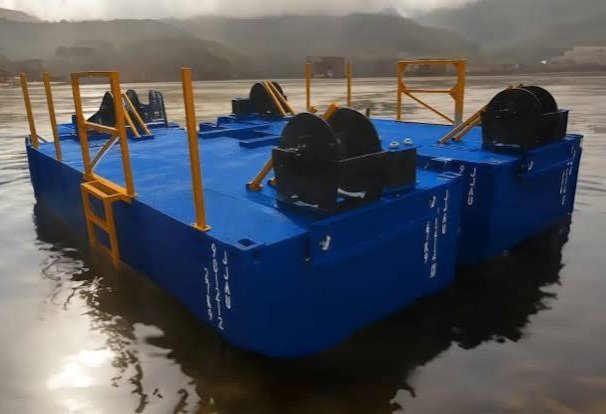
A sectional barge is much more than a floating deck. It is a structural asset that must safely support dynamic loads, maintain stability during dredging operations, and perform reliably in varying water conditions for decades.
Choosing an experienced engineering partner directly impacts project safety, productivity, and lifecycle costs.
At Acquafront Infrastructure Private Limited (AIPL), every modular floating structure is engineered around the client's operational requirements instead of following standard catalogue dimensions. This project-specific approach ensures that the barge performs efficiently under real-world site conditions while meeting stringent structural and marine engineering standards.
Unlike conventional fabrication, AIPL integrates design validation, structural analysis, buoyancy calculations, fabrication, transportation planning, installation, and commissioning into a single engineering workflow.
Over the years, AIPL has delivered modular floating infrastructure for government agencies, EPC contractors, mining companies, public utilities, and industrial clients across India.
These projects demonstrate the company's capability to fabricate large-scale floating structures with customized layouts, high load-bearing capacities, and long operational life.
| Project | Application | Quantitative Data |
| Hirakud Reservoir, Odisha | Floating water intake infrastructure | 204 sq. m floating platform |
| Bansagar Dam, Madhya Pradesh | Water Supply Scheme | Modular floating intake platform |
| Vedanta Ltd., Odisha | Chromite mine operations | 50 sq. m modular floating platform (2024) |
| Ultratech Cement, Satna | Industrial water intake | 24 sq. m, 48 sq. m & 72 sq. m platforms |
| Floating CNG Station, Varanasi | Inland waterways | 324 sq. m floating structure |
| Floating CNG Mobile Refuelling Unit | Marine fuel infrastructure | 212 sq. m floating structure |
| Floating Gurudwara, Punjab | Religious infrastructure | 636 sq. m floating structure |
| Sabarmati Wet & Dry Dock | Seaplane infrastructure | 308 sq. m floating dock |
| Floating Stage – Jash-e-Bhopal | Event infrastructure | 32-tonne floating stage |
Reliable performance begins with precision fabrication. Every stage of manufacturing influences the durability, buoyancy, and structural integrity of the final barge.
The process begins with a detailed engineering review that considers:
Advanced engineering calculations are performed before fabrication drawings are released.
AIPL uses marine-grade structural steel, including IS 2062 E250 Br Grade Steel, depending on project specifications.
Material selection focuses on:
Fabrication includes:
Each module is manufactured with precise tolerances to ensure seamless on-site assembly.
Marine environments accelerate corrosion, making protective coatings essential.
Typical protection systems include:
These coatings help extend the service life of the barge to 20+ years, with proper maintenance supporting 25–35 years of operation.
Before dispatch, every module undergoes multiple quality checks, including:
Engineering compliance is critical for ensuring safety and long-term reliability.
AIPL incorporates nationally recognized engineering practices and quality standards into its modular floating infrastructure.
This engineering-led methodology ensures reliable performance even under demanding dredging conditions.
The specifications of a sectional barge vary according to project requirements. The table below outlines the typical engineering capabilities offered by AIPL.
| Parameter | Typical Capability |
| Structure | Modular steel sectional barge |
| Fabrication Material | Marine-grade steel (IS 2062 E250 Br Grade) |
| Load Handling Capacity | 50+ tonnes |
| Design Life | 20+ years |
| Extended Service Life | 25–35 years (with maintenance) |
| Module Configuration | Fully customizable |
| Transportation | Road transportable |
| Assembly | On-site modular assembly |
| Applications | Dredging, mining, water intake, marine construction |
| Execution | Design, Fabrication, SITC |
Choosing the appropriate barge requires evaluating both operational and engineering factors.
Before finalizing a sectional barge, consider:
Working with an experienced manufacturer during the planning stage helps optimize both capital investment and operational efficiency.
Engineering, Procurement, and Construction (EPC) contractors increasingly favor modular barges because they simplify project execution.
For government infrastructure projects with strict timelines, these benefits often translate into improved productivity and faster project completion.
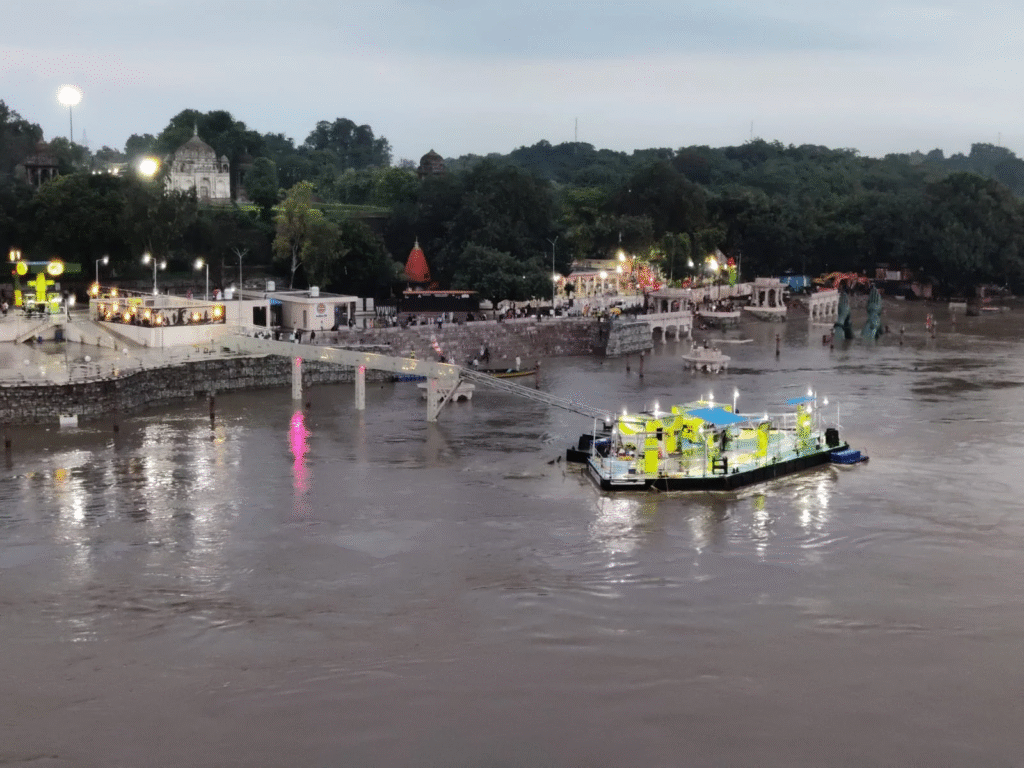
A well-designed sectional barge is a long-term capital asset. While high-quality fabrication and marine-grade coatings provide durability, regular maintenance is essential to maximize operational life and minimize downtime.
With preventive maintenance, AIPL's modular floating infrastructure is designed for a 20+ year service life, which can be extended to 25–35 years depending on operating conditions and maintenance practices.
| Maintenance Activity | Recommended Frequency | Purpose |
| Visual inspection of hull and deck | Weekly | Identify corrosion, deformation, or damage |
| Connection bolt and pin inspection | Monthly | Ensure structural integrity between modules |
| Weld inspection | Quarterly | Detect fatigue cracks and maintain strength |
| Protective coating inspection | Every 6 months | Prevent corrosion and extend service life |
| Mooring and anchoring inspection | Monthly | Maintain operational safety and positioning |
| Buoyancy and freeboard assessment | Annually | Verify structural performance |
| Complete structural audit | Every 3–5 years | Evaluate long-term reliability |
The overall cost of a Sectional Dredging project depends on several engineering and operational parameters. Rather than focusing solely on the initial fabrication cost, project owners should evaluate the total lifecycle cost.
Although modular barges may involve higher engineering precision during fabrication, they often deliver lower lifecycle costs due to:
This makes sectional barges a cost-effective choice for long-term marine infrastructure projects.
India's investment in inland waterways, ports, irrigation networks, mining, and river rejuvenation is expected to drive sustained demand for modular marine infrastructure.
Government initiatives focused on improving navigable waterways, enhancing logistics efficiency, and strengthening coastal infrastructure are encouraging wider adoption of modular dredging technologies.
Future trends include:
As project complexity increases, engineering-led manufacturers with proven execution experience will play an increasingly important role in delivering reliable and scalable floating infrastructure.
Selecting the right manufacturing partner is just as important as selecting the right sectional barge.
AIPL combines engineering expertise with practical execution experience to deliver customized modular floating infrastructure for demanding industrial and marine applications.
With successful projects across Odisha, Madhya Pradesh, Uttar Pradesh, Punjab, Gujarat, and Rajasthan, AIPL continues to support EPC contractors, consultants, government departments, and industrial clients with reliable modular floating infrastructure.
Sectional Dredging uses modular steel barges assembled on-site to support dredging equipment. It offers flexibility, easy transportation, and efficient deployment.
Sectional barges provide easier transportation, faster assembly, scalable deck sizes, simplified maintenance, and lower lifecycle costs.
Depending on the engineering design, AIPL's modular barges can safely handle 50+ tonnes of operational load.
With proper maintenance, AIPL's modular barges have a standard service life of 20+ years, extendable to 25–35 years.
Yes. Every AIPL sectional barge is custom-engineered based on equipment load, deck layout, site conditions, and project requirements.
It is widely used in river dredging, reservoir desilting, canal modernisation, mining, ports, inland waterways, and coastal infrastructure projects.
Engineering-driven manufacturers like Acquafront Infrastructure Private Limited (AIPL) design and fabricate customized modular barges for government and industrial projects across India.
Yes. AIPL has successfully executed modular floating infrastructure projects across Gujarat, Uttar Pradesh, Madhya Pradesh, Odisha, Punjab, and Rajasthan.
Sectional barges can support excavators, cutter suction dredgers, booster pumps, cranes, slurry pipelines, generators, operator cabins, and other marine equipment.
Individual modules are transported by road using conventional trailers and assembled at the project site, reducing logistics complexity.
Mining, ports, irrigation, inland waterways, construction, marine infrastructure, hydropower, and industrial water intake projects commonly use sectional barges.
Evaluate engineering expertise, project experience, customization capabilities, quality standards, and successful project references. AIPL's portfolio demonstrates experience across diverse marine infrastructure projects.
Yes. AIPL offers complete engineering, fabrication, Supply, Installation, Testing, and Commissioning (SITC) services for customized modular floating infrastructure.
A quality sectional barge should incorporate robust structural engineering, buoyancy analysis, marine-grade materials, and compliance with relevant quality and inspection standards such as those followed by AIPL.
AIPL combines engineering-driven design, custom fabrication, IRS-compliant modular floating infrastructure, IIT-backed engineering validation, heavy-load capability, and proven execution across multiple infrastructure sectors.
Sectional Dredging has transformed the way modern dredging projects are executed by offering modularity, scalability, and long-term cost efficiency. Compared with conventional barges, sectional barges provide faster mobilization, easier transportation, simplified maintenance, and the flexibility to adapt to changing project requirements.
As infrastructure development accelerates across India's waterways, reservoirs, ports, mining operations, and industrial facilities, the demand for reliable modular floating infrastructure will continue to grow.
With its engineering-first philosophy, customized fabrication capabilities, and proven project execution across sectors, Acquafront Infrastructure Private Limited (AIPL) is well-positioned to support clients with durable, high-performance sectional barges tailored to their operational needs.
Consult experienced engineers to design customised floating infrastructure tailored to your operational requirements.
📞 +91 7678232371
🌐 www.acquainfra.com
📩 Admin@acquainfra.com
Mr. Achin Agrawal
Director & CTO
Acquafront Infrastructure Private Limited
Expert in floating infrastructure engineering and modular marine systems.

