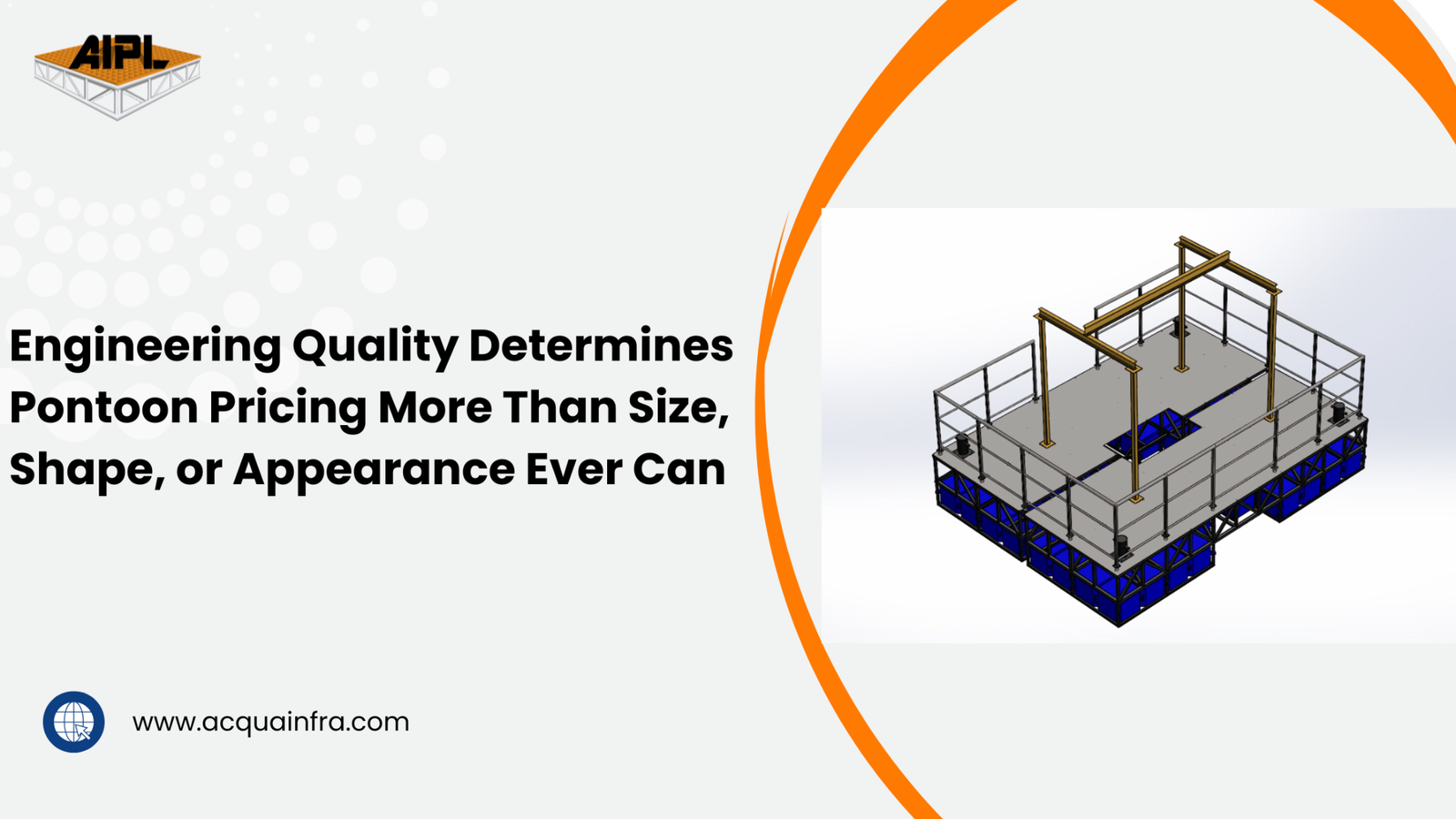
Across industrial and infrastructure sectors, buyers often compare quotations from different manufacturers and expect similar-looking pontoons to have similar prices. In reality, the Pontoon Price depends on much more than external dimensions or appearance. Engineering quality, material selection, fabrication standards, and lifecycle performance all influence the final cost.
Whether the requirement is a Floating Pump Pontoon, Construction Pontoon, Marine Work Platform, Floating Jetty, or Water Intake Pontoon, selecting a floating structure based solely on price can result in higher maintenance costs, operational disruptions, and reduced service life.
An engineering-driven manufacturer evaluates project requirements before preparing a quotation. Factors such as equipment loads, water depth, environmental conditions, and future expansion are considered to ensure long-term reliability. This approach delivers greater value throughout the lifecycle rather than simply reducing the initial purchase cost.
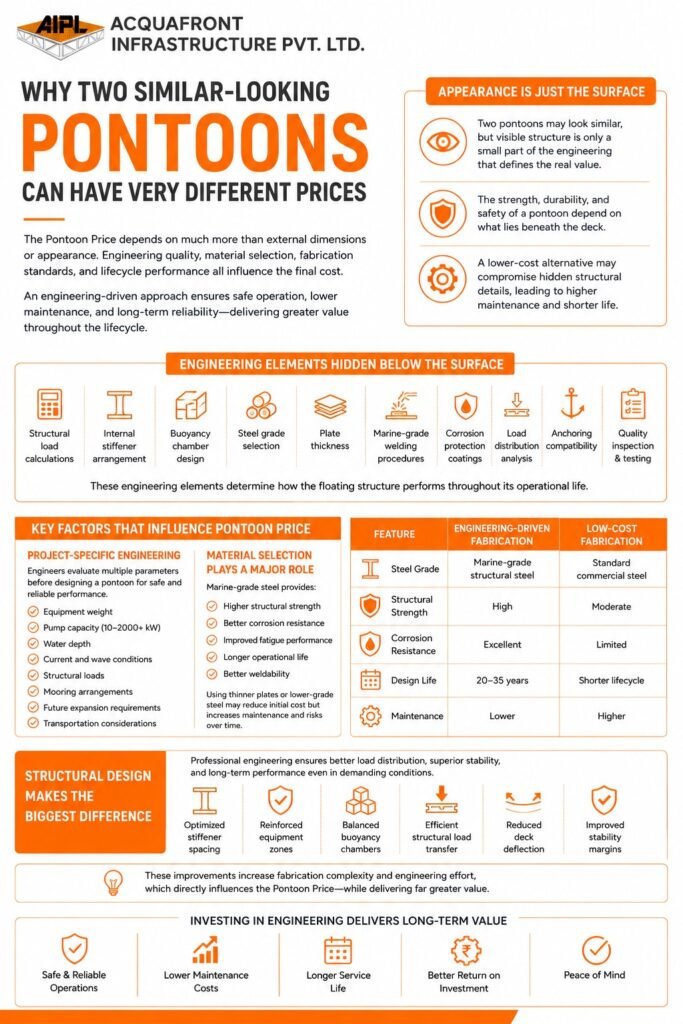
At first glance, two floating pontoons may appear almost identical. Both may have similar deck sizes, painted steel surfaces, and floating capability. However, the visible structure represents only a fraction of the engineering that determines the actual Pontoon Price.
The real value lies beneath the deck. Structural calculations, buoyancy design, internal stiffeners, welding quality, and corrosion protection all influence performance, durability, and maintenance requirements over the life of the floating infrastructure.
An engineering-driven pontoon is designed to deliver safe operation under demanding conditions, whereas a lower-cost alternative may compromise critical structural details that are not immediately visible during inspection.
Several engineering factors contribute significantly to the final Pontoon Price, even though they cannot be seen after fabrication.
These engineering elements determine how the floating structure performs throughout its operational life rather than simply how it looks on delivery.
The Pontoon Price is determined by the engineering effort required to ensure safe, reliable, and long-lasting performance. Each project has unique operating conditions, making customization essential instead of relying on standard fabrication.
Before fabrication begins, engineers evaluate several project parameters to develop a floating structure suited to the intended application.
These include:
Engineering analysis requires experienced designers, advanced calculations, and project-specific modelling, which directly influence the overall Pontoon Price while improving operational reliability.
Material quality has a direct impact on strength, durability, and lifecycle costs.
Marine-grade steel provides:
Manufacturers offering unusually low quotations often reduce costs by using thinner plates or lower-grade steel, which may increase maintenance and reduce structural reliability over time.
| Feature | Engineering-Driven Fabrication | Low-Cost Fabrication |
| Steel Grade | Marine-grade structural steel | Standard commercial steel |
| Structural Strength | High | Moderate |
| Corrosion Resistance | Excellent | Limited |
| Design Life | 20–35 years | Shorter lifecycle |
| Maintenance | Lower | Higher |
Two pontoons with identical dimensions can perform very differently because of their internal structural design. Engineering determines how effectively loads are distributed across the floating structure during operation.
A professionally engineered pontoon generally includes:
Although these improvements increase fabrication complexity, they significantly improve long-term durability and reduce maintenance costs.
Fabrication quality is another major factor influencing Pontoon Price. Even the best engineering design can fail to deliver expected performance if fabrication standards are compromised.
Professional fabrication involves controlled welding procedures, dimensional inspections, surface preparation, and corrosion-resistant coating systems. These processes ensure that every structural component performs as intended in demanding marine environments.
Poor fabrication practices often result in:
Investing in quality fabrication helps reduce downtime while extending the service life of the floating infrastructure.
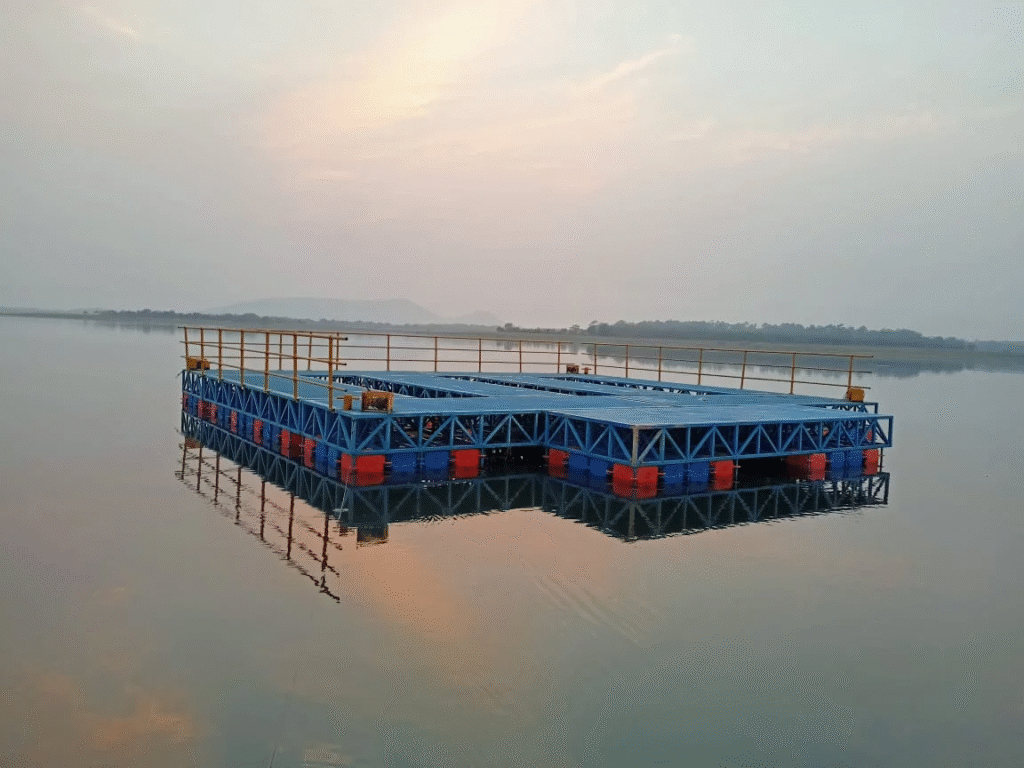
Floating infrastructure operates continuously in harsh environments where moisture, chemicals, and changing water levels accelerate corrosion. A comprehensive coating specification significantly influences lifecycle costs.
High-quality corrosion protection generally includes:
Although advanced coating systems increase the initial Pontoon Price, they substantially reduce repair costs and extend the operational life to 20+ years, with proper maintenance supporting service lives of 25–35 years.
A lower quotation may appear attractive during procurement, but hidden exclusions often emerge after project execution begins.
Common hidden costs include:
Evaluating quotations based on total lifecycle value rather than purchase price alone helps project owners make informed investment decisions.
The true Pontoon Price reflects the engineering effort required to ensure safety, durability, and long-term operational performance. Every floating structure should be designed based on project-specific requirements rather than standard dimensions.
Structural load analysis determines how the pontoon will perform under operational conditions. Engineers evaluate multiple loading scenarios before finalising the design.
Key considerations include:
AIPL custom-engineers floating infrastructure capable of supporting 1000+ tonnes, depending on project requirements and operational conditions.
A floating structure must remain stable under varying operating conditions. Proper buoyancy calculations help maintain safe freeboard, balance, and structural performance.
Engineers evaluate:
These calculations are especially important for Floating Pump Pontoons, Construction Pontoons, and Marine Work Platforms carrying heavy equipment.
Every project requires a suitable mooring arrangement based on water depth and environmental conditions.
Typical engineering considerations include:
Appropriate anchoring reduces structural stress while improving operational safety and positioning accuracy.
Marine environments expose floating infrastructure to continuous moisture and corrosion.
A professionally engineered coating specification generally includes:
Proper corrosion protection contributes significantly to a 20+ year service life, extendable to 25–35 years with planned maintenance.
Although two pontoons may look similar, their engineering standards can vary significantly.
| Engineering Parameter | Engineering-Driven Pontoon | Basic Fabrication |
| Structural Design | Project-specific | Standard design |
| Material Grade | Marine-grade steel | Commercial steel |
| Buoyancy Analysis | Included | Often limited |
| Load Calculations | Detailed | Basic |
| Corrosion Protection | Multi-layer marine coating | Standard paint |
| Engineering Documentation | Complete | Limited |
| Lifecycle | 20–35 years | Shorter |
| Maintenance Cost | Lower | Higher |
Looking beyond the purchase price allows buyers to evaluate the total lifecycle value rather than only the initial investment.
Selecting the right manufacturer is just as important as evaluating the quotation itself. Engineering expertise directly influences structural performance, reliability, and project success.
Acquafront Infrastructure Private Limited (AIPL) follows an engineering-first approach built around IIT-driven engineering, IRS-compliant floating infrastructure, and custom-engineered fabrication. Every floating structure is designed according to operational requirements instead of relying on standard configurations.
AIPL's floating infrastructure supports:
AIPL has delivered floating infrastructure across multiple sectors, including:
These projects demonstrate how engineering quality, rather than appearance alone, determines long-term project performance and value.
Engineering quality, material grade, fabrication standards, load capacity, and project-specific design have the greatest impact on Pontoon Price.
Internal engineering, steel quality, structural design, and corrosion protection vary significantly even when two pontoons appear similar.
Yes. Lower-cost pontoons may require higher maintenance, repairs, or structural modifications during their lifecycle.
Yes. Marine-grade steel improves strength, durability, and corrosion resistance while increasing long-term value.
It ensures the floating structure remains stable under varying operational loads and environmental conditions.
Yes. AIPL designs every floating structure according to project requirements, equipment loads, water depth, and environmental conditions.
AIPL's floating infrastructure has a standard design life of 20+ years, extendable to 25–35 years with proper maintenance.
AIPL engineers Floating Pump Pontoons supporting 10–2000+ kW applications.
AIPL can execute floating infrastructure projects requiring 1000+ tonnes load handling capability, depending on project requirements.
Engineering-driven companies like AIPL provide custom-designed floating infrastructure for industrial and government projects across India.
Yes. AIPL executes floating infrastructure projects across Gujarat and other Indian states.
Yes. AIPL has successfully executed projects in Uttar Pradesh, Madhya Pradesh, Odisha, and several other regions.
Compare engineering capability, fabrication quality, project experience, lifecycle value, and turnkey execution rather than only price.
Yes. Custom-engineered floating infrastructure can be designed for future expansion and operational flexibility.
AIPL combines IIT-driven engineering, IRS-compliant fabrication, marine-grade manufacturing, turnkey SITC execution, and proven experience across India's marine infrastructure sector.
Two pontoons may look almost identical, yet their engineering, fabrication quality, and lifecycle performance can differ considerably. Comparing quotations solely on price often overlooks the technical factors that determine long-term reliability and operating costs.
A professionally engineered pontoon delivers better structural integrity, improved corrosion resistance, lower maintenance, and greater operational safety throughout its service life. These advantages typically outweigh the savings offered by the lowest quotation.
By combining IIT-driven engineering, IRS-compliant fabrication, marine-grade manufacturing, and extensive project experience, AIPL continues to deliver custom-engineered floating infrastructure that offers lasting value across India's marine, industrial, and waterfront projects.
Consult experienced engineers to design customized floating infrastructure tailored to your operational requirements.
📞 +91 7678232371
📩 Admin@acquainfra.com
Mr. Achin Agrawal
Director & CTO
Acquafront Infrastructure Private Limited
Mr. Achin Agrawal leads the engineering and technology initiatives at Acquafront Infrastructure Pvt. Ltd. (AIPL), specialising in modular floating infrastructure, marine engineering, lifting barges, construction pontoons, floating work platforms, and heavy-duty marine systems. With extensive experience in designing and executing complex floating infrastructure projects, he has contributed to solutions deployed across reservoirs, dams, ports, industrial waterfronts, and inland waterways throughout India. Under his technical leadership, AIPL continues to deliver IIT-driven engineering, IRS-compliant fabrication, and turnkey SITC solutions that meet the evolving needs of India's marine infrastructure sector.

