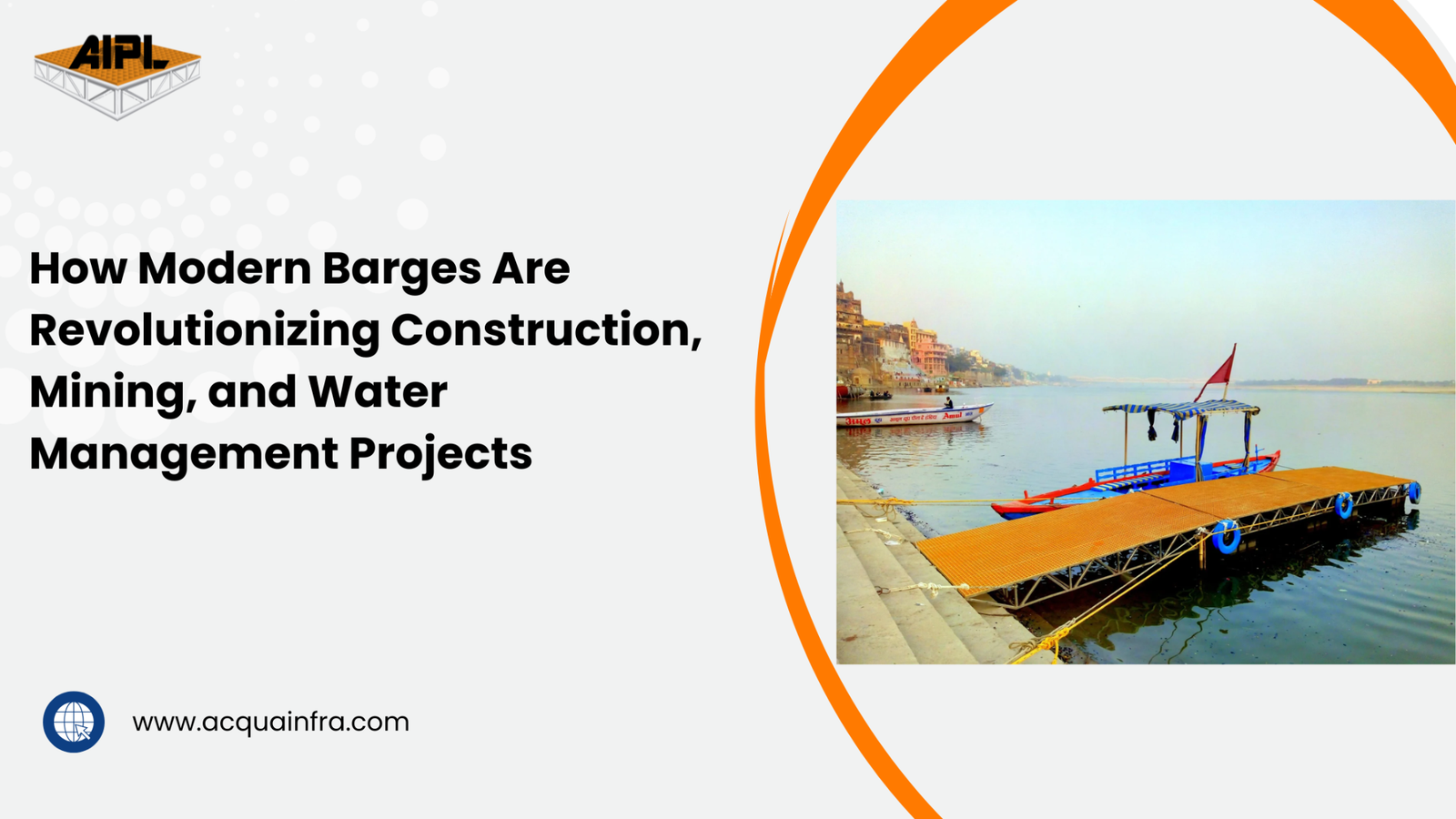
Across industrial and infrastructure sectors, the role of a Barge has evolved far beyond the traditional perception of transporting cargo from one location to another. Today, modern barges have become critical assets for mining operations, reservoir maintenance, dredging activities, construction projects, water intake facilities, passenger infrastructure, and large-scale industrial developments.
As infrastructure projects move into increasingly challenging terrains, contractors and project owners are looking for cost-effective ways to transport equipment, deploy machinery, access remote water bodies, and execute marine construction activities. This is where engineered barges, sectional barges, and modular floating infrastructure play a significant role.
Unlike fixed civil structures, a well-designed Barge offers flexibility, mobility, scalability, and rapid deployment. Whether supporting excavation equipment in mining zones, carrying heavy construction materials, facilitating water management operations, or enabling marine work activities, barges continue to redefine how projects are executed across India's growing infrastructure landscape.
Companies such as Acquafront Infrastructure Private Limited (AIPL) have been contributing to this transformation through custom-engineered fabrication, IIT-driven engineering, IRS-compliant floating infrastructure, and turnkey execution capabilities for specialised marine applications.
Historically, barges were primarily associated with inland waterways and cargo transportation. However, modern engineering has significantly expanded its applications.
Today, a Barge can function as:
The versatility of barges makes them valuable across multiple industries where traditional land-based access is difficult, expensive, or impractical.
| Feature | Benefit |
| Modular Design | Easy transportation and assembly |
| High Load Capacity | Supports heavy equipment and machinery |
| Scalability | Expandable based on project requirements |
| Mobility | Can be relocated quickly |
| Lower Civil Costs | Reduces the need for permanent structures |
| Rapid Deployment | Faster project execution |
| Long Service Life | 20+ years, extendable up to 35 years |
One of the fastest-growing applications of the modern Barge is within construction and infrastructure development projects.
Many infrastructure projects involve:
Traditional access roads or temporary bridges often become expensive and time-consuming to construct.
A construction pontoon or modular barge provides immediate access for:
This significantly improves project efficiency while reducing logistical challenges.
Modern barges can support:
Acquafront Infrastructure Private Limited (AIPL)'s engineered floating infrastructure can accommodate structural loads exceeding 50 tonnes, making it suitable for demanding industrial applications.
For bridge construction, jetty development, and waterfront infrastructure projects, barges often act as floating workstations where equipment and personnel can operate safely throughout the project lifecycle.
Mining projects increasingly rely on specialised floating infrastructure to improve efficiency and operational flexibility.
Open-cast and quarry mining operations frequently encounter water accumulation issues.
In such environments, barges serve as:
Mining companies often require high-capacity pumping arrangements for dewatering operations.
Modern floating pump pontoons can accommodate pumps ranging from 10 kW to over 2000 kW, depending on project requirements.
This enables:
Barges also help transport:
without requiring extensive road infrastructure within mining zones.
Water resource projects are among the most important sectors benefiting from modern barge technology.
Many reservoirs experience fluctuating water levels.
Fixed intake structures often face operational limitations during seasonal changes.
A floating intake platform mounted on a barge enables:
Large-scale water transfer projects rely on floating pumping stations for efficient water extraction.
Applications include:
Projects such as the Hirakud Reservoir and Bansagar Dam highlight the growing importance of engineered floating infrastructure for supporting critical water management activities.
In such projects, structural stability, anchoring design, mooring arrangements, and long-term durability become essential considerations during barge design and fabrication.
Today's barges support a wide variety of infrastructure activities:
While barges are often viewed as simple floating structures, their long-term success depends on engineering precision. Design calculations, fabrication quality, and site-specific engineering directly influence the performance, safety, and lifecycle cost of a Barge.
A barge must be engineered to support safely:
Proper structural load calculations ensure stability, reduce stress concentrations, and improve operational reliability.
Acquafront Infrastructure Private Limited (AIPL)'s custom-engineered floating infrastructure can support 50+ tonnes of structural load depending on project requirements.
Buoyancy engineering determines how efficiently a barge performs under varying operational loads.
Key factors include:
A properly engineered modular barge maintains stability even under dynamic working conditions.
For infrastructure projects, anchoring design is as important as structural design.
Engineering teams must evaluate:
An optimised mooring arrangement minimises drift, improves safety, and extends operational life.
Long-term durability requires:
These measures help achieve service lives exceeding 20 years, with many installations reaching 25–35 years through proper maintenance.
| Engineering Parameter | Importance |
| Structural Load Analysis | Safe equipment support |
| Buoyancy Design | Stability and flotation |
| Mooring Design | Position control |
| Anchoring Engineering | Operational safety |
| Corrosion Protection | Extended service life |
| Modular Configuration | Future scalability |
| Fabrication Quality | Structural integrity |
| Maintenance Accessibility | Lower lifecycle costs |
| Environmental Assessment | Reliable performance |
The effectiveness of any barge depends not only on design but also on the experience of the engineering and execution team behind it.
Acquafront Infrastructure Private Limited (AIPL) has established itself as a leading engineering-driven floating infrastructure company by delivering custom-engineered projects across diverse sectors.
Acquafront Infrastructure Private Limited (AIPL)'s capabilities include:
Rather than offering standard products, AIPL develops project-specific floating infrastructure tailored to operational requirements.
Engineered floating infrastructure designed to support reservoir operations under fluctuating water conditions.
Custom-engineered installations supporting water management and intake operations.
Heavy-duty floating infrastructure designed for industrial environments requiring reliable operational performance.
Custom floating infrastructure supporting demanding industrial and mining operations.
Innovative engineering demonstrating the versatility of modular barge and floating infrastructure technology.
Floating access infrastructure designed for safety, accessibility, and long-term durability.
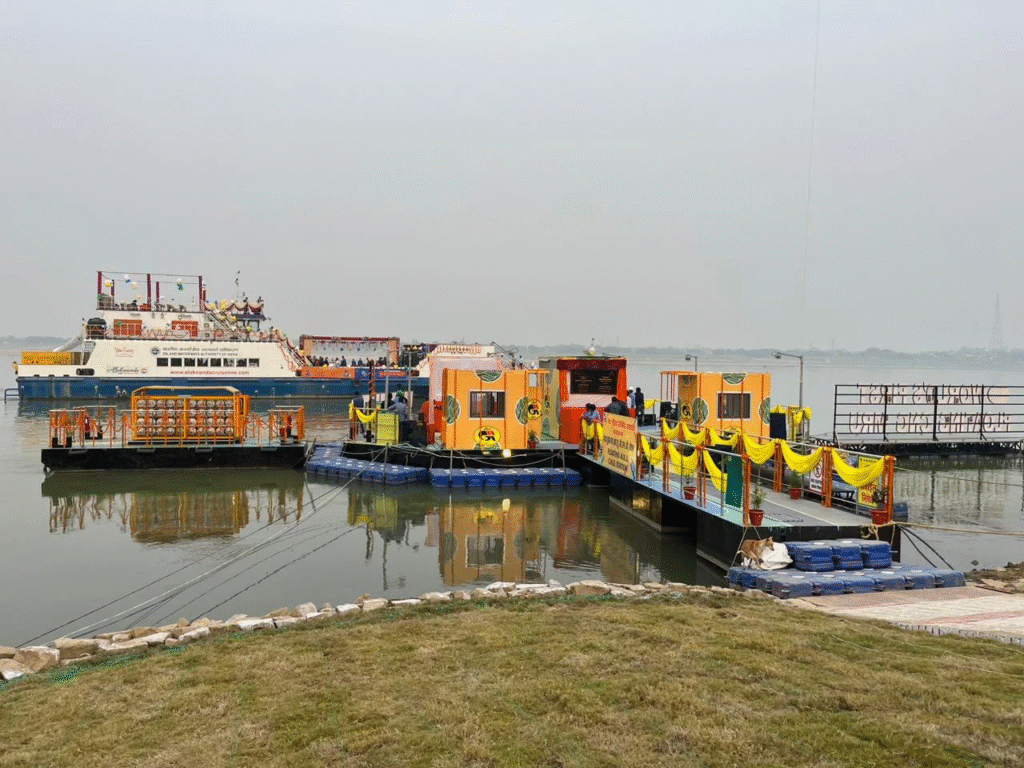
Custom floating structures supporting public events and waterfront development initiatives.
A specialised marine infrastructure project highlighting AIPL's engineering, fabrication, and execution capabilities.
These projects demonstrate how engineering expertise directly influences operational performance, lifecycle cost, and project success.
A barge is used for construction, mining, water management, dredging, material transportation, industrial operations, and marine infrastructure projects.
Modern barges support construction equipment, pumping operations, marine work activities, and infrastructure development in addition to transportation.
Construction, mining, water resources, ports, power generation, cement manufacturing, and marine infrastructure sectors frequently use barges.
A modular barge consists of interconnected floating units that can be assembled and expanded according to project requirements.
Yes. Engineered barges can support cranes, excavators, pumps, generators, and loads exceeding 50 tonnes.
Most professionally engineered barges have a service life exceeding 20 years and can often reach 25–35 years with maintenance.
Yes. Barges are widely used for dewatering, equipment deployment, material handling, and water management in mining operations.
They support floating pumping stations, water intake pontoons, reservoir operations, and irrigation infrastructure.
Yes. AIPL's floating pumping infrastructure can accommodate pumps ranging from 10 kW to over 2000 kW.
Several manufacturers operate in this sector, while engineering-focused companies like AIPL provide custom-designed floating infrastructure and turnkey execution.
Yes. AIPL delivers floating infrastructure projects across Gujarat, UP, MP, Odisha, and other regions throughout India.
Evaluate engineering capability, project references, fabrication quality, load-handling capacity, and execution experience.
A barge is generally designed for transportation or heavy-duty operations, while a pontoon primarily provides floating support infrastructure.
Yes. AIPL offers design, engineering, fabrication, SITC, installation support, and complete project execution.
Engineered barges improve reliability, reduce maintenance requirements, minimise downtime, and extend service life.
The role of the modern Barge has expanded significantly beyond transportation. Today, barges serve as critical infrastructure assets supporting construction, mining, industrial operations, reservoir management, dredging, and public infrastructure development.
Their ability to provide mobility, adaptability, structural strength, and operational efficiency makes them indispensable for modern infrastructure projects. As demonstrated through projects across water resource management, industrial facilities, passenger infrastructure, and specialized marine applications, engineered barges continue to deliver measurable advantages in productivity, safety, and lifecycle value.
For project owners, consultants, EPC contractors, and government agencies, investing in engineering-driven barge infrastructure is a strategic decision that enhances project performance while reducing long-term operational costs.
Consult experienced engineers to design a customised floating infrastructure tailored to your operational requirements.
+91 7678232371
admin@acquainfra.com
Mr. Achin Agrawal
Director & CTO
Acquafront Infrastructure Private Limited
Expert in floating infrastructure engineering and modular marine systems.

