India currently transports nearly 65% of freight through road networks, increasing:
Fuel consumption
Traffic congestion
Logistics costs
Carbon emissions
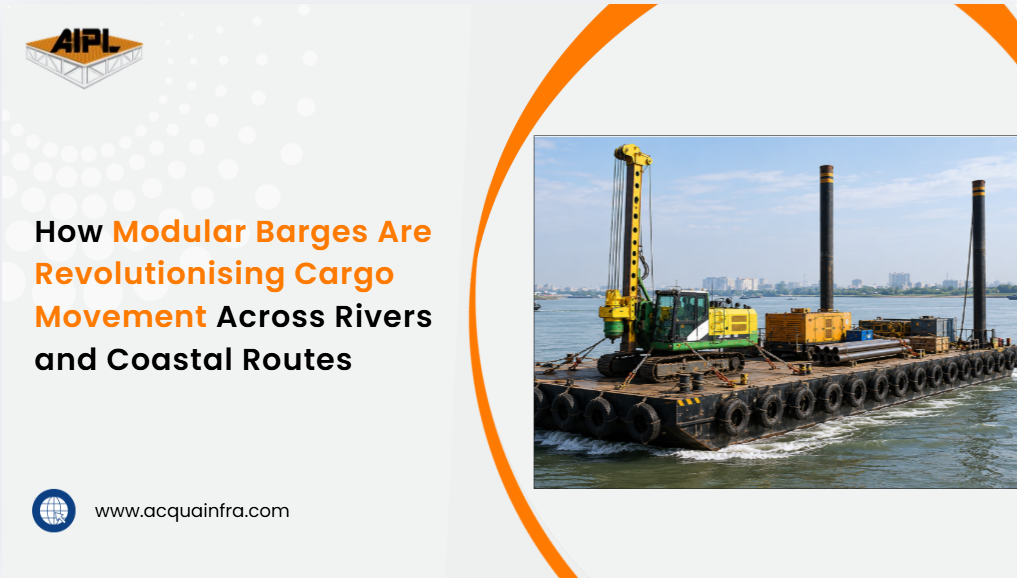
As industries shift toward economical and sustainable alternatives, Modular Barges, sectional barges, inland cargo barges, and floating cargo platforms are emerging as highly efficient solutions for inland and coastal transportation.
Compared to conventional road logistics, modular cargo barge transportation can reduce cargo movement costs by nearly 30–60% in suitable inland waterway projects while significantly improving operational flexibility.
Modern modular floating infrastructure systems, modular floating platforms, floating utility platforms, modular marine platforms, and temporary floating platforms offer:
Faster mobilisation for temporary floating infrastructure
Companies like Acquafront Infrastructure Private Limited (AIPL) are supporting this transition through IRS-approved modular barges, floating marine platforms, floating utility platforms, and turnkey marine engineering solutions across India.
Why Inland & Coastal Cargo Transportation Is Evolving Rapidly
India possesses:
14,500+ km of navigable waterways
7,500+ km of coastline
This creates major opportunities for:
Inland barge transportation
River cargo movement
Coastal logistics
Floating construction infrastructure
However, traditional transportation systems continue to face commercial and operational limitations.
Rising Pressure on Road Transportation
India’s logistics costs currently account for nearly:
13–14% of GDP
This is significantly higher than many global economies.
Heavy cargo transportation through road networks often increases costs due to:
High fuel consumption
Oversized cargo permissions
Toll expenses
Traffic delays
Road infrastructure limitations
Common Road Transport Challenges
High fuel costs
Increased maintenance
Delayed cargo delivery
Higher environmental impact
Complex logistics handling
For industries operating near:
Rivers
Reservoirs
Dams
Ports
Inland waterways
Coastal corridors
Modular barges, sectional barges, transportation barges, utility barges, and floating cargo platforms are becoming more economical and operationally efficient alternatives.
Demand for Flexible Marine Infrastructure
Modern infrastructure and EPC projects increasingly require floating infrastructure systems, modular floating platforms, floating utility platforms, modular marine platforms, and temporary floating platforms that can be:
Easily mobilized
Expanded as required
Reassembled at remote sites
Rapidly deployed
Customised for varying structural loads
This flexibility is one of the key reasons why:
Modular barges
Sectional barges
Floating work platforms
Utility barges
Marine construction barges
are gaining rapid acceptance across India.
How a Modular Barge System Improves Cargo Movement Efficiency
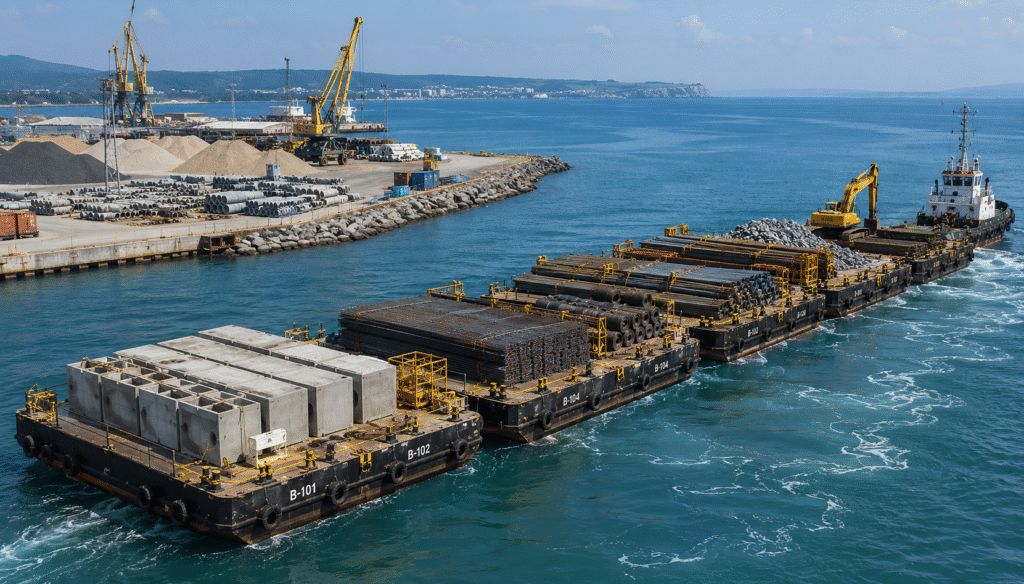
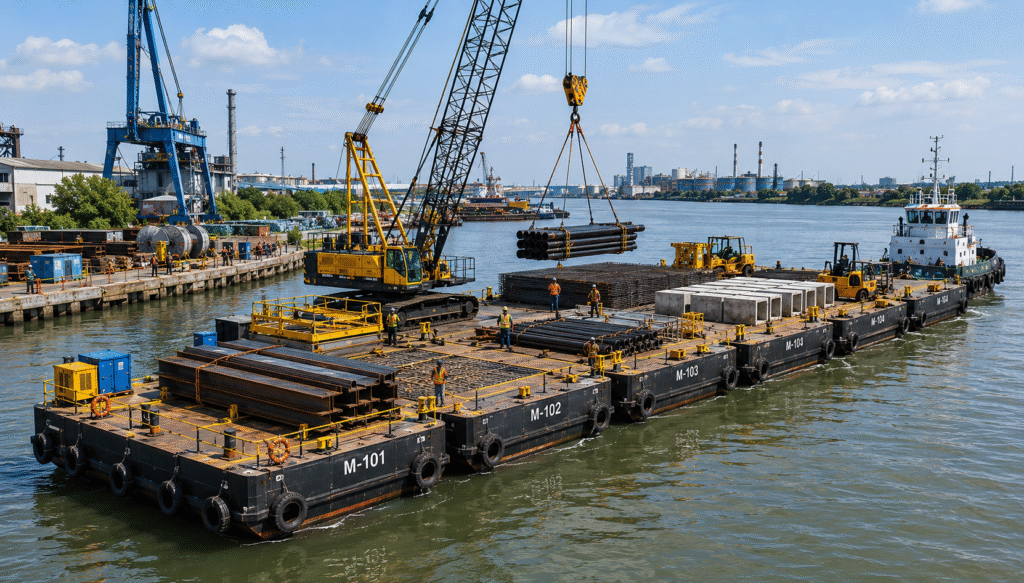
A Modular Barge consists of interconnected floating units engineered to function as:
Floating cargo platforms
Marine work barges
Construction pontoons
Utility barges
Transportation barges
Unlike permanently welded barges, modular units can be transported separately and assembled directly at project sites.
Faster Transportation & Deployment
One of the biggest advantages of modular floating barges is simplified logistics.
Compared to traditional welded barges, modular barge systems can:
Reduce deployment timelines by 40–50%
Reduce mobilization complexity
Improve transportation flexibility
Easy Transportation to Remote Areas
Individual modular units can be transported using:
Trucks
Flatbed trailers
Rail logistics
Inland transportation routes
This makes them ideal for:
Mining zones
Reservoir regions
Remote dam sites
River construction corridors
Coastal industrial projects
Dredging and piling operations
AIPL’s modular barge systems are specifically engineered for:
Modular assembly
Easier transportation
Rapid deployment
Heavy-duty industrial operations
Scalability for Varying Cargo Loads
Cargo handling requirements vary significantly across industries.
Modern modular cargo barges and marine floating platforms can support:
Small utility applications
Heavy industrial machinery
Temporary marine infrastructure
Crane-mounted operations
Typical Structural Capacity
Depending on configuration, modular barges can support:
50–100+ tonne structural loads
Crane and excavator operations
Dynamic cargo movement
Industrial material transportation
Typical Applications Include
Heavy machinery transportation
Construction equipment movement
Dredging support
Floating crane operations
Temporary marine bridges
Mining logistics
River cargo movement
Floating construction platforms
Marine work barges
Floating utility platforms
This scalability provides modular floating infrastructure with a major operational advantage over fixed marine structures.
Why Modular Barges Are Ideal for River Cargo Operations
India’s inland waterway network is expanding rapidly under:
Inland waterways initiatives
River transportation projects
Smart port development
River connectivity programs
Lower Draft Requirement
Compared to larger marine vessels, modular inland barges operate efficiently in shallow draft conditions.
This is especially useful in:
Seasonal rivers
Reservoir transport
Irrigation canals
Dam zones
Barrage infrastructure projects
Better Stability for Heavy Loads
Modern Modular Barges are engineered using:
Marine-grade steel
Buoyancy calculations
Hydrostatic stability analysis
Structural reinforcement systems
Engineering Benefits
Engineering Parameter
Modular Barges Advantage
Structural Flexibility
Modular Configuration
Load Distribution
Balanced Floating Deck
Transportation
Easier Logistics
Maintenance
Replaceable Units
Mobilization
Faster Assembly
Expansion Capability
High
Operational Adaptability
Excellent
AIPL’s modular floating infrastructure uses:
IS 2062-compliant steel
Marine-grade corrosion protection
IRS-certified methodologies
Modular marine engineering systems
How Modular Barges Support Coastal Cargo Operations
Coastal cargo movement requires highly adaptable floating infrastructure.
Adaptability Across Coastal Conditions
Coastal operations involve:
Variable tides
Dynamic wave conditions
Corrosive marine environments
Temporary loading infrastructure
Modern modular barges and floating marine platforms are engineered with:
Corrosion-resistant marine coatings
Anchoring systems
Flexible mooring systems
Structural buoyancy chambers
to withstand demanding marine environments.
Floating Infrastructure for Temporary Cargo Handling
Many coastal projects require temporary floating systems instead of permanent RCC infrastructure.
Common Coastal Applications
Port expansion support
Temporary floating jetties
Offshore construction support
Marine equipment staging
Coastal dredging operations
Floating workstations
Construction pontoons
Floating utility platforms
This makes modular floating infrastructure systems, modular floating platforms, floating utility platforms, modular marine platforms, and temporary floating platforms commercially attractive for:
EPC contractors
Port developers
Marine infrastructure companies
Coastal logistics operators
Technical Engineering Behind Modern Modular Barges
Modular Structural Fabrication
Each modular barge unit typically includes:
Watertight buoyancy chambers
Interlocking connection systems
Marine-grade deck structures
Structural stiffeners
Load transfer reinforcement
AIPL modular barges use:
Interconnected locking mechanisms
Reinforced structural connectors
Marine-grade fabrication systems
for enhanced stability and operational safety.
Anchoring & Mooring Engineering
Safe marine operation depends heavily on properly engineered:
Mooring systems
Anchoring systems
Load restraint arrangements
Common Mooring Arrangements
Deck-to-bed anchoring
Shore anchoring
Chain mooring
Wire rope anchoring
Flexible shock-absorbing mooring
These systems are engineered based on:
Hydrographic studies
Wind load analysis
Current velocity
Wave conditions
Operational load requirements
AIPL custom-engineers anchoring layouts for each site based on environmental and operational conditions.
Heavy Load Handling Capability
Modern modular barge systems are engineered using:
Buoyancy analysis
Structural load calculations
Hydrostatic stability assessments
to ensure safe operation under varying cargo conditions.
Modern Modular Barges Can Support
Cranes
Excavators
Concrete batching equipment
Cargo containers
Pumping infrastructure
Dewatering systems
Marine construction equipment
AIPL’s modular floating infrastructure supports:
50+ tonne structural loads
Industrial pumping systems
Heavy construction equipment
Floating utility applications
depending on engineering configuration.
Product Lifespan & Durability
Marine-grade fabrication significantly improves operational life.
Typical Durability Features
Anti-corrosion coating
Marine-grade steel
Replaceable modular units
Reinforced buoyancy chambers
IRS-compliant fabrication
NABL-tested material quality
AIPL modular barges are typically engineered for:
20+ years operational lifespan
Extendable service life up to 25–35 years
with proper maintenance practices.
AIPL’s Experience in Modular Floating Infrastructure
AIPL has executed multiple modular floating infrastructure, floating jetty, modular barge, and floating platform projects across India for government departments, EPC contractors, industrial clients, and marine infrastructure applications.
16+ floating pump pontoon and modular infrastructure projects executed across India
Projects delivered across:
Odisha
Madhya Pradesh
Uttar Pradesh
Gujarat
Rajasthan
Assam
Chhattisgarh
Himachal Pradesh
Floating platforms engineered up to:
636 sq. m platform size
50+ tonne structural loads
35 MLD water extraction systems
1500+ m³/hr pumping capacity
Major Executed Projects
Floating CNG Infrastructure – Varanasi
AIPL engineered:
The world’s first Floating CNG Filling Station
Floating CNG Mobile Refuelling Unit (MRU)
for GAIL India using modular floating mild steel barges.
Sabarmati Wet & Dry Dock Project – Ahmedabad
308 sq. m floating dock infrastructure
Developed using Steel Integrated Floating Jetty (SIFJ) technology
Designed for seaplane operations and marine maintenance
Hirakud Reservoir Project – Odisha
204 sq. m modular floating intake platform
9.5 MLD water extraction system
3 submersible pumps (500 m³/hr each)
Bansagar Dam Project – Madhya Pradesh
Floating pump pontoon for Beohari Water Supply Scheme
400 m³/hr pumping capacity
SIFJ-based modular floating infrastructure
Industrial & Mining Projects
AIPL has executed floating infrastructure projects for:
Ultratech Cement
Vedanta-linked mining operations
Industrial water extraction systems
Mine dewatering pontoon applications
Industries Benefiting from Modular Barges
Infrastructure & EPC
Bridge construction
Marine logistics
River engineering
Floating construction platforms
Mining & Cement
Equipment transportation
Floating intake infrastructure
Mine dewatering pontoon systems
Energy & Utilities
Floating CNG infrastructure
Water intake barges
Floating solar platform integration
Government & Public Infrastructure
Inland waterways development
Smart city floating jetty projects
Disaster response logistics
Temporary river connectivity
Frequently Asked Questions (FAQs)
1. What are Modular Barges used for?
Modular Barges are used for cargo transportation, dredging support, marine construction, floating cranes, inland waterway logistics, and temporary floating infrastructure projects.
2. How do Modular Barges improve cargo transportation?
They enable scalable floating infrastructure with faster deployment, lower transportation costs, easier site assembly, and modular expansion capability.
3. Are Modular Barges suitable for river cargo movement?
Yes. Their shallow draft capability makes them highly effective for inland waterways, reservoirs, canals, and river logistics.
4. Can Modular Barges operate in coastal areas?
Yes. Coastal barges are engineered for marine environments, wave conditions, corrosion resistance, and tidal operations.
5. What materials are used in Modular Barges?
Marine-grade mild steel, watertight buoyancy chambers, corrosion-resistant coatings, and reinforced structural frameworks are commonly used.
6. Who provides Modular Barges in India?
Engineering-focused companies like Acquafront Infrastructure Private Limited (AIPL) provide custom-engineered modular floating infrastructure and turnkey execution services across India.
7. What load capacity can Modular Barges handle?
Heavy-duty modular barges can support structural loads exceeding 50 tonnes, while larger modular configurations may support 100+ tonne applications depending on engineering design.
8. Are Modular Barges customizable?
Yes. Size, deck layout, buoyancy, structural load capacity, mooring arrangements, and anchoring systems, bollards, fenders, spuds, and marine restraint systems are fully customizable.
9. What is the lifespan of a Modular Barge?
Typically 20+ years, extendable up to 35 years with proper maintenance and marine-grade corrosion protection systems.
10. Are Modular Barges suitable for mining projects?
Yes. Mining industries widely use modular inland barges and floating utility platforms for equipment transport, dewatering systems, and floating infrastructure support.
11. Top-rated Modular Barges suppliers near me – how to choose?
Choose suppliers with executed projects, IRS-compliant engineering, IIT-vetted expertise, turnkey fabrication capability, and marine-grade manufacturing standards.
12. Are Modular Barges available in Gujarat, UP, MP, and Odisha?
Yes. AIPL has executed modular floating infrastructure projects across Gujarat, Uttar Pradesh, Madhya Pradesh, Odisha, and several other Indian states.
13. Can Modular Barges support cranes and heavy machinery?
Yes. Marine work platforms can be engineered for cranes, excavators, batching equipment, dredging systems, and industrial machinery.
14. What industries benefit most from Modular Barges?
Infrastructure, EPC, mining, dredging, water supply, cement, tourism, coastal logistics, and energy sectors benefit significantly.
15. Who provides turnkey Modular Barge fabrication in India?
AIPL offers design, engineering, fabrication, SITC (Supply, Installation, Testing & Commissioning), and customised floating infrastructure execution across India.
Conclusion
India’s growing focus on:
Inland waterways
Coastal logistics
Sustainable transportation
Floating infrastructure development
is significantly increasing the demand for Modular barges, sectional barges, transportation barges, utility barges, and floating cargo platforms.
Compared to traditional transportation systems, modular barges offer:
30–60% lower logistics costs
Faster mobilization
Easier transportation to remote regions
50–100+ tonne load handling capability
Flexible modular expansion
Lower operational downtime
With:
IRS-compliant engineering
Marine-grade fabrication
20–35 year lifespan
Modular assembly capability
Heavy-duty structural performance
Modular barges are becoming one of the most efficient solutions for modern inland and coastal cargo transportation across India.
Planning a cargo transportation or inland waterway project?
AIPL specializes in modular maritime and floating-infrastructure platforms for energy, water, marine, transport, construction, pumping and tourism sectors, supported by a decade of proven engineering.
Registered Under:
Quick Links
Office
3RD Floor, Tower-C, Office No. C - 320 I-THUM Plot No.A-40, Sector 62, NOIDA, Distt Gautam Buddha Nagar, UP – 201301