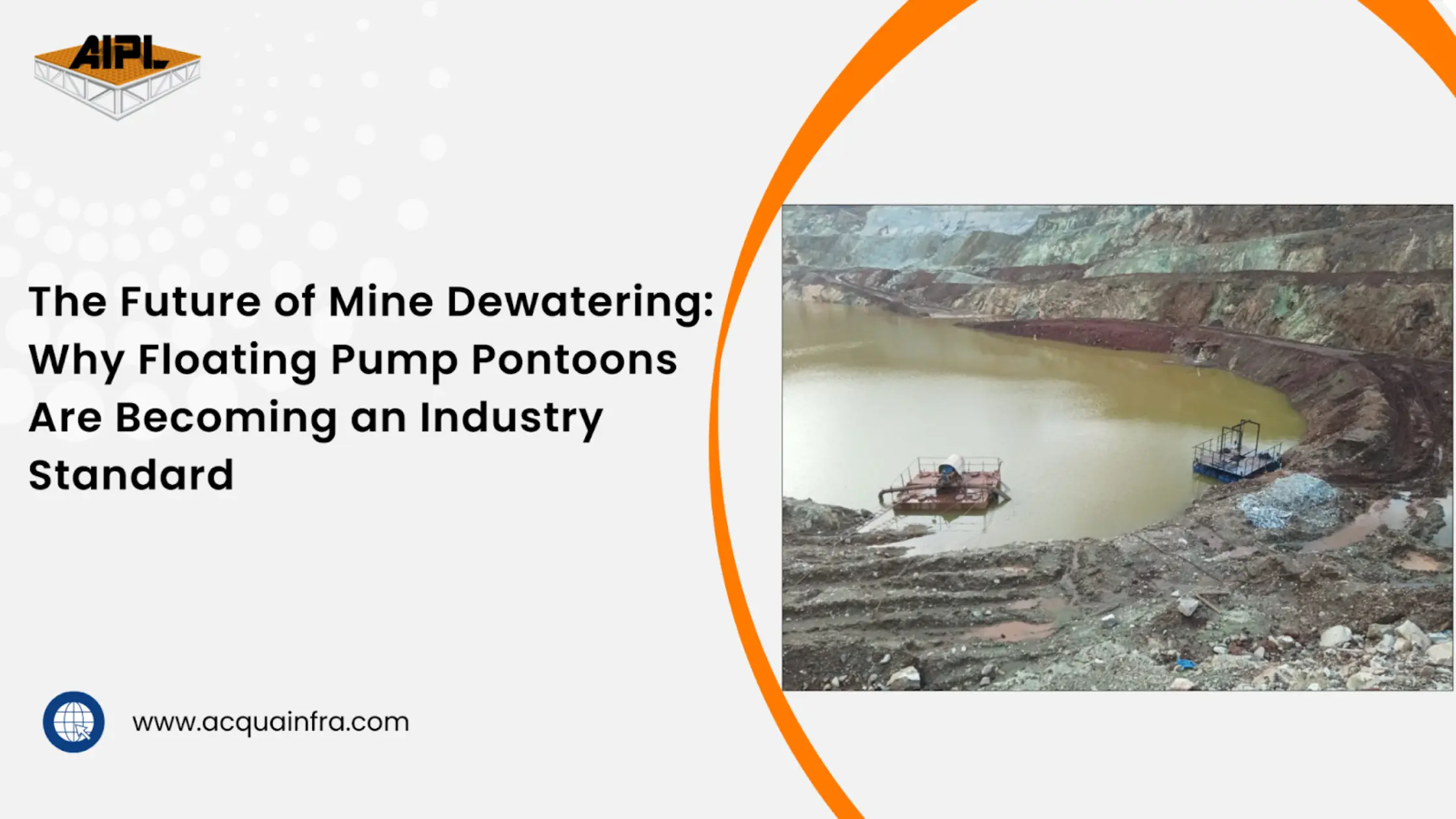
If you are a mine owner, head, engineer, EPC contractor, or quarry operator, mine dewatering is not just a support activity — it directly impacts safety, productivity, and operating cost.
Uncontrolled water accumulation can slow excavation, damage equipment, destabilise slopes, and increase accident risks. Traditional mine dewatering systems often struggle to cope with changing water levels, monsoon inflows, and deep pit conditions.
This is where floating pump pontoons are redefining how modern mine dewatering is planned and executed.
Mine dewatering is the controlled removal of groundwater and surface water from mining areas to maintain dry and stable working conditions.
Without efficient mine dewatering, mines face:
Traditional mine dewatering methods typically rely on fixed pump installations, sump pumping, or ground-mounted pump setups.
These limitations make traditional mine dewatering systems reactive rather than adaptive.
A floating pump pontoon is a modular floating platform that supports pumps, motors, pipelines, and operators directly on the water surface.
Unlike fixed systems, floating pump pontoons move vertically with changing water levels, ensuring continuous and efficient mine dewatering.
To better understand the concept, watch this detailed video on What is Pump Pontoon:
| Parameter | Traditional Mine Dewatering | Floating Pump Pontoons |
| Pump Position | Fixed on ground or sump | Floating on water surface |
| Response to Water Level Change | Manual adjustment required | Automatically adjusts |
| Safety | Higher risk during flooding | Safer operator access |
| Installation Time | Slower due to civil work | Faster, modular installation |
| Downtime | High during the monsoon | Minimal interruption |
| Long-term Cost | Higher due to rework | Lower lifecycle cost |
This comparison clearly shows why floating pump pontoons are becoming the preferred mine dewatering solution.
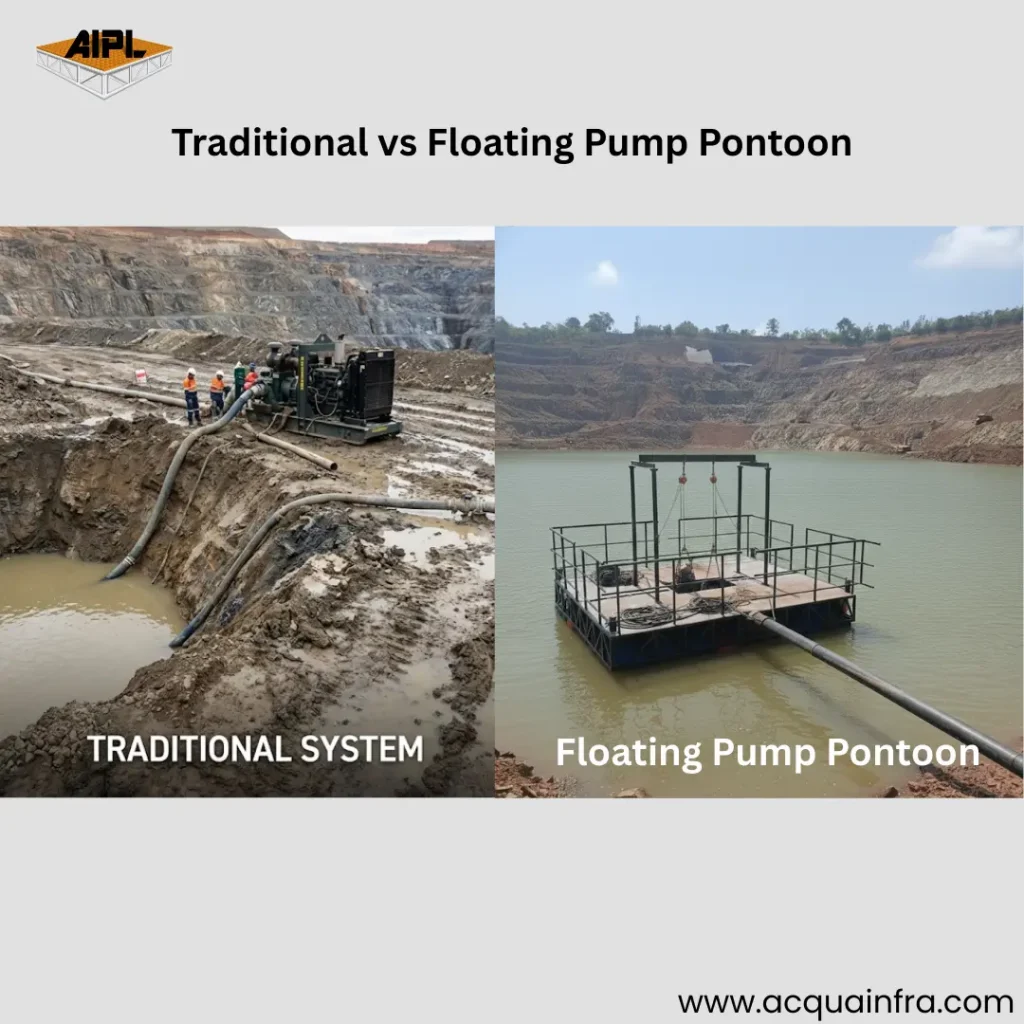
Floating pump pontoons ensure pumps remain at the optimal operating depth despite fluctuating water levels, as demonstrated by the AIPL-deployed pontoons at Vedanta Mines.
Operators no longer need to access unstable pit edges or submerged pump platforms.
Modular pontoons can be installed and relocated quickly as mining progresses.
Reduced civil work and lower downtime result in long-term savings.
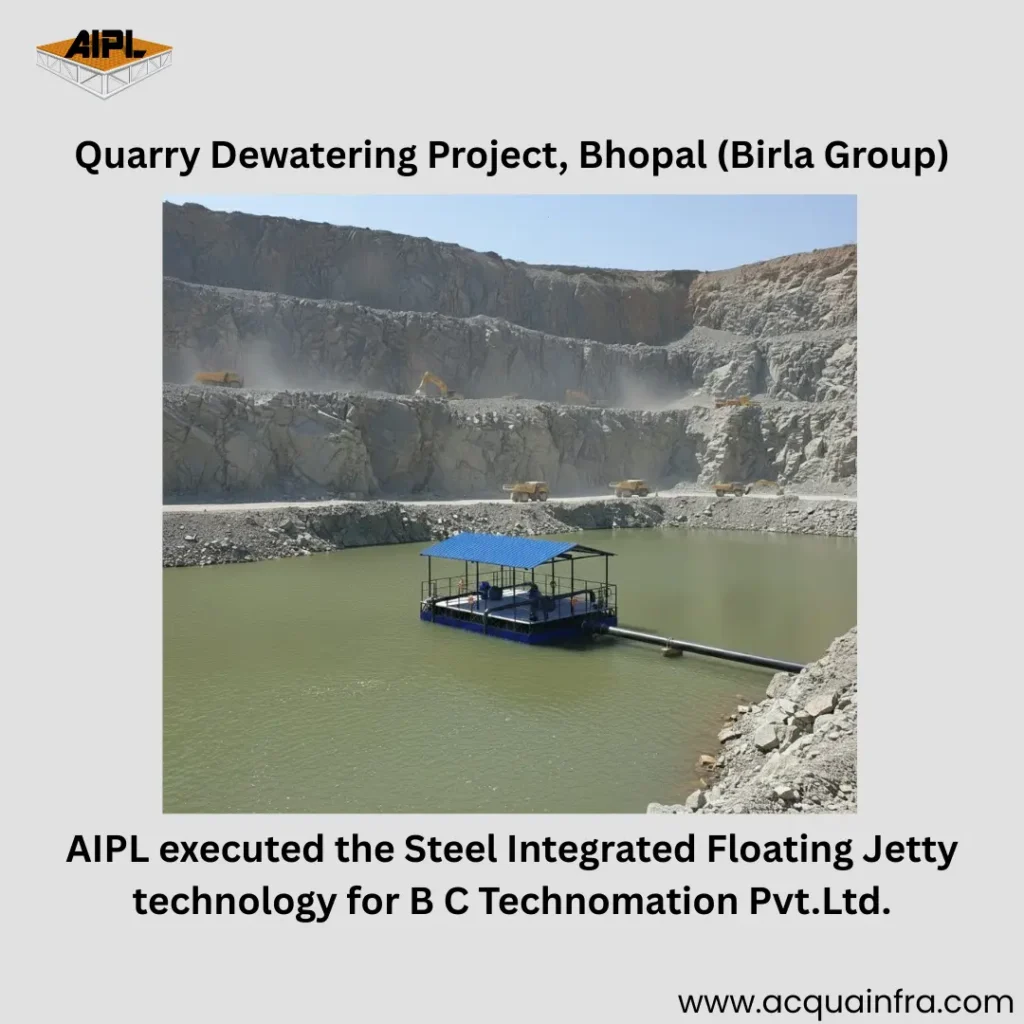
AIPL has executed multiple floating pump pontoon projects that directly address mining and quarry dewatering challenges.
These projects show how floating pump pontoons perform reliably under real mining pressures, not just controlled conditions.
To understand the application of floating pump pontoons in mine dewatering operations, refer to this video: Mine Dewatering Solution | Floating Pump Pontoons for Mines | AIPL –
Mine dewatering is the process of removing unwanted water from mining areas to maintain safe operations.
They adapt automatically to water level changes, improve safety, and reduce downtime.
Yes, they are ideal for deep pits with fluctuating water levels.
With proper maintenance, they can operate effectively for 30+ years.
Mine dewatering prevents flooding, improves worker safety, protects equipment, and allows uninterrupted excavation and production.
Fluctuating water levels, monsoon flooding, unsafe pump access, frequent pump relocation, and high maintenance costs are the most common challenges.
Excess water slows excavation, restricts equipment movement, increases downtime, and can lead to slope instability.
Traditional methods include sump pumping, ground-mounted pumps, fixed pipelines, and temporary civil foundations.
They struggle with changing water levels, require frequent repositioning, and are vulnerable during heavy rainfall or flooding.
A floating pump pontoon is a modular floating platform that supports pumps and pipelines directly on the water surface, adjusting automatically to water level changes.
They keep pumps at the optimal depth at all times, ensuring consistent suction and uninterrupted dewatering.
Yes. They provide a stable working platform, reducing the risk of slips, falls, and accidents near pit edges.
Yes. Floating pump pontoons are ideal for deep pits where water levels change frequently as mining progresses.
Absolutely. They are widely used in quarries to manage continuous water ingress and seasonal flooding.
Floating systems rise with increasing water levels, allowing dewatering operations to continue even during heavy rainfall.
Yes. Their adaptability significantly reduces downtime caused by pump repositioning and flooding.
Centrifugal pumps, submersible pumps, vertical turbine pumps, and other industrial pumps can be mounted based on project needs.
Yes. Their modular design allows easy relocation as mining faces and dewatering points shift.
With proper design and maintenance, floating pump pontoons can have a service life of up to 20 years.
No. Unlike traditional systems, they eliminate the need for permanent civil foundations.
Yes. Lower maintenance, reduced downtime, and minimal civil work result in lower lifecycle costs.
Yes. Steel-integrated floating pump pontoons are designed to support high-capacity and heavy pumps used in mining.
Yes. They reduce ground disturbance and eliminate extensive excavation for pump foundations.
By providing safer access to pumps and reducing hazardous working conditions, they help meet safety and regulatory requirements.
When water levels fluctuate frequently, safety risks increase, or traditional dewatering systems fail to perform reliably.
Mine dewatering is no longer just about pumping water out — it’s about doing it smarter.
Floating pump pontoons offer adaptability, safety, and efficiency that traditional systems simply cannot match. With proven execution by AIPL, they are fast becoming the industry standard for modern mine dewatering.
Ready to start your project? Watch this quick guide on how to submit an enquiry with AcquaInfra:
Talk to AIPL’s engineering team to design a customised Sectional Barge solution tailored to your load requirements, site conditions, and compliance standards.
📞 +91 7678232371
🌐 www.acquainfra.com
📩 Admin@acquainfra.com
Mr. Achin Agrawal
Director & CTO, AIPL
Expert in R&D, product development, and floating infrastructure engineering.
Recipient of the National Meritorious Innovation Award and inventor of patented floating systems used across critical industrial projects.

