admin@acquainfra.com

Designing a Small Marina: Key Considerations for Berthing Structures and Layout

Author : admin
Date : 29.11.25

Designing a small marina requires a careful balance between functionality, vessel safety, and long-term operational efficiency. As waterfront tourism and recreational boating grow by nearly 18% year-on-year in India, developers are seeking compact marinas that deliver smooth berthing, easy navigation, and efficient use of water space.

This short guide highlights the key design considerations for small marina layouts — especially focusing on berthing structures, floating jetties, pontoons, and access planning.


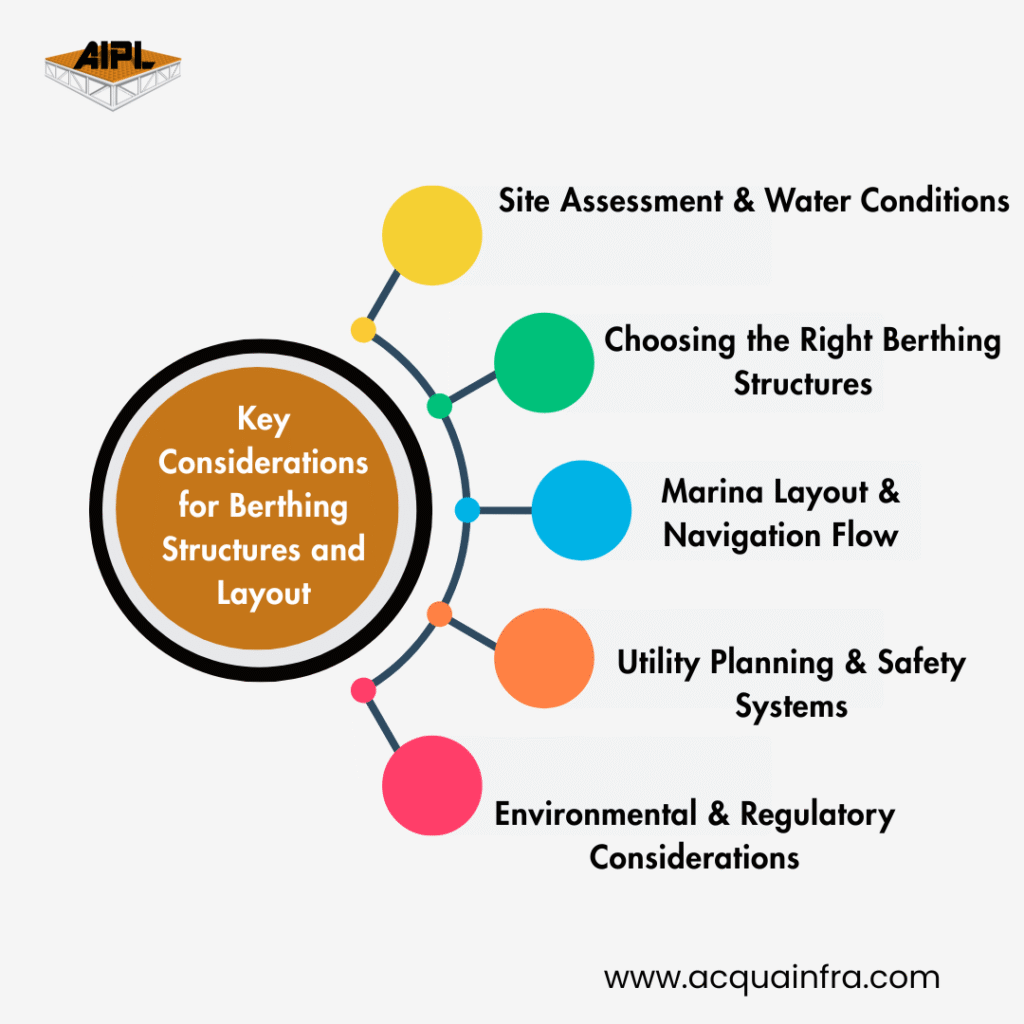
Site Assessment & Water Conditions

Before any marina design begins, engineers evaluate:

  • Water depth to determine pontoon size and draft clearance.
  • Wave climate, ensuring breakwaters reduce wave action by 40–60% for safe berthing.
  • Tidal variation, which defines whether floating jetties or hybrid structures are needed.
    A proper assessment reduces long-term maintenance by up to 25%.

Choosing the Right Berthing Structures

Small marinas commonly use floating pontoons for berthing due to adaptability and reduced civil work.

  • Floating pontoons maintain safe freeboard levels during tides.
  • Modular systems reduce installation time by 50% compared to fixed jetties.
  • HDPE or steel-reinforced pontoons offer a 20–25 year lifespan with minimal upkeep.

For heavy-duty or commercial berths, pile-secured pontoons ensure lateral stability even during high-traffic operations.


Marina Layout & Navigation Flow

A good marina layout improves vessel circulation and maximizes usable space.
Key layout practices include:

  • Maintaining 1.5–2× vessel length for maneuvering areas.
  • Using finger pontoons or T-heads for fast access and clear segregation.
  • Ensuring the main walkway has 2–3 meter width for safe pedestrian flow.

Compact marinas benefit from L-shaped or linear layouts, reducing structural costs by 15–20% while offering full berthing efficiency.


Utility Planning & Safety Systems

Essential utilities define the operational quality of a marina:

  • Shore power & lighting
  • Freshwater lines
  • Fueling provisions (floating refuel docks)
  • Firefighting and emergency ladders
    Integrating these during initial design saves 20–30% in retrofitting costs.

Safety is further strengthened by using anti-slip pontoon decking, marine-grade railings, and well-placed life-saving equipment.


Environmental & Regulatory Considerations

Modern marinas prioritize sustainability:
  • Low-impact pontoon anchoring (pile guides)
  • Use of eco-friendly materials like HDPE
  • Wastewater & bilge management systems
    Proper compliance not only protects the waterbody but also improves project approval timelines by up to 35%.

Conclusion

Designing a small marina blends strategic engineering with efficient berthing planning. By choosing the right pontoon systems, optimizing marina layout, and integrating essential utilities, developers can create compact yet high-performance marinas that support tourism, recreation, and long-term waterfront growth.


FAQs

1. What type of berthing is best for small marinas?
Floating pontoons are preferred due to adaptability, fast installation, and lower civil work.

2. How wide should marina walkways be?
Typically 2–3 meters, depending on expected traffic.

3. Are floating jetties durable for commercial use?
Yes — steel-reinforced or HDPE pontoons last 20–25 years with low maintenance.

4. What reduces wave impact inside the marina?
Breakwaters or wave attenuators cut wave intensity by 40–60%.


Planning to build a small marina with high-efficiency berthing structures?
Partner with Acquafront Infrastructure Pvt. Ltd. (AIPL) — India’s trusted manufacturer of floating jetties, pontoons, and modular marina solutions.

👉 Visit acquainfra.com or contact our team for custom marina design support.


About the Author
Mr. Achin Agrawal, Director & CTO.

  • Expertise includes R&D, Product development, Project design & engineering.
  • National Meritorious Innovation Award 2018 by NRDC (A DST Enterprise) presented during Innovate India conference 2019 at EDII, Ahmedabad.
  • Recognised for groundbreaking innovation with patent no. 485553 in marine Industry.
AIPL specializes in modular maritime and floating-infrastructure platforms for energy, water, marine, transport, construction, pumping and tourism sectors, supported by a decade of proven engineering.

Registered Under:

Office

3RD Floor, Tower-C, Office No.  C - 320 I-THUM Plot No.A-40, Sector 62, NOIDA, Distt Gautam Buddha Nagar, UP – 201301

Follow Us

Manufacturing Unit

Acquafront Infrastructure, Rania Industrial Area, Kanpur, Uttar Pradesh. Pin Code: 209101

E-Mail

admin@acquainfra.com
© All rights reserved 2023 | ACQUAFRONT INFRASTRUCTURE PVT. LTD. are registered Trade Marks
